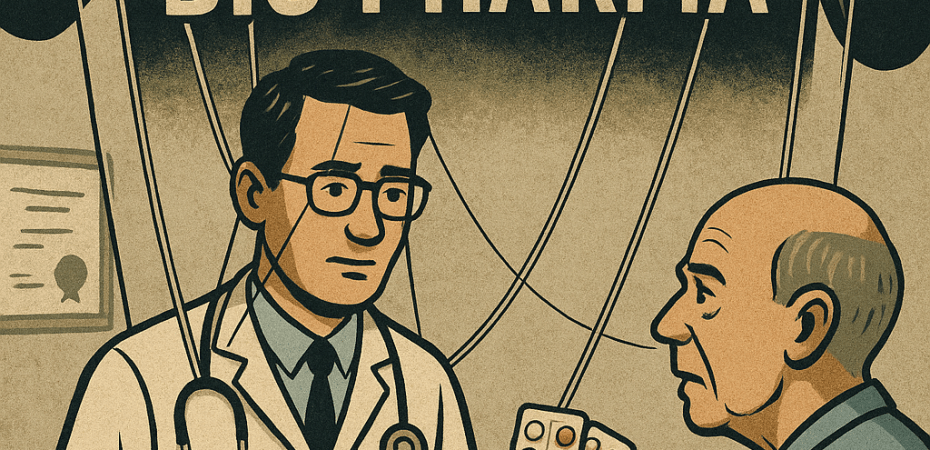
The Midwestern Doctor’s essay on Ozempic and the wider GLP-1 boom is both polemical and occasionally too quick to declare “scam” where “perverse incentive” would do the job. Even so, it lands punches that the official public-health world still prefers not to take. The core claim is not mysterious: when you fuse mass marketing, state-shaped food systems, and a regulator that talks like an investor relations department, you get drugs sold as salvation. His piece frames the GLP-1 story as an emblem of modern medicine’s political economy: profit-seeking firms operating inside a cartel-ish structure, with government rules and subsidies quietly sculpting the whole environment.
I want to separate three things:
- What the drugs do and what we actually know about outcomes.
- Why the surrounding system behaves as if the goal is lifetime dependency, not durable health.
- Why, despite all of that, there is still a hard case for giving some patients these drugs anyway.
1) What the Midwestern Doctor is really arguing
He opens with an almost too-neat storyline: a world in which the next blockbuster markets are pre-selected in elite spaces, then “validated” by regulatory behaviour and media narratives. In his telling, a private finance-and-pharma ecosystem basically announces the future, and the public institutions obligingly make it real.
One of his sharpest quotes is also one of his simplest:
“the head of the FDA was a keynote speaker to investors about the incredibly lucrative opportunity”
Even if you strip away the melodrama, the underlying complaint is recognisable to any libertarian who has watched regulatory capture up close: the regulator becomes culturally aligned with the regulated. It starts to treat “market growth” as evidence of “public good”.
He also argues that American obesity is downstream of a political food economy. He summarises it as subsidised monocrops turned into industrial food, made addictive, then monetised twice: first as calories, then as prescriptions.
You do not have to accept every rhetorical flourish to see the structure:
- policy supports certain agricultural outputs;
- industry processes them into cheap, high-margin foods;
- chronic disease rises;
- the drug market expands to manage downstream harms.
Even as a general model, that is not crazy.
2) The strongest factual plank: weight tends to come back
On the “scam” framing, the most defensible part is not that GLP-1s never work. They often do, in the narrow sense that they produce significant weight loss while you are on them. The uncomfortable part is what happens after.
The STEP 1 trial extension found that after stopping semaglutide, participants regained a large fraction of the lost weight and cardiometabolic measures drifted back too. (PubMed) The BMJ review covered similar patterns across weight-loss drugs more broadly, with regain typically occurring over the following months. (Reuters)
This matters politically because it changes the implied product:
- If a drug “cures obesity”, you take it and stop.
- If a drug “manages obesity”, the revenue model is recurring.
The Midwestern Doctor essentially argues that industry prefers the second, because it is more bankable. That is not a medical claim. It is a business claim. And it fits what we see in many other therapeutic areas, where long-term maintenance markets are more lucrative than one-off resolutions.
3) Side effects: the argument is strongest when it stops shouting
Where his essay becomes most useful is when it speaks plainly about harms that ordinary people are already seeing in real life: nausea, constipation, vomiting, and more serious gastrointestinal events in a minority of patients.
He points to observational work suggesting increased risks of pancreatitis, bowel obstruction, and gastroparesis compared with another weight-loss drug combination. A UK regulator warning about pancreatitis risk in GLP-1 users also shows this is not purely internet chatter. (The Guardian)
He writes about drugs designed to persist in the body far longer than natural GLP-1, and he argues that a mechanism intended to reduce appetite can also predict digestive slowdown and, in some cases, severe complications.
There is also the reality of label warnings. In the US, semaglutide products carry a boxed warning about thyroid C-cell tumours observed in rodents, with explicit contraindications for certain patients. (FDA Access Data)
That does not prove a human cancer wave. It does prove that the “harmless miracle jab” tone you still hear in lifestyle media is dishonest.
4) Where the Midwestern Doctor is weaker: turning “incentives” into “plot”
If you read him carefully, you can see him sliding between two different arguments:
- Argument A (stronger): the system’s incentives predict overuse, soft-pedalling of risks, and marketing-driven guidelines.
- Argument B (weaker): a semi-co-ordinated class of actors “pushes” drugs in a way that implies something like central planning.
The first does not require a conspiracy. It only requires ordinary human motivations operating in an environment where mistakes pay.
A captured regulator does not need to meet in a smoky room. It only needs to recruit from the same social strata, attend the same conferences, treat the same consultancies as “expertise”, and regard dissent as “misinformation”.
In other words: you can explain most of this with boring political economy, not thriller logic.
5) The libertarian point: state power built the obesity market, then sells the antidote
A libertarian critique here should not become “Big Pharma bad” as a moral posture. It should be more precise.
The state shapes the environment in at least four ways:
Food policy and subsidies.
When government policies tilt production towards a few commodity crops, you make processed calories cheap and ubiquitous. The Midwestern Doctor is basically pointing at that pipeline.
Regulation as a moat.
Heavy, expensive approval processes favour large incumbents. They also make off-patent, low-margin approaches harder to deploy at scale, because nobody funds the trials needed to satisfy the gatekeepers.
Healthcare payment structures.
If insurers or public systems pay more readily for prescriptions than for long-term lifestyle support, you create a bias. NICE in the UK, for instance, recommends semaglutide within a structured specialist weight-management context, with stopping rules if sufficient loss is not achieved. (NICE) That is at least an attempt to avoid “everyone forever”, but it still embeds the drug into a managed pathway.
Political messaging.
Once a drug becomes a cultural symbol—modernity, “ending stigma”—it becomes harder to discuss trade-offs honestly. Companies know this and sponsor the vocabulary.
Put together, you get a society where:
- upstream causes are politically costly to fix (food systems, family breakdown, sedentary lifestyles, urban design, stress, low-trust communities);
- downstream pharmaceutical management is politically easy to fund and morally easy to sell.
6) The uncomfortable exception: some people need the lesser evil
Here is where I refuse the easy, puritan line that treats every GLP-1 user as a dupe. Some people are not merely “a bit overweight”. Some are so metabolically damaged, so heavy, or so far down the road to diabetes complications, heart failure, sleep apnoea, and joint collapse that “just eat less” is not a plan. It is a slogan.
For those patients, the relevant comparison is not:
- Ozempic vs perfect health through willpower.
It is:
- Ozempic vs progressive disability, early death, or bariatric surgery, or uncontrolled diabetes.
Semaglutide has demonstrated clinically meaningful weight loss in trials while on treatment, and NICE’s very existence in this space reflects that there are populations where the benefit can be judged worth the risk under supervision. (NICE)
So yes: the Midwestern Doctor may be right that the marketing machine wants to expand the category until it includes bored teenagers and wealthy people seeking a “beach body”. But it does not follow that every use is folly.
A humane, adult position is:
- Stop the cultural push for mass, casual prescribing.
- Keep access for high-risk patients where the alternative is worse.
- Be honest that stopping often leads to regain, so the decision is closer to “long-term management” than “cure”. (PubMed)
7) The real scandal is not the molecule. It is the system that makes the molecule feel inevitable.
The Midwestern Doctor ends up in the same place as many other heterodox writers: “they” are corrupt; “they” are lying; “they” are pushing the drug. But the deeper scandal is not personal wickedness. It is structural. If you want a society with fewer Ozempic users, you need:
- food markets that do not funnel everyone into ultra-processed diets;
- local cultures that reward restraint and competence rather than grievance and sedation;
- medical institutions that can say, without panic, that a drug can be both helpful and overused.
In a sane world, GLP-1s would be a narrow tool for a subset of high-risk patients, used alongside serious dietary changes and realistic exercise, with clear stopping rules, and with adverse events tracked in a way that does not require investigative journalism to surface.
We do not live in that world.
Reading list for a serious (but readable) understanding
Evidence on GLP-1 outcomes and weight regain
- Wilding et al., STEP 1 trial extension (weight regain after withdrawal of semaglutide). (PubMed)
- BMJ analysis on weight regain after stopping obesity drugs (summary and underlying paper). (Reuters)
Safety signals and regulatory material
- JAMA research letter on gastrointestinal adverse events with GLP-1 receptor agonists (risk signals, observational design). (JAMA Network)
- FDA prescribing information for Wegovy (boxed warning and contraindications). (FDA Access Data)
- FDA warning letter referencing Ozempic/Wegovy boxed warnings (useful for seeing regulator language). (U.S. Food and Drug Administration)
- MHRA warning on pancreatitis risk with weight-loss injections (UK context, real-world reporting). (The Guardian)
UK policy framing (how a cautious system tries to bound use)
- NICE TA875 overview and recommendations (who should get semaglutide, conditions, pathways). (NICE)
- NHS/DHSC explainer on Wegovy access in the UK (public communication, scope). (healthmedia.blog.gov.uk)
Political economy and the libertarian lens
- On regulatory capture and bureaucracy-as-barrier: classic public choice framing (George Stigler’s capture theory is the canonical starting point; look for reputable summaries or academic chapters if you want something shorter than the original papers).
- On food policy incentives and commodity agriculture: work on US farm subsidies and processed-food economics (academic and policy literature; if you want, I can curate a tighter list aimed at UK readers who need the parallels rather than US details).
For balance: pro-GLP-1 clinical framing (so you do not read only one side)
- NICE guidance documents above already provide a “benefit under constraints” rationale. (NICE)
- Specialist obesity-medicine and endocrinology sources discussing appropriate patient selection, side-effect management, and long-term follow-up (often boring, often more honest than media coverage).
A brief safety note
Nothing here is personal medical advice. These drugs can be appropriate for some high-risk patients and a poor choice for others, and the decision should be made with a clinician who can weigh contraindications, comorbidities, and monitoring.

Discover more from The Libertarian Alliance
Subscribe to get the latest posts sent to your email.


