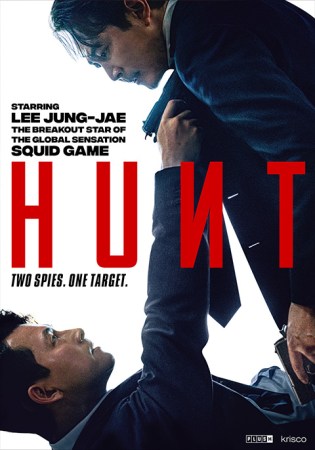
Hunt (헌트, 2022)
Directed by: Lee Jung-jae
Written by: Lee Jung-jae and Jo Seung-hee
Produced by: Lee Jung-jae and Han Jae-duk
Cinematography: Lee Mo-gae
Music: Jo Yeong-wook
Starring: Lee Jung-jae, Jung Woo-sung, Jeon Hye-jin, Heo Sung-tae, Go Youn-jung
I was made to watch Hunt during one of my increasingly frequent visits to Bryan Mercadente. Bryan enjoyed it enormously. He admired the violence, the atmosphere of suspicion, the endless betrayals and the parade of men shooting, beating and torturing one another in the name of causes that seemed increasingly difficult to distinguish. He emerged from the experience animated and enthusiastic. I emerged thoughtful and rather depressed.
This reaction was not because Hunt is a bad film. Quite the contrary. It is a remarkably accomplished piece of cinema. The acting is superb. The cinematography is frequently magnificent. The pacing rarely slackens despite a narrative so dense with double-crosses and hidden loyalties that I eventually surrendered any hope of tracking every twist. Korean cinema has now become so consistently excellent that one almost takes its virtues for granted. Strong performances, technical confidence and visual sophistication have become normal expectations rather than pleasant surprises. Hunt delivers all of these qualities in abundance.
Yet as the film progressed, I found myself paying less attention to the mechanics of the conspiracy and more attention to the assumptions underlying the world it portrays. The plot concerns spies and assassination attempts during the military dictatorship of Chun Doo-hwan in the 1980s. Two intelligence officers become convinced that a North Korean mole has penetrated the South Korean security apparatus. From this premise emerges a labyrinth of deception involving political dissidents, secret agents, military operations and competing visions of patriotism. The film is inspired by real historical events and makes extensive use of the atmosphere surrounding the Gwangju massacre and the authoritarian politics of the period.
I confess that I eventually lost track of exactly who was plotting against whom. This may have been my fault, though several professional critics seem to have experienced similar difficulties. Even Lee Jung-jae reportedly re-edited the film after its Cannes screening because foreign audiences struggled to follow the historical and political context. Nevertheless, the precise details of the conspiracy matter less than the larger picture that emerges. What struck me throughout was the film’s assumption that government ultimately rests on violence and that political life consists largely of deciding who gets tortured before they torture you.
The violence is relentless. Men are interrogated, beaten, threatened and murdered with a frequency that would be exhausting were it not presented with such technical skill. Bryan naturally enjoyed these sequences. He has always possessed a fascination with the darker aspects of human existence. He enjoys horror films, true crime stories and historical accounts of atrocities. He would probably regard this as evidence of intellectual honesty. Perhaps he is partly correct. One should not look away from evil simply because it is unpleasant.
At the same time, I found myself increasingly disturbed by what the violence represented. The film is set during a dictatorship, and therefore it would be dishonest if it avoided brutality. Yet Hunt raises a larger question that extends far beyond South Korea in the 1980s. Why do governments so often resort to torture, secret police and political violence? Why does repression appear with such regularity across different cultures and historical periods?
The usual explanation is insecurity. Governments become frightened. They face real or imagined enemies. They conclude that extraordinary threats require extraordinary methods. There is some truth in this. States, like individuals, often behave badly when they are afraid. Yet fear alone cannot explain the persistence of torture. Nor can it explain the strange enthusiasm with which many regimes embrace it.
Torture is not merely a technique. It is an institution. Once established, it creates incentives that reshape the character of government itself. The intelligent and morally serious rarely enjoy inflicting suffering. The positions therefore tend to attract men who do. Over time, the system fills with sadists and opportunists. Such men are useful when rulers wish to intimidate their opponents. They are less useful when rulers require honesty or restraint. A government that relies heavily on torture gradually empowers the wrong people.
Bryan and I disagree strongly on this point. He accepts that torture is unpleasant, but he tends to view it as one of many tools available to serious governments. He is fond of reminding me that states have employed torture for thousands of years. He argues that institutions do not survive for millennia without possessing some practical utility. I agree to a point. Torture can undoubtedly produce information. It would be absurd to deny the accumulated experience of countless governments across human history. If applied intelligently, it can uncover truths.
The problem is that other methods can do the same. Careful interrogation, patient investigation, forensic analysis and the cross-referencing of evidence often produce equally reliable information. They do so without empowering sadists and without undermining the legitimacy of the state. The practical case for torture therefore becomes much weaker than its defenders suppose. Even where it works, it frequently causes damage that exceeds its benefits.
Christianity understood something similar long before the emergence of modern political science. The Christian objection to torture is not primarily sentimental. Christianity has no illusions about human nature. It does not assume that all men are good. Indeed, its understanding of human depravity is often far darker than that of secular ideologies. Yet Christianity begins with the proposition that every human being bears the image of God. Men are fallen. They are capable of terrible evil. They remain, nevertheless, creatures of infinite worth.
This belief transformed Europe. It did not eliminate cruelty, nor did it abolish injustice. Human beings remain human beings. What Christianity did accomplish was the gradual creation of moral restraints upon power. It established the principle that rulers themselves stand beneath a higher authority. Kings, emperors and governments could not simply define morality according to convenience. Their actions were subject to judgement.
Watching Hunt, I found myself reflecting on how absent this assumption appears within the world of the film. The various intelligence agencies and political factions operate according to a simple logic: victory justifies methods. Their disagreements concern goals rather than principles. They argue about who should hold power. They rarely question the legitimacy of power itself.
This brings me to another disagreement with Bryan. He regards East Asia as a beacon of competence in an increasingly irrational world. He points to educational achievement, technological sophistication, public order and economic success. These are genuine accomplishments. South Korea, Japan, Taiwan and increasingly China have achieved extraordinary things. It would be foolish to deny this. East Asian societies often function more effectively than many Western ones. Their governments are frequently more competent. Their populations are often more disciplined.
Yet Bryan sometimes allows admiration to become idealisation. His fundamental mistake is to assume that intelligence and competence necessarily produce wisdom or goodness. They do not. The peoples of East Asia possess many admirable qualities. High intelligence is certainly one of them. Yet intelligence is morally neutral. It can be used to construct a hospital or a prison camp. It can produce advanced medicine or sophisticated surveillance systems. A clever man can discover a cure for disease. He can also discover more efficient methods of oppression.
The twentieth century should have settled this matter. Germany was highly educated. Japan was highly disciplined. Soviet Russia possessed immense intellectual resources. None of these advantages prevented catastrophe. In some cases they facilitated it. Intelligence helps people achieve their objectives. It says very little about whether those objectives are morally desirable. What ultimately matters is not IQ but moral vision. Goodness emerges from seeing reality correctly. It emerges from understanding that human beings possess dignity because they are created by God. Remove this foundation and intelligence alone becomes dangerous. One may build a prosperous civilisation, but one cannot build a truly humane one.
South Korea itself provides an interesting example. The Korea depicted in Hunt is bleak. It is a society dominated by fear, suspicion and political violence. The modern Republic of Korea remains imperfect, but it is incomparably better than the dictatorship portrayed here. It is freer, more prosperous and more respectful of individual dignity. This improvement has coincided with one of the most remarkable Christian transformations in modern history.
Christianity did not make Koreans intelligent. They already were. What Christianity contributed was a moral vocabulary capable of restraining power and dignifying the individual. Churches, schools and Christian institutions helped create a society in which mercy became more respected than brutality and in which human beings increasingly came to be valued for reasons other than their usefulness to the state.
One sees the contrast most clearly when comparing South and North Korea. Both peoples share the same ancestry, language and cultural inheritance. Yet one society has increasingly absorbed Christian ideas while the other has attempted to eradicate them. The results speak for themselves. The North remains one of the most oppressive regimes on earth. The South, despite all its faults, has become a prosperous democracy.
China presents a more complicated case. Its achievements since 1980 have been extraordinary. Hundreds of millions have escaped poverty. Technological and economic development have proceeded at astonishing speed. Yet I suspect that China’s future greatness will depend on something more than material success. The continued growth of Christianity within China may ultimately prove more significant than any industrial policy or economic reform. A civilisation can become rich through intelligence and hard work. To remain humane, it requires something higher.
Returning to the film itself, it would be unfair not to praise its artistic achievements. Lee Jung-jae gives an excellent performance, conveying intelligence, weariness and ambiguity with remarkable subtlety. Jung Woo-sung matches him throughout, creating a rivalry that feels genuine even when the plot becomes labyrinthine. Both men possess immense screen presence. One believes them completely as intelligence officers trapped within a system that demands impossible choices.
The supporting cast is equally strong. Jeon Hye-jin and Go Youn-jung bring emotional depth to roles that could easily have become functional plot devices. Even minor characters feel like real people rather than mechanisms for advancing the narrative. Korean cinema remains exceptionally good at this. It rarely forgets that politics ultimately affects human beings.
Lee Mo-gae’s cinematography deserves special praise. The film captures the atmosphere of the 1980s with extraordinary confidence. Government offices, hotel corridors, safe houses and city streets all feel authentic. The action scenes are staged with clarity and precision. Unlike many modern thrillers, Hunt rarely becomes visually incoherent.
As cinema, it succeeds brilliantly. As a portrait of political life, it left me profoundly uneasy. Bryan saw an exciting thriller about spies and assassins. I saw a warning about what happens when intelligence becomes detached from morality and when power ceases to recognise any authority higher than itself. The tragedy of the world depicted in Hunt is not that its rulers lack intelligence. Many of them are extremely intelligent. The tragedy is that intelligence alone cannot tell a man why he should be good. Christianity can.
That is why the future of civilisation depends not primarily upon cleverness, efficiency or technological progress. These things are useful and often admirable. They are not enough. A society becomes truly civilised when it recognises that every human being bears the image of God and must therefore be treated accordingly. The world of Hunt has largely forgotten this truth. Its violence follows naturally from that forgetfulness.

Discover more from The Libertarian Alliance
Subscribe to get the latest posts sent to your email.