
Taken from Jim Rose
Discover more from The Libertarian Alliance
Subscribe to get the latest posts sent to your email.
Related posts:
 Richard Dearlove and the Rediscovery of British Industry
 Examination in the Philosophy of Liberty: The Headmaster’s Report
 Just governance
 Who’s a Fascist?
 Response to facial recognition cameras consultation
 The digital ID scam
 Trump Accounts: Capitalism by Permission
 My memories of Ann Widdecombe
 Fallacies of Wealth Redistributionism
 Ninety-Five Blasts from the Past
 The Leftist Assault on Western Thought
Powered by YARPP.
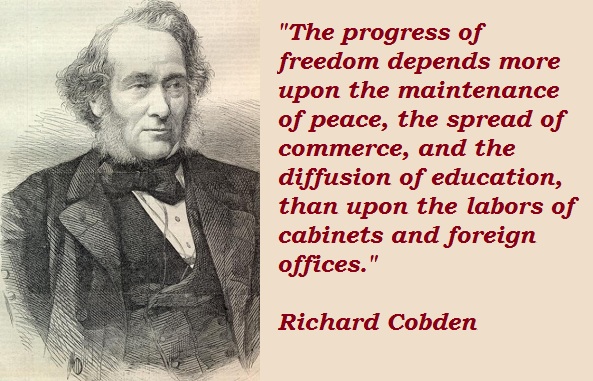
I agree with Mr Cobden about free trade, however (alas) his promises that the new elected Council in Manchester (under the Act of 1835) would lead to lower local taxes proved to be the opposite of the truth. As for “peace” – sadly it takes only one to make a conflict (not two), those who neglect their defences (and alliances) invite attack. Although some small nations have managed to get by trusting large allies (and thus not spending much on their own military forces) – but this is dependence (in fact if not in name).
As for “education” – there comes the greatest dispute, it was a common place in 19th century liberalism that governments should promote education (that doing so would promote liberty and responsibility), history shows the opposite to be the case in relation to such schemes. E. G. West (“Education and the State” 1965) was one of the first to show that such schemes were not needed – but he did not fully explore how they UNDERMINED (not promoted – undermined) liberty and individual and community responsibility. The logical problem was seen by some 19th century liberals (the voluntaryists), but most did not see that if MOST people were unfit to organise the education of their own children, how could they be trusted to do anything else? And if MOST people were taught (from their most early years) that the state should be looked for basic things – how could they be expected to grow up to be “free and responsible”?
“Ah Paul – but the 19th century liberals only wanted a few people too be educated at the expense of the taxpayers” Some liberals yes, some liberals no – and once one starts subsidising something it becomes more and more (not less and less) dependent on the subsidies.
“Ah now you are using hide sight”.
Yes – guilty as charged.
“But what do we do NOW – now that people have been taught (for generations) to depend on the state?”.
I have not got a clue – if I had a practical plan to save the Western Civilisation I would not be wasting my time here (I am only here because I have nothing better to do).
Beware “gap filling”.
The 1870 Forster Act (on education) was defended as “filling the gaps” where voluntary schools had not been created sufficiently – in practice the government schools (with massive subsidies behind them) destroyed the private (voluntary) schools aimed at the poor.
Also (in the early 20th century) the measures of David Lloyd George (copying Bismark) were supposed to “help” and “fill the gaps in” fraternal (“Friendly Society”) mutual aid organisation provision (some 80% and rising of industrial workers were members of such mutual aid schemes covering sickness and old age in 1911) – instead, over time, state intervention destroyed such voluntary efforts.
One can argue over motivation all day long – perhaps liberals such as F. in 1870 and David L-G in the early 1900s had wonderful noble motives (and perhaps they had vile motives), but the terrible EFFECTS of their actions are clear.