
This is one of the most common arguments that I hear from creationists. The claim is that if evolution is true, then in the fossil record we should see lots of intermediate species. In other words, we should see transitional fossils showing the changes from one group of organisms to the next. So far, we are on the right track. Evolution certainly does make that prediction. The problem is that creationists then proceed to make the factually incorrect claim that no transitional fossils have ever been found. The reality is that we have hundreds of transitional fossils, and examining them not only provides extremely strong evidence for evolution, but it shows a critical logical flaw in creationists’ thinking.
First, it is important to realize that the definition of “transitional fossil” is totally arbitrary. Any species that does not go extinct is an intermediate. In other words, evolution generally does not reach “end points” (living fossils being one debatable exception). To put this another way, we tend to think of the species that are alive today as the final products of evolution, but they aren’t. If we could go forward several million years into the future, we would see very few of today’s species but we would see plenty of their ancestors. So everything is an intermediate between the previous generations and the future generations. Nevertheless, I understand creationists’ point that we should see obvious transitions between major groups, so I’ll focus this post on them.
To understand the full story of transitional fossils, we have to go all the way back to Charles Darwin. In Darwin’s day, paleontology was a budding field, and the fossil record was extremely incomplete, so he did not have any transitional fossils, but he predicted that if evolution was true, we should find the intermediates once the fossil record is more complete. Further, being a good scientist, Darwin proposed that the fossil record should be a good way to test his theory. You see, science works by making testable predictions and proposing falsifiable hypotheses. Transitional fossils meet both of those criteria: if evolution is true, we should find numerous intermediates, and failing to find them would discredit (falsify) the theory. Creationism, of course, makes the opposite prediction. If all organisms were created basically in their present form, and if evolution is limited to occurring within a “kind,” then there should not be any intermediates between major groups.
Now, let’s jump back to the present and see which predictions have come true. Before I go any further, I want you to picture in your mind what an intermediate between a dinosaur and a bird would look like. No doubt, you have pictured an animal that is hallway between the two: an animal that has some of the features of a dinosaur and some of the features of a bird. That is also what evolution predicts that we should find. Now, the question is, “do we find such creatures in the fossil record?” The answer is, of course, a resounding YES!
The most famous intermediate between dinosaurs and birds is of course the Archaeopteryx, but it’s not alone. We have other examples such as Confuciusornis, Jeholornis, and Sinornis just to name a few. All of these fossils not only display some traits of dinosaurs and some of birds, but they show a spectrum of change. This is critically important. If creationism is true, and organisms are relegated to distinct kinds, then there should be clear gaps between each kind, but if evolution is true, then there should be a gradual transition resulting not in two distinct kinds, but in a spectrum with multiple intermediate species such that there is no clear break between the two groups. Evolution’s prediction is, of course, precisely what we find. On the one extreme, we have dinosaurs such as Triceratops and Stegosaurus that are clearly reptiles, but the group of dinosaurs know as Theropods already show some bird-life features. For example, the furculum (commonly known as a wishbone) was once thought to belong exclusively to birds, but we now know that some Theropods had it. Further, many of these dinosaurs had feathers (again a trait that was once thought to be unique to birds). Dinosaurs known as Oviraptors are even suspected to have guarded their nests (a trait that is rare among reptiles). In fact, many of these dinosaurs are so bird-like that scientists are flummoxed about whether they are birds or reptiles. There is no really clear point at which they stop being reptiles and start being birds (exactly as we would expect if evolution was true).
Jumping ahead a few million years, we arrive at the famous Archaeopteryx. At this point, everyone is in agreement that it is a bird and could fly for short periods, but it is still distinctly different from our modern birds. For example, it had a skull with teeth, long forearms, a long tail, a small sternum, and largely unfused digits on the hands. All of these features are found in dinosaurs and modern reptiles, but not in modern birds. In fact, despite being considered a bird, the skeleton of Archaeopteryx is so very dinosaur like that scientists once misidentified an Archaeopteryx skeleton as the skeleton of a Theropod dinosaur know as Compsognathus!

Archaeopteryx is as clear of an intermediate as we could ever hope to find. Although it is considered to be a bird, it is so dinosaur like that scientists once misidentified one of its fossils as a Compsagnathus (a dinosaur). Image via The Pterosaur Heresies
As we move past Archaeopteryx and closer to modern birds, we slowly accumulate more bird-like features. Confuciusornis, for example, had a beak very much like a modern bird, and Jeholornis had forearms with flight specializations that were not found on Archaeopteryx. One of the best examples of these advancements is Sinornis. It was far more bird-like than Archaeopteryx, possessing a more well developed sternum for flight muscle attachment, greatly reduced tail, and fused digits. Nevertheless, it still retained some dinosaur features such as a skull with teeth.
Finally, we arrive at our modern birds. These are clearly distinct from dinosaurs, but they still retain many reptilian features such as scales. Take a look at the feet of birds such as chickens and herons, for example. The structure of their feet is nearly identical to the structure of the feet of Theropods such as Tyrannosaurus rex. Further, we can test this relationship using genetics. If birds did evolve from reptiles as the fossil record suggests, then we would expect the genetic codes of birds to be much more similar to reptiles than to any other group of animals. Again, this is a testable prediction that evolution makes and creationism does not make. The results are, of course, that the DNA of birds is more similar to the DNA of reptiles than it is to the DNA of any other group of modern animals. So both the fossil record and genetics are in agreement with the predictions of evolution.
An even more astounding test of evolution’s predictions came in 2007 when scientists were able to obtain soft tissue from a fossilized Tyrannosaurus rex. They weren’t able to actually get DNA, but there were able to get protein sequences. Proteins are made of chains of amino acids. There are 21 different amino acids and their order determines the protein that is made, but for most proteins there are multiple amino acid sequences that will result in the same protein. Because of this, they are very useful for determining the relatedness among organisms because closely related species tend to have similar amino acid chains (e.g., all mammals have protein sequences that are more similar to each other than they are to the protein sequences of amphibians). This gives us another clear prediction. If birds evolved directly from dinosaurs, then the protein sequence of the T. rex should be more similar to the protein sequences of birds than to reptiles, but if, as creationists maintain, dinosaurs are a uniquely created “kind” of organism that are distinctly different from birds and are in fact a type of reptile, then the protein sequence should most closely resemble a reptiles. As you probably guessed, however, the sequence of the T. rex is more similar to a bird’s than it is to a reptile’s (or to any other modern animal). Again, evolution’s predictions consistently come true.
I realize I spent a lot of time on the evolution of birds, but I want to stress that they are in no way a cherry picked example. I could show a similar sequence between fish and amphibians, amphibians and reptiles, reptiles and mammals, etc. (I’m generally loath to cite Wikipedia, but they actually have a pretty good list of intermediates). Further, genetic comparisons agree with these fossil trends. This is an extraordinary number of predictions that evolution got right and creationism got wrong.
How do creationists explain these fossils?
So, given this wealth of transitional fossils, how do creationists continue to maintain the belief that there are no missing links? They simply claim that all of these fossils are not evolutionary intermediates, but are in fact uniquely created organism that just happen to appear to be intermediates. So, for example, Archaeopteryx is not an intermediate, rather, God just felt like creating something that had half the features of a bird and half the features of a dinosaur. As I will explain, however, this view is logically incoherent and extremely problematic.
First, I want to stress the difference between what the scientists are doing and what the creationists are doing. As I previously explained, creationists like to argue the scientists and creationists have the same amount of evidence and they just interpret it differently. The fossil record offers an excellent way to illustrate why that is simply untrue and misrepresents how science actually works. You see, creationists are proposing that scientists are looking at the fossils, then interpreting them to fit their preconceived notion that evolution is true. When we look at the history of science, however, we find that evolution predicted the existence of these fossils beforehand. In other words, scientists aren’t looking at the fossils and concluding that they are intermediates because they want evidence of evolution. Rather, evolution predicted that we should find an organism with half the features of a bird and half the features of a dinosaur, an organism with half the features of a fish and half the features of an amphibian, etc. In contrast, creationism predicted that these organisms should not exist, but since they clearly do exist, they have simply modified their view so that they now claim that these are not actually intermediates but are uniquely created kinds. There is obviously a huge difference between these two approaches. Evolution correctly predicted what the fossils should look like beforehand, whereas creationism made an incorrect prediction, then made an ad hoc change to try to make the fossils fit the creationist view. Really think about this for a second. If these creatures were uniquely created, isn’t it astounding that evolution managed to successfully predict their existence? Further, evolution didn’t just predict the existence of one bizarre intermediate, it has successfully predicted the existence of hundreds of intermediates! This is why evolution is so powerful: it makes accurate predictions.
To further illustrate the problem here, I’m going to demonstrate that creationists are committing a circular logic fallacy (sometimes it is actually question begging or no true Scotsman depending on exactly how they word it). All of these fossils are exactly what evolution predicted beforehand. If you just imagine what an intermediate between these groups would look like, you’ll no doubt imagine something exactly like the fossils that we have, and the intermediates agree with the genetic data. So scientifically, there is no reason not to consider these to be intermediates because they match evolution’s a priori predictions. So the creationist claim that they are unique kinds is not based on scientific grounds, but on the grounds of personal belief (i.e., its pseudoscience). To illustrate, imagine the following dialogue between a scientist and a creationist (I have personally had this conversation with creationists):
- Creationist: Evolution isn’t true because there are no missing links.
- Scientist: What about Archaeopteryx, Basilosaurus, etc.
- Creationist: None of those are intermediates, they are actually specially created kinds.
- Scientist: How do you know that they aren’t intermediates?
- Creationist: Because evolution isn’t true.
You no doubt see the problem here. There only reason that you would think that these aren’t intermediates is if you have already convinced yourself that intermediates don’t exist. Lest you think that I am committing a straw man fallacy, ask yourself this: what would it take to convince a creationist that something was a transitional fossil? To put it another way, can you imagine an organism that more perfectly embodies the traits of two major groups than Archaeopteryx? Archaeopteryx is as perfect a match for the predictions of what an intermediate should look like as you could ever hope to find. The problem is that no matter what intermediate we find, creationists will always assert that it is just a specially created organism. This is why creationism is pseudoscience and why the claim that “creationists and scientists are both interpreting the evidence” is nonsense. Creationists have decided beforehand that evolution isn’t true, so any evidence to the contrary will be “interpreted” to show that evolution isn’t true no matter how absurd those interpretations are. This is why science cannot ever start with a conclusion. It must always start with the evidence, then draw a conclusion.
Again, to avoid any accusations of a straw man fallacy, consider the history of our knowledge of the evolution of turtles. For many years, we didn’t have any fossils of a proto-turtle (i.e., an early evolutionary step with a partially formed shell). The earliest fossil we had was Proganochelys, which was distinctly different from modern turtles, but still was obviously a turtle with a fully formed shell. Creationists were adamant that turtles disproved evolution because if evolution was true we should see proto-turtles (this is of course an argument from ignorance fallacy given that the fossil record is still far from complete). To quote one of their pages on this topic,
“Given the amazingly unique structure of turtles, it should be a rather easy task to find the transitional forms to trace the evolutionary path from ancestral reptile to turtle, if that is in fact what has happened. He [Dr. Gish] explains that the changes would not be subtle, but obvious, even to someone with no training in anatomy or paleontology…. The biblical account of Creation in Genesis 1—animals created to reproduce after their kinds—would mean that turtles should be instantly recognizable as turtles, with the shell and other unique features fully formed from the start.”
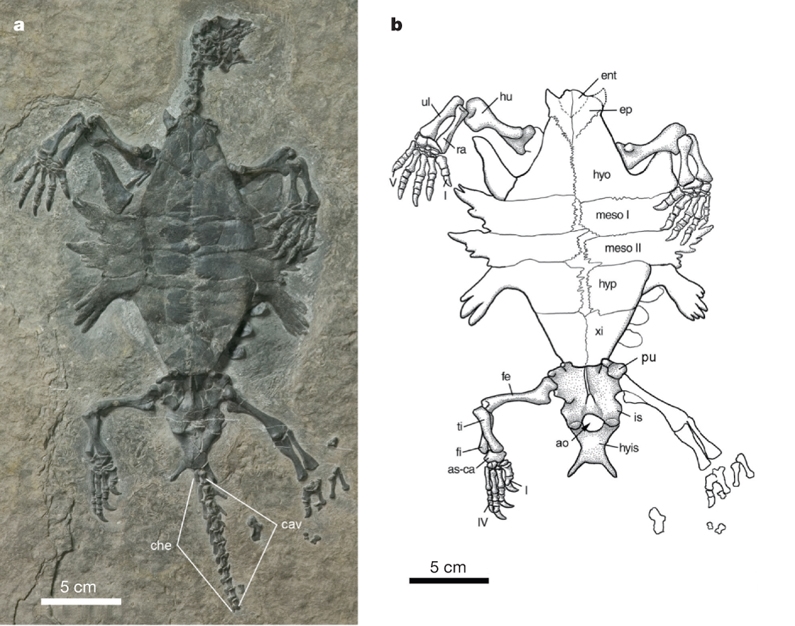
Once again, we have creationism and evolution making opposing predictions. That quote came from 1999, but if you fast-forward to 2008, you’ll find that paleontologists discovered several species of proto-turtle. Odontochelys is the most striking of these fossils (in my opinion). Its tail and parts of its body and skull are very lizard like, but on its stomach, it has the unmistakable plastron (bottom half of a shell) of a turtle. The ribs, however, have not fully fused into a carapace (top half of the shell). So although it clearly has a partial shell, it also clearly does not have the fully formed shell of a modern turtle. This is a near perfect match for what we would expect a proto-turtle to look like, and it certainly meets creationists’ prediction that a proto-turtle would be, “obvious, even to someone with no training in anatomy or paleontology.” Nevertheless, despite the fact that evolution’s predictions were clearly met and creationists’ predictions clearly failed, creationists refuse to acknowledge Odontochelys as an intermediate. Rather, they insist that it is a specially created organism which, for unknown reasons, God decided to make look just like a proto-turtle (this is an ad hoc fallacy at its finest). Rather than grappling with the obvious logical fallacy that they just committed, creationists instead spend their time trying to discredit the find by claiming that scientists predictions were actually wrong because of disagreements about where turtles originated (geographically and land vs. sea). What they are missing is that these disagreements are simply healthy academic discussions about the details of turtle evolution. They are not debates about whether or not turtles evolved or whether or not these fossils are one of the steps in turtle evolution. I won’t waste any more time on their “reasoning” about turtles, but the creationists’ arguments on this topic are laughably ridiculous (such as the blatantly and demonstrably false claim that, “we have never observed the development of new genetic information”).
Finally, these intermediate fossils completely shatter creationists’ notion of distinct “kinds.” Go back to the bird fossils for a minute and try to give a definitive answer for when dinosaurs stop and birds begin. You can’t, and neither can scientists! There is this massive grey area where we aren’t sure what to call a bird and what to call a dinosaur. As a result, many scientists now refer to “avian dinosaurs” and “non-avian dinosaurs” (avian meaning “bird”). This makes absolutely no sense if God created discrete kinds, but it is exactly what evolution predicted. Dinosaurs and birds aren’t distinct “kinds,” rather, they represent two ends of a continuum, and that continuum only makes sense if evolution is true.
To conclude this post, I want to directly address any creationists that are reading this. Seriously ask yourself what it would take to convince you that something was an intermediate fossil. In other words, what scientific criteria could you possibly propose for determining if something is an intermediate that would not result in the conclusion that fossils like Archaeopteryx are transitional fossils? We have hundreds of fossils which clearly posses half the features of two different groups, so if you cannot give a scientific reason why you think that none of these are truly intermediates, then you must admit that you are deciding that they are not intermediates based solely on your religious convictions, and, as I previously explained, that is not logically valid and it places you well within the realm of pseudoscience.
Note: creationists often harp on the fact that some of these intermediates (such as Archaeopteryx) are not actually in the direct lineage of our modern birds. Although this fact is true, it does nothing to discredit their stance as bird intermediates, nor does it minimize their evolutionary importance. The evolutionary tree is full of dead branches. In other words, many evolution paths result in a dead end (i.e., extinction). So, in the case of Archaeopteryx, we think that it was a sister taxa to the group that actually evolved into modern birds, rather than being in that group itself. In other words, it was closely related to the group that became modern birds, and, as such, it still gives us good insight to the evolutionary history of birds and represents a transitional fossil, but it is technically an intermediate to a group of birds that went extinct rather than the group of birds that survived to the present day.
Note on sources: I apologize for citing papers for which the full text is not freely available to the general public, but, as a scientist, the peer-reviewed literature is my source for information because it is the most accurate. If you want the free copy of any of the papers I cited, you can usually email the author and ask for one, and sometimes you can get a copy through your library (especially if you go through a university library).
Discover more from The Libertarian Alliance
Subscribe to get the latest posts sent to your email.
Unfortunately, this is a very poor article that fails to acknowledge the real gaps in the fossil record. You could possibly explain the gaps by reference to the unusual conditions required to preserve fossils: the fossil record is, by its nature, patchy. For a full fossil record, you would need a whole series of intermediate links, eg between an okapi and a giraffe showing how the neck gradually extended over time.
There are numerous changes that could be adopted by natural selection once the final shape had emerged, but you would have to how intermediate links before the point where the final shape had attained the utility that meant it was a positive in terms of natural selection. For example, an eye would not be the product of one mutation, but the end result of a whole process — and yet until the developing eye produced vision, it would not add anything at all to the animal in terms of natural selection.
There are issues with Darwin’s theory. I believe scientists are trying to examine whether natural selection could happen more quickly than thought in order to deal with them. This article was ignorant of the real problems in proving evolution via the fossil record alone.
I disagree regarding the eye. Any patch of photosensitive cells would give an advantage. From this, you can imagine any number of incremental improvements before you see a recognisable eye.
But we are talking of single mutations needing to produce an advantage. If a patch of photosensitive cells is produced by a single genetic mutation, then maybe.
That’s exactly what we now believe happened.
The “eye” has evolved independently at least 44 time in the last 540 million years (Dawkins, 2004.) it comes into being because it confers utility.
For you, my darling. Here’s Dawkins explaining the evolution of the eye:
I’m not going to look at that – unless Dawkins is able to show each single mutation produces an advantage I don’t see that he has a point, and so there’s no reason to watch that.
That is exactly what he shows. It’s only two and a half minutes.
OK, I’ll have a look, seeing as you persist in recommending it.
I looked – and nothing in the video shows that single random genetic mutations can produce an eye. He starts by saying skin is light sensitive anyway (and so apparently implies no mutation is required). This is quite unacceptable. I cannot see out of the back of my elbow. Then he says if you imagine the cells secret liquid that forms a lens – once again, no indication of how many mutations are involved – and then he says if we imagine skin forming over the lens – with no indication of how many mutations that would require either. He hasn’t addressed the question.
Most evolutionists behave as if there were not questions to answer over this process — but the fossil record does not show the range of forms Darwin had expected, possibly because certain geological conditions are required for fossils to be preserved. I would expect the answer to be more in the realm of a period of accelerated evolution owing to the bombardment of the earth with rays from outer space or something like that – not lame arguments that an eye, which would require millions of mutations over hundreds of millions of years could be formed in the fashion he suggests. Even his proposed “solution” is entirely conjured up out of thin air – in a manner no different to belief in God.
Imagine a species of organism, say an early animal, with a generation time of 14 days – not inconceivable. Then imagine geological conditions to have been stable for 40 million years at a time (also seen.) That’s 40 million times 26 generations, which is something over 1,000 million (a billion) generations. Fruit flies can do that even today.
You can get a lot of accruing, slowly beneficial mutations, into a thousand million generations, in a mere 40 million years – less than 1/100th of the lifetime of this planet, David! And that’s just one species, out of millions at a time, all doing mutation stuff….because they can’t prevent it….
There’s not even anything like 1,000 million cells in total, in one of your eyes.
Yes, very large sudden fluxes of, say, gamma-rays, say from a nearby Supernova detonation, might have occurred at times, and might therefore have caused sudden “rapid bursts of mutations” in organisms, owing to a short period of fierce gene-destruction and/or modification. This may even have caused “mass extinction events”, of which we have hard evidence of about a dozen large ones and many smaller ones inside even the last 540 million years. Or these could all be down to “climate change”….(All those SUVS, nuclear power stations and fossil-fuel-burning by not only A afarensis/H habilis etc, but even by Trilobites and dinosaurs themselves! All those BMW people-movers and M-series sports-cars that they had in the upper Pleiocene, to swing through the trees with!)
There is indeed evidence that this kind of even has happened more than once, but not owing to fossil-fuel burning by organisms like man…. The Milky Way is an averagely stable/unstable galaxy, and stuff just happens when it happens.
DJ,
Mutations do not have to confer an immediate advantage – just not a disadvantage. A neutral mutation can act as a ‘scaffolding’ for further mutations (of which some may be advantageous). If, later in the evolutionary process, a mutation removes the ‘scaffolding’ we are left in a position of being unable to exactly map out the useful intermediate forms.
So, to further the scaffolding analogy, did God make all masonry arches, or did the stones just magically hover until the keystone was slotted in? No, the intermediate form involved a wooden structure propping it all up. If no stone mason existed, I could surmise this process, but never prove it, much like the argument about transitional eyes here.
“Fossilisation” is a rather rare process. It involves the sudden burial, very deeply and fast, by a cataclysm, of objects. Usually, it needs a vast and rapid mudslide, or something like that. These don’t occur that often, but Texas-sized mudslides, a couple of miles or more deep, can and have occurred on the arrival of things like asteroids and so forth. That’s why we know so much about the physiology of dinosaurs, since they were sufficiently cretinous that they stood there watching the mudslide arriving, and got buried by their herds, in their hundreds.
Honestly, a one-legged man at an arse-kicking-party would have moved faster than they had seemed to do.
Hominins, by contrast, have had larger brain mass/body mass ratios for several millions of years, and therefore don’t stick about to get burial, but do what Gandalf said in Moria in TLOTR part 1…”RUN!…That’s why we have not enough fossil skeletal remains of Hominins to fill even a small school bus. Even counting all the teeth, finger bones and skull fragments.
The fossil record is necessarily discontinuous, because things don’t fossilise regularly all the time or even in big amounts. The fossil record will tell you a very great deal about _what was living at a particular moment_ , but not certainly what was going on between those frozen moments. The theory of evolution can be explained and backed up mush more firmly by inspecting DNA itself, and knowing the rate – very well known now and understood – at which it randomly mutates and thus alters slightly at any individual time the “code” for a particular gene for a certain task. We have enormous knowledge now about this. We can even say, to about within 100,000 years out of about 6 million(ish), when the common ancestor of chipmanzees (Pan troglodytes) and early Hominids, the Australopithecines, actually lived, and where – roughly.
Do we know how much of the fossil record we know, and how much remains undiscovered? I guess this is a mathematical rather than an epistemological question.
The “fossil record” is known to be very incomplete, and this has always been known. It’s just that non-zoological “observers” have never wanted to realise or accept this fact.
Regarding “Man”…
…For example, we don’t have enough fragments of Hominin bones and teeth (teeth preserve quite well, which is why we have about 400 of the buggers and nowt much else) to fill an average Southport School Bus…Even if we aggregated everything and tried to lego-build the minimum number of possible complete skeletons.
But we are bursting at the seams with “dinosaur fossils”, because the dinoblokes were stupid, and just stood there regarding the 3,000-metre-high-red-hot-mudslide that engulfed them all for hundreds of miles. They didn’t “see it as a threat” because they weighed several tons each and had “brains” the size of shrivelled peanuts. They were (almost inanimate) robots. So, then, what did they need a brain for anyway? They could hatch, grow, eat, fuck and die, all easily, for millions of years, without a brain, in the absence of existential threats. That’s why I _blame them_, for having done, in 155 million years, f**k-all. They left us _no computer records of anything, not even to do with “climate change”. Useless, lazy, pre-capitalist bastards, the dinosaurs; which deserved to go the way of all flesh then. We could even have learned about the “ozone layer”, from them, and why perhaps Modern Man and his CFCs is _not_ responsible for depleting it. That’s just for starters.
You’ve convinced me, David. I blame the dinosaurs. :>))