
Note by Sean Gabb Richard says: “The way we are governed has undergone a revolution – an invisible revolution.” This is a depressingly true observation. Getting us out of the current mess we are in will take more than a rearrangement of the bottoms on seats in Parliament. We need to consider something like a (non-violent) revolution, in which we shall spend many years under regulatory siege by the rest of the world. I suspect Richard is not that unhappy with much of the regulation we now suffer. His main wish is that we should leave the EU and move one step up the chain of authority, so we can have more direct influence. What we can learn from him, I suggest, is the enormity of what needs to be done to make this country free again, and how little intellectual preparation the well-funded policy institutes have made for this. SIG
EU referendum: the invisible revolution
The FUD continues unabated, as the Guardian reports that HSBC, Britain’s biggest bank, has issued “a stark warning about the economic risks of the UK pulling out of the European Union”, citing the economic uncertainty created by the risk of the UK going alone.
This comes as the bank has revealed it was threatening to move its headquarters out of London to another country, a threat that has not impressed Mark Gilbert of Bloomberg.
Writes Gilbert, there’s a saying used to call the bluff of someone who threatens to flounce out of the room during an argument: “Don’t let the door hit your backside on the way out”. That sums up, he says, how the UK should react to the bank’s threat to move its headquarters to a different country.
The real issue, we also learn from Gilbert, is nothing to do with the EU, but the increased bank levy. And threatening to leave in a fit of pique every time there’s a threat of increased regulation or a nudge in taxation smacks of teenagers threatening to run away from home because a curfew is too early or household chores are too tedious. HSBC is becoming a bore by regularly trying to blackmail the Treasury.
But, in terms of using blackmail, the Guardian and other media outlets which are running the EU meme are every bit as guilty, exploiting public ignorance and fear, to sell a false bill of goods.
The point that the likes of HSBC and their media fellow travellers choose to obscure is that the banking industry is global and so, increasingly, is its regulation. In fact, there has been what has been described as a “Cambrian explosion” in international regulatory co-operation which has transformed the regulatory environment.
Conveniently, the extent of this transformation has been charted by the OECD and by researcher from Arizona State University. And in their documents we see this helpful chart (below) which sets out the structure of global financial regulation.

Readers will observe the focal position of the Financial Stability Board (FSB) and the remarkable number of organisations that make rules, set standards and co-ordinate regulation within this crucial field. But they will also note the relatively inconsequential position of the EU, which is a downstream organisation when it comes to framing regulation.
But this is all part of a much bigger picture, which goes under the classification International Regulatory Co-operation (IRC), as charted by the OECD.
Not only has it recorded a staggering proliferation of organisations involved, the OECD has identified eleven “mechanisms” of IRC, ranging from the formal and comprehensive to the informal and partial.
These run to harmonisation through rule-making by supranational or joint institutions such as the EU, treaties between states, regulatory “umbrella” partnerships such as the Canada-US Regulatory Cooperation Council, and intergovernmental organisations such as the ILO, OECD and WTO.
The territory also includes regional agreements on regulation such as APEC and UNECE, mutual recognition agreements, transgovernmental networks such as the Basel Committee on Banking Supervision, national requirements to consider international standards, incorporation of international standards in national law, soft law instruments and dialogue/information exchange among regulators and stakeholders (see diagram below).
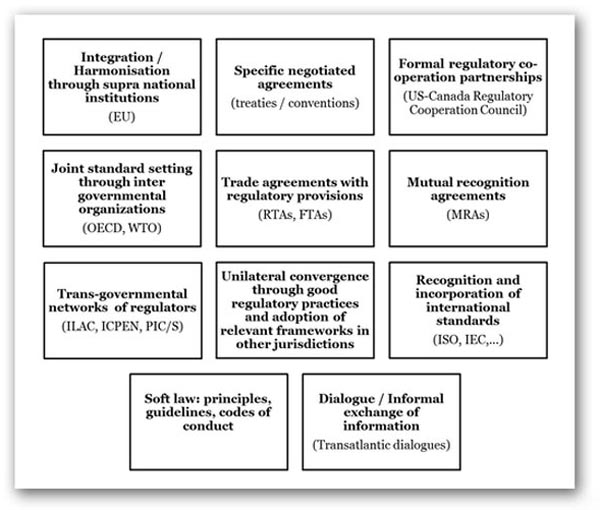
The UK government is fully involved, as is the US government, where IRC is subject to a Presidential Executive Order, with action directed through the Office of Management and Budget. And it drives trade relations between the US and Canada.
Yet, while writ of IRC is dominating the global regulatory environment, it is almost completely invisible to the media, to most politicians and commentators. This means that most of what we are told is superficial to the point of misleading. The way we are governed has undergone a revolution – an invisible revolution – and the media is not even close to putting us in the picture.
Discover more from The Libertarian Alliance
Subscribe to get the latest posts sent to your email.
You know, I really want to sticky-this to the front page for a day or so, and also to remove the stickies on several fossil articles now there.
But I cannot do it, under the “new editor” that goes “BEEP BEEP BOOP” AT ME WHEN I GO INTO THE EDIT SCREEN.
Please can some knowledgeable man tell me how to stop wordpress being childishly facile, and just let me edit this blog how I want to? I’m just a user, so _no html_ please. I _just want it to work_ ….
Reblogged this on The Sceptic Isle.
Dr North does some interesting work on the EU (as well as “climate change” and several other issues) as this piece shows. He puts in a huge amount of work into his reguarly updated blog, which is always worth a visit and in almost all cases is far superior to MSM scribblings.
But unfortunately he is no liberal and as Sean rightly notes, he seems quite happy with a whole raft of silly regulations providing that they don’t come via the EU.
Delegated legislation was always a bad idea – it was condemned by John Locke centuries ago. On the grounds that the only just powers of Parliament were themselves delegated powers, from the people, and that Parliament had no right to delegate these powers to officials – that they were not the property of Parliament. Locke clearly feared that the French example would be followed – where foolish Estates General in the past had delegated so much power to the government that the Estates General was not even called any more (why should the French King take the risk of calling the Estates General – he could even tax without their consent, because of powers foolishly delegated to the Crown by Estates General in the past).
In pointing out that there were “obviously” things that Parliament could not do such students of the Common Law of England as Chief Justice Sir Edward Coke and, the best part of a century later, Chief Justice Sir John Holt (he of 1688 and all that) pointed that Parliament “obviously” did not have the right to give its own powers. Of course they did not stop there – as every school boy used to know Sir Edward Coke denounced the idea that Parliament (as well as the King – for there was a statute involved) could punish someone for the “crime” of not having a scrap of paper called a “licence” – this is the once famous case of Doctor Bonham, the Common Law knows of no such “crime” and Parliament (as well as the King) has no right to invent new crimes. Who was the victim of the “crime” of Mr Bonham – only the King and the Royal College (who split the license money between them), the King was not acting as the protector of anyone – he was just seeking to take money, and the existence of a Parliamentary statute supporting the point changed nothing. Now Sir Edward Coke sort-of recanted (when he came under pressure) – but Chief Justice Sir John Holt did not, bugger any Parliament (as well as any King) who violated the rights of ordinary folk. It was the job of a judge (such as Sir John) to protect them – even people accused against treason against the very Whig government that Sir John himself supported.
If the law forbad defence council he (Sir John – the judge) would act as their defence council, preventing prosecutors tricking people with points of law – for JUSTICE MUST BE DONE (if need by against the will of the Whig Parliament that Sir John himself supported).
Be all this as it may……..
After the Blackstone heresy it was accepted in English law (although not by the Americans – who remained OLD Whigs not New Whigs).that Parliament could do whatever it liked.
For example the Covenant of Sir Edward Carson and co just before the First World War in Ulster – with people lining up to sign in their thousands upon thousands (some signing in their own blood) that they would fight to the death rather than accept Irish Home Rule from Dublin baffled many people in Britain (Scotland as well as England) how could people threaten to fight against Parliament? Did they not accept that Parliament was the sole decider of these matters? Well NO they did not – and it was their attitude that was the older and more traditional one. But it was not taught in the universities – so the governing class could not understand it. Although many ordinary English, Welsh and Scottish people did understand it – back then. The National Rifle Association in Britain having two million members and there being a large scale Constitutional Club network (the name still exists – but all meaning has gone from it).
However, the universities did teach (back then) that there were important voices that said the following……
“Yes Parliament can do anything it likes – but it would be incredibly ill advised to hand over legislative powers to officials, for they (the officials) will strangle liberty with all their mad rules and regulations”.
This was the argument of Dicey before the First World War, and the argument that Chief Justice Hewitt made after it – “The New Despotism” published in 1929.
“The New Despotism” argued that tyranny was already arriving as officials could make “law” (because of authority given to them by misguided Parliaments).
However, the defenders of delegated legislation had a ready reply.
“In the United States there is a indeed danger, which is why the Supreme Court was right to strike down Mr Roosevelt’s National Industrial Recovery Act by nine votes to zero in 1935 – because in the United States, Congress has no real control over the Executive so the courts must step in or the Executive will become tyrannical. But here in the United Kingdom PARLIAMENT can demand that any minister come and explain himself and can demand that any Civil Servant be brought low. The American Congress can just talk – Parliament has POWER”.
Some people (such as me) find such arguments unconvincing (indeed it could be argued that the American Congress is a bit less powerless than the British Parliament – rather than more so) – but they were the official line to the 1970s.
Any minister could bring Civil Servants to heal and ministers were responsible to Parliament (not a President) so the system was safe.
Then the United Kingdom of Great Britain and Northern Ireland joined the EEC (ads the E.U. was then) and all this started to change.
In stages, starting in 1973, it became clear that Civil Servants were NOT responsible to ministers and Parliament.
For example under the Single European Act of 1986 (the other great mistake of that terrible year was the government take over of the City of London – under the Orwellian name of “deregulation”) but already implicitly from 1973 onwards all a Civil Servant has to say to a minister is the following. ………
“I am acting in accordance with the lawful instructions of European law – so you minister, and the Parliament you represent, can GET STUFFED”.
And all a minister can say in reply to the Civil Servant is “yes Sir” or “yes Madam”.
Thus Parliament in 1972-1973 did to itself what the French Estates General did to itself in relation to the French Crown in the Middle Ages.
Will Parliament try and take its powers back?
I do not know – but there is presently little sign of this.
As for the specific issue – HSBC (much though I despise fractional reserve banks) is not trying to “blackmail” anybody, nor has it got much to do with the E.U.
The bank is constantly hit with more taxes and more regulations (this will come as a surprise to people who believe the “Russia Today” propaganda that banks in Britain and not taxed and regulated hard – but there we go) it has a duty to its shareholders (the owners of the bank) to try and do something about this.
If government (the British government) will not listen to its complaints – it will have to leave (most likely NOT for an E.U. country, more likely for Switzerland or Singapore).
Sadly British politics (like American politics) is dominated by the view that “the rich” “big business” do not pay their “fair share” of tax.
This is false – as, in reality, “the rich” and “big business” pay a fortune in tax (the wonderful “NHS” and so on could not last five minutes without the tax paid by “the rich” and “big business”).
However, British politicians (of various parties) like American ones seem intent on driving out “the rich” and “big business”.
Who will pay the Welfare State then?
Nobody will pay for it – it will collapse.
But they, the political class, have not thought that far ahead.