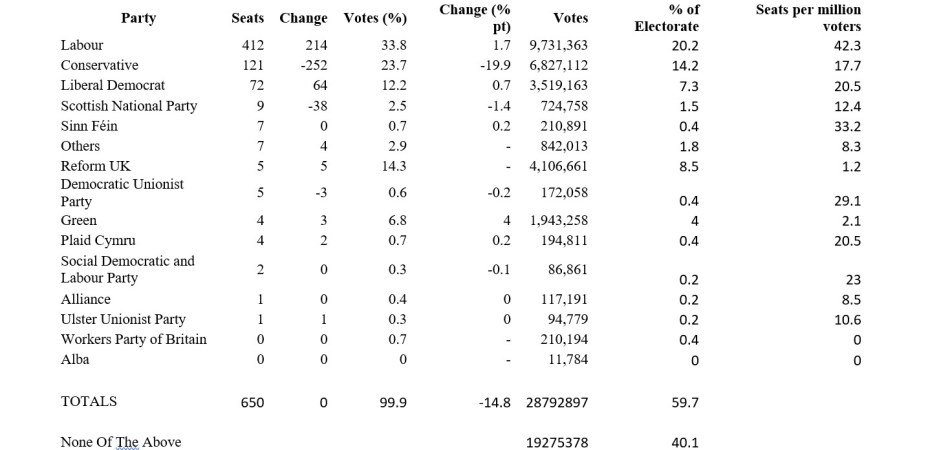
The data junkie in me has massaged the July 4th election results into the following tables:
| General Election Results 2024 | |||||
| Turn-out % | 59.9 | Electorate | 48068275 | ||
| Party | Seats | Change | Votes (%) | Change (% pt) | Votes |
| Labour | 412 | 214 | 33.8 | 1.7 | 9,731,363 |
| Conservative | 121 | -252 | 23.7 | -19.9 | 6,827,112 |
| Liberal Democrat | 72 | 64 | 12.2 | 0.7 | 3,519,163 |
| Scottish National Party | 9 | -38 | 2.5 | -1.4 | 724,758 |
| Sinn Féin | 7 | 0 | 0.7 | 0.2 | 210,891 |
| Others | 7 | 4 | 2.9 | – | 842,013 |
| Reform UK | 5 | 5 | 14.3 | – | 4,106,661 |
| Democratic Unionist Party | 5 | -3 | 0.6 | -0.2 | 172,058 |
| Green | 4 | 3 | 6.8 | 4 | 1,943,258 |
| Plaid Cymru | 4 | 2 | 0.7 | 0.2 | 194,811 |
| Social Democratic and Labour Party | 2 | 0 | 0.3 | -0.1 | 86,861 |
| Alliance | 1 | 0 | 0.4 | 0 | 117,191 |
| Ulster Unionist Party | 1 | 1 | 0.3 | 0 | 94,779 |
| Workers Party of Britain | 0 | 0 | 0.7 | – | 210,194 |
| Alba | 0 | 0 | 0 | – | 11,784 |
| TOTALS | 650 | 0 | 99.9 | -14.8 | 28792897 |
| None Of The Above | 19275378 | ||||
| Party | Votes | % of Electorate | Seats per million voters |
| Labour | 9,731,363 | 20.2 | 42.3 |
| Conservative | 6,827,112 | 14.2 | 17.7 |
| Liberal Democrat | 3,519,163 | 7.3 | 20.5 |
| Scottish National Party | 724,758 | 1.5 | 12.4 |
| Sinn Féin | 210,891 | 0.4 | 33.2 |
| Others | 842,013 | 1.8 | 8.3 |
| Reform UK | 4,106,661 | 8.5 | 1.2 |
| Democratic Unionist Party | 172,058 | 0.4 | 29.1 |
| Green | 1,943,258 | 4 | 2.1 |
| Plaid Cymru | 194,811 | 0.4 | 20.5 |
| Social Democratic and Labour Party | 86,861 | 0.2 | 23 |
| Alliance | 117,191 | 0.2 | 8.5 |
| Ulster Unionist Party | 94,779 | 0.2 | 10.6 |
| Workers Party of Britain | 210,194 | 0.4 | 0 |
| Alba | 11,784 | 0 | 0 |
| TOTALS | 28792897 | 59.7 | |
| None Of The Above | 19275378 | 40.1 |
A few observations:
- Sinn Fein got almost exactly the same number of votes as the Workers Party, yet got 7 seats against none at all.
- The Workers Party got more votes than any of the DUP, Plaid Cymru, the SDLP, Alliance or the Ulster Unionists, yet got no seats at all, while the five parties below them totalled 13 seats.
- Reform got one-sixth more votes than the Liberal Democrats, yet got only 5 seats against 72.
- Reform got more than 5.6 times as many votes as the SNP, but only just over half the number of seats.
- The 8.5% of the electorate who voted Reform received only 0.8% of the representation.
- Only 34.4% of the electorate voted Labour or Tory, but they received 82% of the representation.
- 65.6% of the electorate – very nearly two-thirds – are not represented in either the government or the official opposition.
- 69.7% of the voters voted Labour, Tory or Lib Dem, but they received 93.1% of the representation.
- The remaining 30.3% received only 6.9% of the representation.
If this is “representative democracy,” the system is clearly broken. But proportional representation has its own problems, too.
Discover more from The Libertarian Alliance
Subscribe to get the latest posts sent to your email.
I suggest sortition for executive offices, and referenda for changes of law or policy.
Sortition has a lot to commend it. It is going back to the roots of Athenian democracy, which worked pretty well under the conditions back then. And it would kill career politics stone dead.
But should not all government officials be elected by sortition from among those with the willingness and the necessary skills? That would also kill off career bureaucracy.
A less draconian solution would be to put a cap of, say, ten years on how long in a lifetime any individual should be allowed to be in a job paid for by taxpayers. There would have to be a few exceptions, e.g. military officers in time of war.
As to referenda, yes. The Swiss system, or an adaptation of it, on all new or amended legislation.
How well could these ideas be adapted to local governments, as well as national?
Certainly, use sortition for all offices that do not require unusual skills or abilities. That keeps some scheme of appointment for judges and leadership in the armed forces. But it leaves everything else open to some degree of chance. Perhaps we could modify the system by restricting sortition to those candidates who put themselves forward and can get a certain number of seconders. As for local government, we could start there, running different experiments in different areas.
Thank you for this information and analysis, Neil. Obviously what stands out is the apparent inequity for the smaller parties, and perhaps for the Tories too.
I support maintaining FPTP (the Westminster system), with some modifications to allow greater equity for the smaller parties – however that is not because I sympathise with the smaller parties. I don’t.
Here I will address one of the arguments made against the FPTP and show why I think it is hollow.
FPTP offers the advantage of ‘revolution by ballot box’: it gives the winning party an elective dictatorship, provided they can cross the line. This in turn aligns with parliamentary democracy and the unitary state (really, a parliamentary state): the idea is that Parliament itself (the King-in-Parliament, to be specific) should rule the country, not intermediary institutions such as commissions, public agencies, advisory councils, tin pot regional mayors, etc. It is hard to win seats under FPTP, but this is a positive thing as it acts as a selection pressure, deterring amateurs by requiring political parties to get their act together. The failure of the Right to secure significant parliamentary representation in this country is, I would suggest, less down to FPTP and more down to the amateurism of the parties involved and the tendency towards relying on cults of personality rather than building professional organisations.
The downside of the FPTP is the disproportionate number of seats afforded to the major parties, especially the ‘winner’. This leads to a perception that it is unfair on the other parties, but it is not unfair. The unfairness is a chimera. The parliamentary system does not exist for the sake of political parties; it is the interests of the electorate against which we must judge the fairness of the system, not a bunch of self-interested small time politicians.
The conventional defence of FPTP in the current situation is that, even if the political outcome is not reflective of how people voted, and even if it is radically far from being reflective, there is no unfairness on the electorate as a whole because they still have territorial representation. Even if their Member of Parliament is not of their political flavour, he is still their Member of Parliament and duty-bound by custom and convention to act for his constituent (see Parliament and the Public by Edmund Marshall).
I agree with this defence, though it’s my own words as I haven’t seen it articulated before, but I assume this is the defence of the system.
Here’s my problem: the system arose in a time when party affiliation was much looser and Members of Parliament were more independent-minded, so under the principles I have outlined, it didn’t necessarily particularly matter if the political composition of the Commons differed significantly to how the country had generally voted. Each Member of Parliament was still a territorial representative.
We now live in times when it does matter because the political parties are much more ‘politicised’ and polarised from each other, paradoxically while their centre factions have become politically hermaphrodite and almost act like one big party in service of what Dr. Gabb calls The New Enemy Class. This has been accompanied by giantisation of the state into people’s intimate lives, and a greater imposition of party discipline within the Commons. These trends perhaps date back to the first expansion of the franchise and have created an untenable situation for almost 80 years, at least. A major development, in my view, was the formation of the Labour Representation Committee at the turn of the century, which became the Labour Party. That was the point when an aggressive class interest entered the fray and from that point onwards it would not really do, and wouldn’t be cricket, to just disregard the political will of the People.
We now have a situation in which the political will of the People can be seen as a separate thing to the ‘parliamentary will’ of the People. To put it a different way: we still elect territorial Members of Parliament to represent us, but in the process, we are also making different political choices.
The real problem with the Westminster FPTP system is that these political choices are no longer being given full expression. This is not really due to any weakness in the system itself. It is not a structural fault within Westminster FPTP. It is a structural fault within the political parties. Gone are the days of full-flavoured labourism and gradualist socialism or old Toryism and Liberalism. Now the political culture in the Commons is insipid, and the smaller parties have become outlets for political choices that the centre factions have successfully marginalised.
I don’t see the problem as rooted in the ‘mathematics’ of the system. It’s more that the way of thinking, the culture, is wrong, and instituting a more proportional system wouldn’t remedy this. All it would do is create permanent coalitions from the Left intended to block the formation of a government in the national interest. It would also play into the hands of the ongoing Leftist initiative to undermine and subvert parliamentary sovereignty, and thus national sovereignty, by ending the territorial connection between lawmakers and the People, and eroding Parliament’s role by placing all meaningful competencies with a mixture of unelected quangos and public bodies and devolved assemblies. The result will be that no meaningful change in this country will be possible and nobody will be accountable for anything and Britain will continue its slide into oblivion.
If I order the parties from highest to lowest in seats per million voters, and take the top 10, I see: Labour, Sinn Fein, DUP, SDLP, Lib Dem, Plaid Cymru, Tory, SNP, UUP, Alliance. Four of these are Northern Ireland parties, and one each Welsh and Scottish. The English are getting a very bad deal!
Another of the problems with Westminster as is, is that MPs follow their party lines, not the interests of their constituents, either individually or collectively. For example, Jeremy Hunt has never represented me! Many of the policies he has favoured are totally hostile to me – including IR35 and net zero. Net zero and similar policies, having far greater costs than “benefits,” are hostile to just about everyone.
Yes, the root problem is that the culture is wrong. Government should serve the people, not rule over us. And it should be for the nett benefit of every single individual among the governed, real criminals excepted. I.E. John Locke’s “public good.” As you know, I am in favour of dismantling the whole system and building a better one to replace it.
Bear in mind that FPTP only dates from 1885. Until then many seats had two members,and most had until 1832. This gave a different scheme of representation.
@alanbickley/@Neil Lock
I acknowledge that reform is needed, but the reforms must, in my view, embrace the wider issues of how MPs and Parliament conducts itself. Obviously they must also embrace the more radical issues identified by Dr. Gabb prior to his sojourn as military leader of the physical force struggle for English neo-Actonite liberation from the tyrannical Leftist New Enemy Class dispensation, but those points are already well articulated.
Of relevance to this discussion, I work on the basis that Dr. Gabb’s proposals, if implemented, would amount to a restoration of parliamentary sovereignty and unitary statehood.
In that light, here are my more modest proposals:
1. Restore the hereditary House of Lords, together with the judicature committee of Law Lords. End all life peerages. Ban anyone who has served in the Commons or in the previous 10 years have been a member of or donated to a political party from entering or speaking in or serving in the Lords in any capacity, with the exception of existing hereditary title holders who would be grandfathered back into the peerage. This would not prevent governments from conferring hereditary titles in the usual way, including appointments to the peerage, but it would end the use of hereditary peerages for the purpose of political patronage. Require that hereditary peers must never join or donate to a political party, and must serve as crossbenchers, meaning that most members of the second chamber must be politically impartial (at least in the formal sense). The exception to this would be the ‘temporary peerage’, a new class of appointed peers that I describe in 3 below.
2. Require that no ministers can be appointed from the Lords. In the matter of law-making, the Lords should be a reviewing chamber only, with the right to delay, veto or substantially revise any legislation that was not part of the ruling party’s manifesto. Where the legislation was part of a manifesto, the Lords can block, delay or propose revisions to the bill, but ultimately has no right to veto it if the Commons chooses to enact the bill in the face of Lords’ objections.
3. FPTP remains in place but with reforms to encourage MPs to act more independently – for example, only permit party whipping on matters that were promised in a manifesto and on the conditions that the ‘contractual’ election pledge was articulated in specific terms that correspond to the proposed legislation and the MP did not exclude himself from the ‘contractual’ pledge. These reforms could be agreed as parliamentary conventions, no need for legislation.
4. Modest measures to allow marginal political views to be accommodated within the parliamentary system. For instance, where a smaller party achieves a significant percentage of the general vote (let’s say, at least 5%) but none of their candidates win seats, they are permitted to appoint one or more peers to the House of Lords who would serve on a temporary basis until the next election. These temporary peers would have the title of Member of Parliament and the usual appellation of ‘MP’, giving them some status with the general public.
5. Finally, and perhaps most important of all, a pardon for Jeremy Corbyn if he is willing to participate in an English folk rapper dance in the middle of Trafalgar Square, on the basis that while he is wrong about pretty much everything, he does seem like a decent bloke – and he does look like the folk dancing type.
This comment has a degree of frivolity most unbecoming a journal of serious debate. Worse, I cannot determine exactly what is and is not frivolous.
Nothing wrong with a sense of humour, but the only frivolous point is the last one.
I support PR -specifically, AV for the Commons,PR for the Lords, equal power for both,fixed term GEs,referendums on major issues.
By “equal power for both,” do you mean that the Commons has the power to initiate new or amended laws, or repeal laws, but the Lords have the power of veto over any new law, amendment or repeal?
If so, would any veto by the Lords automatically trigger a referendum?