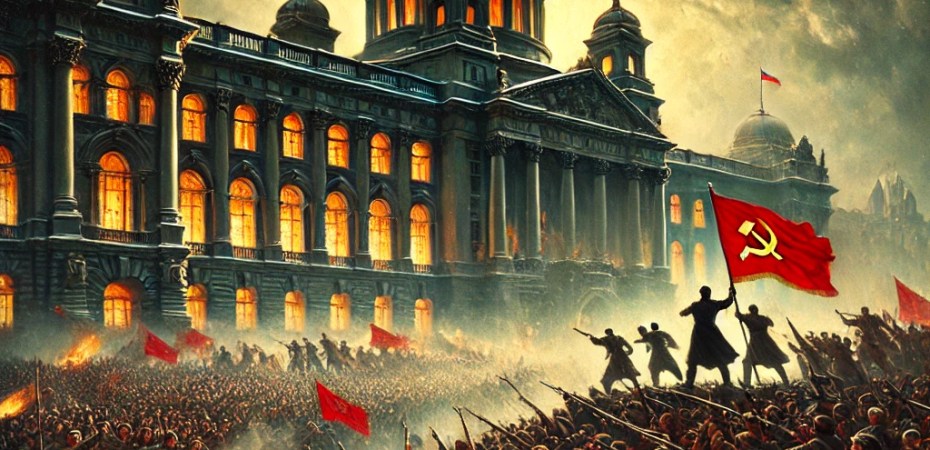
Crane Brinton’s Anatomy of a Revolution, originally published in 1938, is a leading work in the study of revolutions, offering a comparative analysis of the English, American, French, and Russian revolutions. Brinton’s work aims to identify the essential characteristics and phases common to these revolutions, providing a systematic framework that has proven applicable to both historical and modern revolutionary movements.
Background to the First Publication
The 1930s were a period of significant upheaval—the Great Depression, the rise of authoritarian regimes, and the continuing impact of the Russian Revolution. It was within this context that Brinton, an historian at Harvard University, began his work. His aim was to develop a comprehensive, analytical approach to understanding revolutions, moving away from purely narrative or ideologically driven accounts.
Anatomy of a Revolution was well-received on its release, praised for its methodical analysis that treated revolutions as phenomena that could be understood in terms of recurring patterns and stages. Brinton’s approach was distinctive in its focus on the structural and procedural aspects of revolutions, offering insights that went beyond the specific details of individual events.
Revision in the 1960s
By the 1960s, Anatomy of a Revolution had become a classic text in revolutionary studies. However, the post-War years had seen the emergence of new revolutionary movements, particularly in Asia, Africa, and Latin America, that did not always fit neatly into the patterns Brinton had identified. In response, Brinton revised the book in 1965 to incorporate these new developments and to refine his analysis in light of the changing global context.
The 1965 revision expanded the scope of Brinton’s analysis, taking into account the complexities of more recent revolutionary movements, such as the Chinese Revolution and the various anti-colonial struggles. This revision ensured that Anatomy of a Revolution stayed relevant.
Key Indicators of Revolution in Brinton’s Framework
Brinton identified several critical factors that often signal the onset of a revolution. These indicators are:
- Social and Economic Discontent: Brinton emphasises that revolutions typically begin when a significant and vocal segment of the population feels economically constrained or politically marginalised. This group, though not necessarily impoverished, perceives that their opportunities for advancement are unfairly limited by the existing regime. This sense of discontent creates fertile ground for revolutionary sentiment. For instance, in the French Revolution, the middle classes felt increasingly frustrated by the aristocracy’s privileges, despite their economic success.
- Inefficient and Unresponsive Government: A dysfunctional government that fails to address the needs and grievances of its people is a critical pre-revolutionary sign. Brinton notes that in the cases he studied, the governments were not only ineffective but were also perceived as corrupt or hostile to the interests of the broader population. This perception often leads to a loss of public trust and accelerates the revolutionary process. The Russian Revolution, for example, was partly driven by widespread dissatisfaction with the Tsarist regime’s inability to manage the economic and military crises facing the country.
- Intellectual Opposition: The rise of intellectuals who criticise the government and propose alternative systems is another significant indicator of a coming revolution. These intellectuals often gain the support of the discontented, spreading revolutionary ideas and providing the ideological foundation for the movement. During the American Revolution, Enlightenment thinkers like John Locke influenced colonial leaders, providing the philosophical underpinnings for the revolt against British rule.
- Loss of Legitimacy: As the regime begins to lose its legitimacy in the eyes of the people, revolutionary ideas gain traction. This loss of legitimacy can result from economic mismanagement, corruption, or perceived injustice. When the public’s faith in the existing order erodes, the likelihood of revolution increases. In the French Revolution, the monarchy’s inability to address financial crises and social inequities led to a significant decline in its legitimacy, paving the way for revolutionary change.
- Formation of Revolutionary Organisations: The emergence of organised revolutionary groups or movements that can mobilise the discontented population is a critical step toward revolution. These groups often start as small factions but can grow rapidly if the conditions are right. For example, the Bolsheviks in Russia were initially a minority faction, but their disciplined organisation and clear ideology enabled them to seize power during the revolution.
Application to the Iranian Revolution and Modern England
Brinton’s framework has been used to analyse various revolutions, including the Iranian Revolution of 1979. In Iran, social and economic discontent was widespread, particularly among the middle class and religious groups who felt alienated by the Shah’s secular and authoritarian rule. The government, perceived as corrupt and disconnected from the needs of the people, further exacerbated this discontent. Intellectual opposition, led by figures such as Ayatollah Khomeini, provided an alternative vision that appealed to the discontented masses. As the Shah’s regime lost legitimacy, revolutionary organisations, including religious groups, gained momentum, leading to the eventual overthrow of the monarchy.
When considering modern England through the lens of Brinton’s analysis, similar warning signs can be observed:
- Social and Economic Discontent can be seen in the growing sense of inequality and economic frustration among certain segments of the population. Issues such as the housing crisis, wage stagnation, and regional disparities contribute to a feeling of economic restriction.
- Inefficient and Unresponsive Government is perceived by some in the repeated failures to address key issues such as healthcare, social welfare, and political representation. Public trust in government institutions has been challenged by scandals and perceived inaction.
- Intellectual Opposition is evident in the rise of various movements and intellectuals who attack the established order, whether from the left or right of the political spectrum. These attacks often gain support from those who feel disenfranchised by the current system.
- Loss of Legitimacy is reflected in the declining trust in traditional political institutions and parties, exacerbated by events such as Brexit and the handling of the COVID-19 pandemic. This erosion of legitimacy can create a vacuum where revolutionary ideas might flourish.
- Formation of Revolutionary Organisations might not yet be prominent, but the increasing polarisation and organisation of grassroots movements suggest a potential for more structured opposition in the future.
In conclusion, Brinton’s Anatomy of a Revolution provides a valuable framework for understanding the signs and stages of revolutions. The book’s revisions in the 1960s allowed it to remain relevant in a changing global context, and its principles continue to offer insights into both historical and contemporary political dynamics. The key indicators identified by Brinton—social and economic discontent, inefficient government, intellectual opposition, loss of legitimacy, and the formation of revolutionary organisations—are as applicable today as they were in the revolutions he originally studied.
Discover more from The Libertarian Alliance
Subscribe to get the latest posts sent to your email.