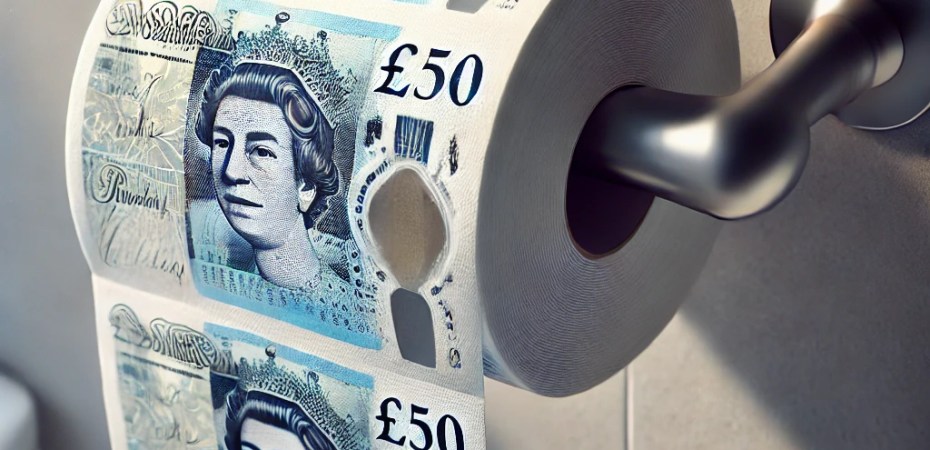
The Bank of England calls its proposal for a digital pound a leap into the future. The question is what kind of future?
The Bank assures us that the digital pound would be “denominated in sterling and its value would be stable, just like banknotes.” However, it went off gold in 1931, the pound has lost something like 99 per cent of its value. Rather than turning it into ones and zeros, the bank might think more about fixing it against some external standard – gold, for example – and then promising to pay on demand.
Beyond the dubious economic merits, the digital pound paves the way for further government surveillance and control. The Bank claims that “neither the Bank of England nor the Government would be able to control how you spend your money.” Yet, the infrastructure of a centralised digital currency enables authorities to monitor every transaction, and impose spending restrictions, and even freeze accounts at will.
Imagine a future where your ability to purchase certain items is curtailed because they’ve been deemed undesirable by those in power. Today, it will be cigarettes; tomorrow, dissident literature. A digital pound will be another tool for enforcing conformity and suppressing dissent.
The Bank insists that the digital pound “would not replace cash” and that it “will continue to issue it for as long as people want to keep using it.” But as digital payments become the norm, cash usage will inevitably dwindle, leading to its eventual obsolescence. Once cash is gone, we’ll be entirely at the mercy of a system that monitors and controls every penny we spend.
The Bank argues that a digital pound would “help us maintain trust in money and protect our financial system, while also improving payments by increasing efficiency and enabling innovation.” Yet, our current payment systems are already efficient and reliable. The digital pound appears to be a solution in search of a problem, with the obvious and intended costs to our privacy and freedom outweighing any minor conveniences.
The digital pound is being marketed as a modern necessity. In reality, it’s an excuse for a dystopian level of surveillance and control under the guise of progress. Then again, what else is to be expected?
Discover more from The Libertarian Alliance
Subscribe to get the latest posts sent to your email.
From Hugo Miller
“the digital pound would be “denominated in sterling and its value would be stable, just like banknotes.” ”
The Pound has lost a staggering 94% of its value in the last fifty years. Going digital will not solve this problem. As long as the government can sccumb to Human nature by printing fiat money at will (‘mouse-click money’) this problem will persist.
But that is not the worst of it. As you correctly state, the government will be able to simply turn off your money if you step out of line. That is a highly effective method of stamping out dissent, as already practised in China. The government will be able to ration how much eat you buy, how much gasoline, how many flights – every damned thing in fact. They can impose negative interest rates and even impose an expiration date on your money, so if you don’t spend it within, say, six months, it will evaporate.
There is only one escape route from this digital jail, and that is Bitcoin. Bitcoin enables individuals to trade freely and privately with one another, un-observed by governments. And if things get too hot, Bitcoin can be taken out of the country un-observed by customs.
‘Money’ is ging digital, whether we like it or not. We can either submit to total government control of our lives with the CBDC, or we can embrace freedom money and join the Bitcoin revolution.
With modern electronic funds transfer and internet banking, I seldom use cash nowadays anyway. What further good or harm will this new invention do? It just sounds like a new kind of public sector bank account. What’s the point of it?
GBP is inefficient (financial transactions using crypto is a fraction of the cost) and unreliable (sending money abroad takes days and may not even reach it’s destination, but you will still be charged to use the SWIFT system). Also the UKGov can currently freeze your account and not disclose why. Central Bank Coins (CBC) issued by any country are simply digital variants, retaining all the problems of the existing FIAT system (inc. devaluation due to ongoing money printing), but with extra controls available for governments as you mention above. The only real alternative is non-CBC crypto (e.g. Bitcoin, Ethereum etc), giving the user sovereignty of their own money. Also keeping cash in a safe at home is a good hedge for potential bank runs in the future, as people being to realise the risk of not always being able to access their money when they want. #ComputerSaysNo