Reading The Daily Telegraph is like visiting a boot fair. Most of the items on offer are not fit for any reasonable purpose—dusty relics from the 1980s and 1990s, curiosities misrepresented and serving no useful purpose, outright frauds. Every so often, though, you stumble upon something that does exactly what you need. Bjorn Lomborg’s article, “There is no green energy revolution: pretending otherwise makes us poor,” published on the 25th January 2025, is just such a find. It lays bare the terrible effects of the British Government’s green energy policies, particularly their role in driving up electricity costs and impoverishing ordinary working people.
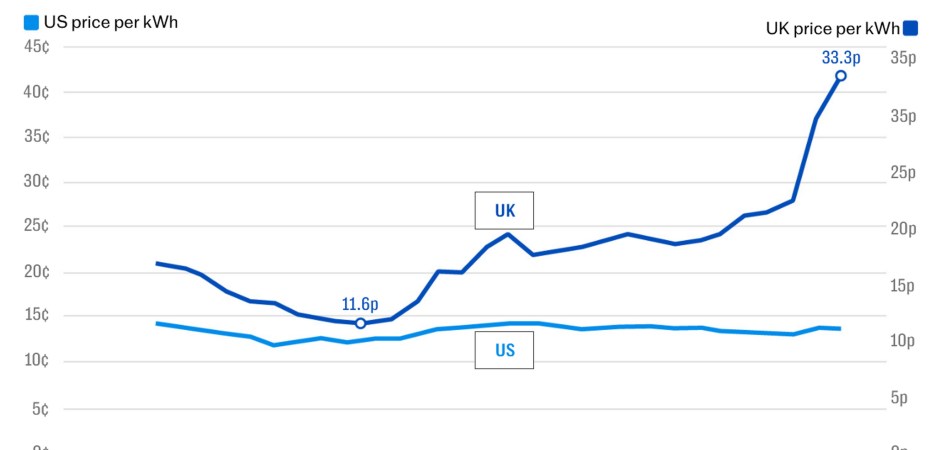
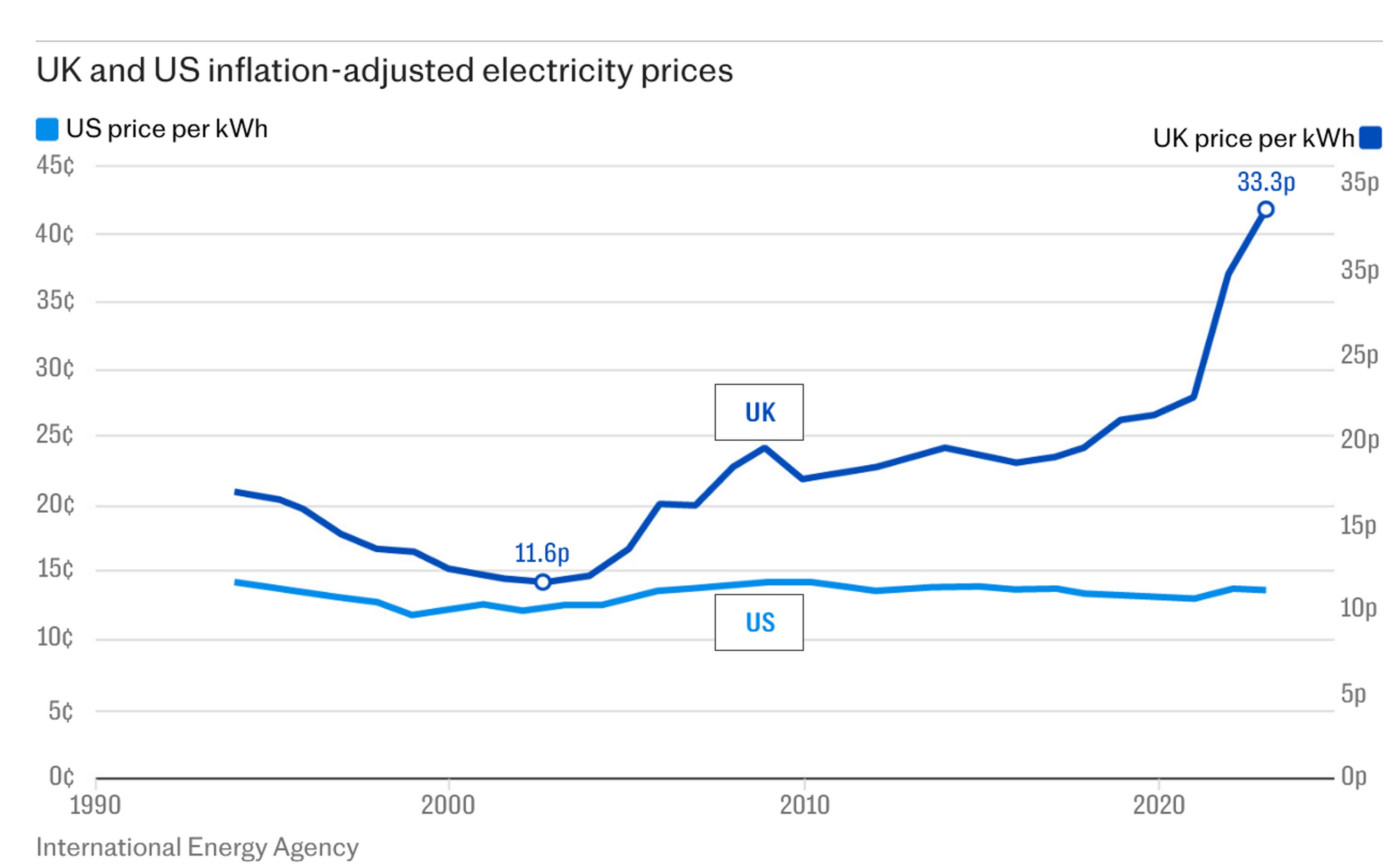
Lomborg makes an unanswerable point: the Government’s obsession with net zero is a ruinous fantasy. The country has been committed to a renewable energy revolution that has made energy costs the highest in the world. He says:
The total annual UK electricity bill is now £90 billion, or £59 billion more than if prices in real terms had stayed unchanged since 2003. That is equivalent to wasting 2.1 per cent of GDP each year. This unnecessary increase is so costly that it is twice the entire cost of UK primary education.
Had prices stayed at 2003 levels, an average family of four would be spending £1,882 on electricity – which includes indirect industry costs. Instead, it now pays £5,425 per year.
There is a strong, clear correlation between more solar and wind, and much higher average energy prices.
And this is a revolution cannot work. Wind and solar power are inherently unreliable. They depend on the weather and the time of day, which means that they cannot provide a steady supply of electricity. To compensate for this, we would need vast amounts of energy storage—enough to power the country during extended periods of low wind or sun. But neither the technology nor the money exists to build such storage on the required scale. Batteries capable of storing green electricity for even a single week would cost more than the entire GDP of most nations. The idea that this is a viable solution is delusional.
Instead of acknowledging the disaster and taking late but radical action to allow energy costs to fall, the Government is doubling down, forcing ordinary people to pay ever-higher prices for energy while pretending that technological miracles are just around the corner. High electricity costs make domestic manufacturing uncompetitive, driving businesses overseas and hollowing out the economy. These same costs inflate the price of food and other essentials, as growing and transporting goods becomes more expensive. The average Briton is left paying inflated prices for basics, all in the name of a green revolution that is doomed to fail.
The Green Horror inflicted on us is not merely the work of fanatical activists. These zealots are only the symptom of a deeper problem. The real cause is a ruling class for which the British Government is merely the interface by which power is exercised over us. This ruling class is using the green agenda as a convenient pretext for transferring wealth to itself. Heavy taxes and regulations, disguised as environmental imperatives, are essentially hypothecated taxes designed to enrich the few at the expense of the many. The money extracted from ordinary working people flows into the pockets of those who profit from building and maintaining wind turbines and solar farms, as well as those running the carbon trading schemes—vastly complex systems that extract immense wealth in ways beyond the awareness and even the understanding of almost anyone who is not on the take.
But the effects continue. A significant faction of the ruling class appears to believe its long-term interests would be better served if there were fewer people to govern. Depopulation by stealth may not be openly discussed, but making energy so expensive that people cannot heat their homes or eat properly achieves the same result. The public is being primed for a grim future—one of cold winters, constant hunger, and diets of processed bugs, of synthetic food that is toxic by probable design. In the meantime, people are being driven into poverty and depression so profound that resistance to these policies becomes impossible.
Lomborg’s article also highlights the ultimate cruelty of this policy: it achieves nothing. Britain contributes less than one per cent of global carbon emissions, making its sacrifices meaningless on the world stage. While Britons shiver in the dark, major polluters like China and India continue to expand their economies, unbothered by the lunatic sermons preached from Westminster. The green revolution will not save the planet; it will only impoverish the British people.
What Lomborg’s article only hints at, but what must be said explicitly, is how the ruling class cloaks these horrors in a veneer of moral superiority. How better to destroy a people than to persuade them that their suffering is not only necessary but virtuous? The green agenda is sold as a moral imperative, a self-sacrifice for the greater good. In reality, it is a tool of exploitation, designed to extract wealth and entrench power.
The British ruling class has betrayed its people, and the consequences are visible everywhere. Energy bills that leave families shivering, empty factories that once provided livelihoods, and supermarkets where basics cost more than luxury items once did. This is not a future of progress but of regression, a deliberate dismantling of the structures that once made Britain great in the world—great in its science and technology, great in its wealth, great in its freedom, great in its power.
The ruling class does not fear the collapse of the nation; it fears the people waking up to what is being done to them. For as long as we are cold, hungry, and distracted by survival, their grip on power remains secure. If we are to resist this slow-motion destruction, we must reject the lies, demand policies that put people over profits, and recognise that the green agenda is not about saving the planet—it is about controlling us.
Discover more from The Libertarian Alliance
Subscribe to get the latest posts sent to your email.
I am divided on these issues because, on the one hand, I can see the long-term benefits of green policies in producing a better, more pleasant physical environment, which in turn will have all sorts of positive ramifications; on the other hand, the agenda at work is unquestionably ulterior, and comes over as rather bossy and obnoxious.
We should have electric cars, but only as a market-driven solution [pun intended], in which manufacturers are free to produce fossil fuel cars in response to demand for them.
We should move towards renewable energy, but as part of an energy mix in which nuclear and fossil fuels are also part of energy generation for supply stability and other strategic reasons, such as the provision of employment and balance-of-payments.
Cities and town centres are much more pleasant when free of cars. The price to be paid for it is restrictions on motorists, which is unfortunate, but as long as good public transport is in place, the impact on freedom and convenience is minimal.
Greater use of public transport and cycles is more healthy and reduces long-term costs for society of health issues caused by habitual driving. Buses, trains and cycles are also more aesthetically pleasing and better for the physical environment.
All in all, you may say I am a green. In fact, I would go further and say I would like to see ecological perspectives take precedence in how the planned environment is designed and shaped. But I also acknowledge the inherent top-down nature of this and the Actonite moral hazard it raises. Power can be abused because people bring ulterior agendas into things, including self-interest and ideology.
Anyway, another interesting essay from young Master Wang. With that handsome profile photo, we may imagine him as the Chinese playboy of Borehamwood. No doubt his wealthy parents have bought him a sports car, which he drives around town in an effort to woo the ladies (so far unsuccessful). This is in between A-level studies, which of course must take priority. Perhaps in a few years from now we will be receiving learned missives from a Dr. Wang, Professor of Medieval Latin at some Oxford college?
A sports car? Some of us, I’ll have you know, still ride bicycles!
Inscrutable circumspection is still, no doubt, are trait of the Chinese, but this hardly need extend into false modesty. Rumour has it that you have been seen speeding down the high street in your Merc while waving at the pretty girls! You’re certainly cutting quite a dash.