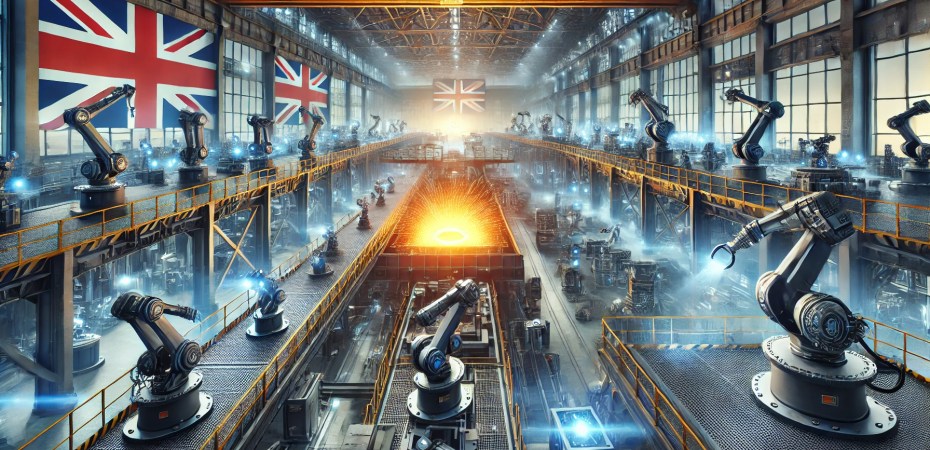
It is difficult to imagine now, but once Britain was the undisputed centre of the world. From Manchester’s textile mills to the shipyards of Glasgow, Britain was an industrial giant, leading the world in technological innovation and manufacturing. Today, the country is reduced to a service economy, run by and for financiers in the City of London, while our political class obsesses over unworkable green policies that strangle what remains of productive industry. If Britain wants to reclaim its place as a serious industrial power, the solution is not some grand government spending programme. It is simply to get out of the way. Cut taxes, slash regulations, and stop imposing self-destructive environmental targets. The people will do the rest.
The industrial decline of Britain is not just a sad historical tale; it is a deliberate choice by successive governments. Instead of allowing investment in real production—research and design, then producing what has been discovered—the British ruling class has spent decades overseeing policies that divert the brightest minds into financial services. While China has been educating armies of engineers and computer scientists, Britain’s best have been lured into corporate law firms and hedge funds, where their job is to manipulate the wealth created elsewhere, not create it here. The figures speak for themselves: over a quarter of Britain’s economy is based on finance and insurance. Meanwhile, manufacturing, the engine of technological progress, has shrunk to less than 10% of GDP.
China, by contrast, has taken the opposite path. It is flooding the world with cutting-edge technology—AI, drones, autonomous vehicles, batteries, robotics—while Britain imports everything from abroad. And yet, British politicians insist that manufacturing is a relic of the past. They ignore the obvious: if the government simply got out of the way, the people of Britain could make things again.
There is no greater example of government idiocy than Britain’s Net Zero obsession. While China and India are building coal plants at a record pace, Britain is deliberately shutting down its own energy production and burdening businesses with punitive carbon taxes. The government boasts about banning petrol cars, making home heating more expensive, and forcing industries to adopt inefficient and costly “green” alternatives. The result? businesses are moving production overseas, and the ordinary Briton is footing the bill for this evil madness.
The lunacy of Britain’s energy policy is best illustrated by a simple comparison of average energy costs across Europe. While countries such as Poland (€174), Finland (€476), and Norway (€543) enjoy affordable power, British households and businesses are being strangled with costs of €2,960—several times higher than in any comparable European nation. How is any British manufacturer supposed to compete when energy costs are five times higher than those in Germany and France? This is not merely incompetence; it is industrial sabotage. Yes, this is one of those mistakes that are too consistent and too obviously destructive to be the result of mere incompetence. It can only be the result of philosophical corruption or outright malice.
Even on the false assumption of anthropogenic climate change, Net Zero does nothing to help the planet. China alone emits more carbon in a few months than Britain does in an entire year. Yet, our politicians insist on bankrupting our industries to set an example—an example that no one else is following. Instead of forcing industries into decline with arbitrary carbon targets, the government should be doing the opposite: encouraging investment in energy production, cutting restrictions on nuclear power, and ensuring that businesses can operate affordably and efficiently.
If Britain is serious about reclaiming its industrial strength, it should take a lesson from China’s DeepSeek AI model. The Chinese have realised that innovation flourishes when barriers are removed. By making their AI model open source, they have created a global community of researchers and developers who will refine and improve it. The same principle applies to industry. Instead of shackling business with taxes and regulations, the government should create an environment where British manufacturers can experiment, refine, and build at speed.
This is not, I repeat, a question of government “investment” (a euphemism for more taxes and waste). It is a question of removing the obstacles that prevent Britain from thriving. Cut corporation tax to match the lowest in Europe. Abolish environmental regulations that make manufacturing expensive and slow. Scrap the absurd restrictions on energy production. And, most importantly, stop funnelling Britain’s talent into financial services at the expense of engineering and industry.
Imagine a Britain where high-tech factories churn out cutting-edge AI chips, where British-designed electric vehicles roll off production lines, where homegrown robotics firms lead the world. This is not a fantasy. It is precisely what China is doing right now, having started from much less than Britain has even now, and Britain could do the same—if only the government would let it.
The choice is stark: continue on the current path of decline, where Britain becomes a theme park for foreign tourists and a playground for bankers, or embrace a future of industrial revival. The answer is clear. Britain must end its obsession with finance, scrap its ruinous green policies, and allow its people to build and innovate. This does not require vast sums of public money. It requires only that the government step aside. If it does, the people will do the rest.
Discover more from The Libertarian Alliance
Subscribe to get the latest posts sent to your email.
China is statism on steroids, isn’t it?