
Modern readers looking back at the ancient world are often encouraged to admire the grandeur of empire and the heroic virtues of its most distinguished men. But one need not dig very far to discover a world drenched in blood and built on unfreedom. The Greeks and Romans, like the Egyptians and Persians before them, ran their societies on principles that must shock any modern reader who looks at them with a full knowledge of the literature and history. Their political orders rested on conquest and slavery at the state level, and on patriarchal discipline at home.
And yet, there is something to be found—not, perhaps, libertarianism in the full-bodied Rothbardian sense, with its axioms and footnotes; but a glimmer. There was something recognisably liberal: a suspicion of tyranny, a defence of personal autonomy, a refusal to submit. The ancient world produced more than one philosopher who saw through the illusions of state power, and more than one society where a man might say what he liked and do as he pleased—so long as he was not a woman, a slave, or a barbarian.
This essay traces those moments of liberty: not to whitewash the classical world, but to acknowledge its complexity—and to show that the desire for liberty is older than the Enlightenment, and deeper than most textbooks suggest.
Let us begin with the most obvious problem. The ancient world was not free. Athens, that supposed cradle of democracy, excluded from political participation women, metics (resident foreigners), and slaves. In the fifth century BC, out of a population of perhaps 300,000, only about 30,000 were full citizens with political rights. Rome was even more hierarchical. Its republican institutions, however admirable in structure, were in practice controlled by a small elite of patricians and equestrians, while millions laboured in chains across Italy, and then the whole Mediterranean.
Liberty, then, was both partial and parasitic. It depended on the unfreedom of others. Free men could afford to participate in politics, because others tilled their fields; others cleaned their houses; others warmed their beds. This must be admitted. To speak of ancient libertarianism is always to speak in qualified terms.
However, the modern world is hardly some libertarian utopia. Today’s citizens are technically free, but monitored, taxed, and regulated in ways that would have made a Roman procurator blush. If the ancients failed to extend liberty to all, the moderns have extended servitude to many. Every government that claims to protect liberty also restricts it—and usually does more of the latter.
The question, then, is not whether ancient liberty was perfect, but whether it was real. Did free men in the classical world enjoy genuine spheres of autonomy? Did some thinkers articulate principles that we might recognise as libertarian, or at least libertarian-adjacent? The answer to both questions is yes.
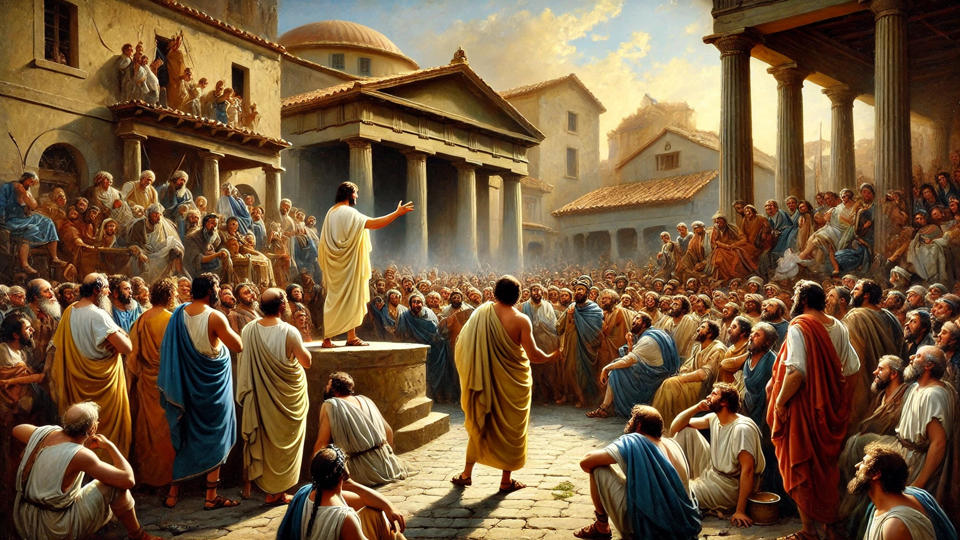
Of all ancient societies, Athens is the one most often claimed as a precursor to modern liberal democracy. Its democratic reforms, beginning with Solon in the early sixth century and culminating under Cleisthenes in 508/7 BC, produced a system in which all freeborn Athenian males over the age of 18 could speak, vote, and hold office.
Power was exercised directly by the ekklesia, the assembly of citizens. The boule (Council of 500) and the dikasteria (popular courts) were filled by lot, not election, in an effort to prevent aristocratic capture. The practice of ostrakismos—exile by popular vote—allowed the demos to neutralise would-be tyrants. This was not representative government; it was participatory. And for its citizens, it offered an astonishing degree of political equality and personal freedom.
In his Funeral Oration, delivered in 429 BC, Pericles declares:
Our constitution is called a democracy because power is in the hands not of a minority but of the whole people. (καλοῦμέν τε πολιτείαν δημοκρατίαν, ὅτι μὲν τὸ εἰς ὀλίγους ἀλλ’ ἐς πλεόνας οἰκεῖ: Thucydides, 2.37)
He goes on to praise the Athenians for their tolerance:
In our private business, we are not suspicious of one another, nor angry if a neighbour does as he likes. (ἐν τοῖς καθ’ ἡμέραν ἐπιτηδεύμασιν ἀνετώτεροι τοὺς ἀλλήλους καὶ οὐ δυσκατάπαυστοι τῷ θυμομένῳ)
This is a striking passage. In it, we find a conception of liberty not merely as participation in politics, but as freedom from interference. The idea that a man might live as he chooses, without harassment from his peers or his government, is a fundamentally liberal one. And here it is, in the mouth of a fifth-century general.
Athens had its flaws—many of them. It was an empire, not a pacifist utopia. It executed Socrates, after all. But for its citizens, it was freer than most modern democracies. One could speak, trade, blaspheme, and ridicule the authorities in the theatre. The state was visible, but limited.
If Athenian democracy embodied a practical commitment to freedom (for some), a number of ancient thinkers took this further, offering explicit critiques of political authority and defences of personal autonomy.
Of all the early libertarian voices, Antiphon (fl. 5th century BC) is perhaps the most radical. In the surviving fragments of his On Truth, he attacks the arbitrary character of law and exalts the natural rights of the individual:
That which is most just by nature is often forbidden by law. (τὰ μὲν φύσει δικαιότατα, νόμῳ δὲ κωλύεται)
For Antiphon, nature is the standard of justice—not custom, not legislation, not the decrees of the assembly. He points out that laws often suppress our natural desires, and that this suppression leads to suffering:
Nature seeks freedom; law servitude. (ἡ φύσις ἐλευθερίαν ζητεῖ, ὁ δὲ νόμος δουλείαν)
This is libertarianism in embryo: a clear distinction between voluntary behaviour and coerced compliance, and a preference for the former.
Epicurus (341–270 BC) is too often dismissed as a glutton. In fact, he was an advocate of personal autonomy, non-aggression, and voluntary association. His philosophy taught that justice arises from mutual agreements not to harm one another:
Justice is nothing in itself, but in mutual agreements made among men not to harm or be harmed. (ἡ δικαιοσύνη οὐθὲν καθ’ αὑτὴν, ἀλλ’ ἐν τῇ μετ’ ἀνθρώπων συμβάσει τοῦ μὴ βλάπτειν μηδὲ βλάπτεσθαι)
He condemned the pursuit of power as inimical to peace of mind. His community in the Garden was private, apolitical, and self-regulating. It was not the polis that made one free, but the absence of fear.
If Epicurus withdrew from the state, Diogenes spat on it. The founder of Cynicism, Diogenes of Sinope (c. 412–323 BC), rejected not only political authority but social convention itself. He claimed cosmopolitan identity:
I am a citizen of the world. (Κοσμοπολίτης εἰμι)
He lived in a barrel, mocked Alexander, and declared that the only law worth following was nature. His life was an exercise in autarkeia—self-sufficiency. He denied property, wealth, rank, and office. One can view him as a kind of anarcho-primitivist: a man who refused to be ruled, and made a public spectacle of his liberty. He was once seen masturbating in the marketplace. When criticised, he replied with characteristic bluntness: “I wish I could relieve hunger just as easily by rubbing my belly.” (εἴθε καὶ τὴν τῆς γαστρὸς λιμόν οὕτω καταπραΰνειν ἠδυνάμην) This was not prurience—it was philosophy: a rejection of shame and social pretence.
Zeno of Citium (c. 334–262 BC), founder of Stoicism, reportedly wrote a Politeia in which he imagined a society without courts, temples, or coinage—a rational, stateless order governed by natural law. Though the text is lost, later Stoics inherited his suspicion of conventional authority.
Epictetus, himself a former slave, taught that true freedom lay in self-mastery:
He is free who is master of himself. (ἐλεύθερός ἐστιν ὁ αὐτοῦ κύριος)
This is internal libertarianism, to be sure—but not apolitical. It reflects a worldview in which coercion, including that of the state, is dismissed as irrelevant to the free man’s worth.
In Rome, we find fewer theorists and more political actors. But some still merit libertarian attention. Above all, I suppose, is Cicero. I can’t say I like the man. He was a shifty, lying hypocrite in his political career. For A-Level Latin I am doing his Pro Caelio. It is not something I will tell the examiners, but the speech is a moral disgrace. His client is a thuggish spendthrift, and even a confessed rapist. He defends this piece of garbage by insulting the chief prosecution witness—a woman who, if she cheated on Catullus, gave her slaves a jollier life than most owners did in the ghastly world of the Roman Late Republic. I’ll go further. His first speech I read in full was Pro Milone. It takes a peculiar kind of cynicism to commission a political murder, then to defend the killer in court with self-righteous cries of silent enim leges inter arma.
This being said, Cicero’s political theory, while not libertarian, contains proto-liberal elements. In De Re Publica and De Legibus, he argues that true law is derived from reason and nature, not custom or command:
There is indeed a true law: right reason in agreement with nature. (Est quidem vera lex, recta ratio, naturae congruens)
Or:
We cannot be freed from the obligations of natural law by senate or people, and we need not look outside ourselves for an expounder or interpreter of it. (Nec vero aut per senatum aut per populum solvi hac lege possumus, neque est quaerendus explanator aut interpres eius alius.)
His ideal state is a mixed constitution, with checks and balances to limit arbitrary rule. He defends private property, contractual freedom, and the rule of law—all foundational liberal principles.
To summarise: no ancient society was libertarian. But some ancient men were. They lived in polities that demanded conformity, extracted tribute, and treated vast numbers as expendable. Yet from within those societies emerged voices of dissent—philosophers who rejected domination, politicians who stood against tyranny, and cities like Athens that, however flawed, gave real scope for liberty.
A further point that I might profitably have developed before this conclusion is that ancient governments, whatever their official form, simply lacked the means of coercion that have been available to modern governments since at least the time of Napoleon. They had no police forces. Poverty kept their bureaucratic machinery small. Diocletian famously tried to fix all prices and wages. His attempt failed so miserably that his Edict had to be withdrawn, and may never have been enforced through the whole Empire even during its operation. It failed not only because it made war on economic reasoning, but also because the means of enforcement simply did not exist. A few centuries earlier, when the Roman bureaucracy hardly existed at all, Caligula could put on a purple robe and demand that everyone in reach should worship him as a god. This might have terrified the Senators, but it had no effect on how people lived and worked in Antioch or Alexandria. It probably had no effect in Naples or Milan. Outside the small centres of political performance, life went on as it always had—local, personal, governed by custom and necessity, not by decrees from the centre. In this sense, ancient liberty was not just a philosophical posture. It was often a lived reality, protected less by law than by the limits of imperial reach.
Liberty is not an invention of modernity. It is a possibility internal to all human beings, glimpsed in all ages. The ancients lived in slave states, yes. But some of them lived as free men within those states—and some died for that freedom.
Primary Sources (Greek and Latin Editions)
- Antiphon. On Truth. Fragment from Diels-Kranz, Die Fragmente der Vorsokratiker, B44.
- Cicero. De Re Publica et De Legibus. Edited by C.F.W. Mueller. Oxford: Oxford University Press, 2008.
- Diogenes Laertius. Vitae Philosophorum. Edited by H.S. Long. Oxford: Oxford University Press, 1964.
- Epictetus. Dissertationes et Encheiridion. Edited by J. Schweighäuser. Oxford: Oxford University Press, 1998.
- Herodotus. Historiae. Edited by C.H. Oldfather. Oxford: Oxford University Press, 1925.
- Lucretius. De Rerum Natura. Edited by W.H.D. Rouse. London: William Heinemann, 1924.
- Pericles (via Thucydides). Historiae. Edited by H.S. Jones. Oxford: Oxford University Press, 1942.
- Plutarch. Vitae Parallelae. Edited by K. Ziegler. Oxford: Oxford University Press, 1951.
- Thucydides. Historiae. Edited by C.F. Smith. Oxford: Oxford University Press, 1919.
Translated Editions
- Cicero. De Re Publica & De Legibus. Translated by Clinton W. Keyes. Cambridge, MA: Harvard University Press, 1928.
- Diogenes Laertius. Lives of Eminent Philosophers. Translated by R.D. Hicks. Cambridge, MA: Harvard University Press, 1925.
- Epictetus. Discourses, Books 1–2. Translated by W.A. Oldfather. Cambridge, MA: Harvard University Press, 1925.
- Herodotus. Histories. Translated by A.D. Godley. Cambridge, MA: Harvard University Press, 1920–1925.
- Lucretius. On the Nature of Things. Translated by W.H.D. Rouse. Cambridge, MA: Harvard University Press, 1924.
- Plutarch. Lives: Sertorius and Eumenes, Phocion and Cato the Younger. Translated by Bernadotte Perrin. Cambridge, MA: Harvard University Press, 1919.
- Thucydides. History of the Peloponnesian War. Translated by Charles Forster Smith. Cambridge, MA: Harvard University Press, 1919.
Secondary Sources
- Cartledge, Paul. The Greeks: A Portrait of Self and Others. 2nd ed. Oxford: Oxford University Press, 2002.
- Cartledge, Paul. Sparta and Lakonia: A Regional History 1300–362 BC. 2nd ed. London: Routledge, 2002.
- Constant, Benjamin. “The Liberty of the Ancients Compared with that of the Moderns.” 1819. Reprinted in Political Writings, edited by Biancamaria Fontana. Cambridge: Cambridge University Press, 1988.
- Finley, M.I. Democracy Ancient and Modern. London: Chatto & Windus, 1973.
- Finley, M.I. Politics in the Ancient World. Cambridge: Cambridge University Press, 1983.
- Forrest, W.G. The Emergence of Greek Democracy: The Character of Greek Politics, 800–400 B.C. London: Weidenfeld and Nicolson, 1966.
- Long, A.A. Stoic Studies. Cambridge: Cambridge University Press, 1996.
- Murray, Oswyn, and Simon Price, eds. The Greek City: From Homer to Alexander. Oxford: Clarendon Press, 1990.
- Raaflaub, Kurt A., ed. Democracy, Empire, and the Arts in Fifth-Century Athens. Cambridge, MA: Harvard University Press, 1998.
- Sinclair, R.K. Democracy and Participation in Athens. Cambridge: Cambridge University Press, 1988.
- Vogt, Katja Maria. Law, Reason, and the Cosmic City: Political Philosophy in the Early Stoa. Oxford: Oxford University Press, 2008.
- Wallace-Hadrill, Andrew. Rome’s Cultural Revolution. Cambridge: Cambridge University Press, 2008.
- Yaron, Reuven. The Stoic Tradition: The Thought of Zeno to Marcus Aurelius. Cambridge: Cambridge University Press, 1964.
Discover more from The Libertarian Alliance
Subscribe to get the latest posts sent to your email.
Justice is nothing in itself: this is a refutation of the doctrine of natural human rights.