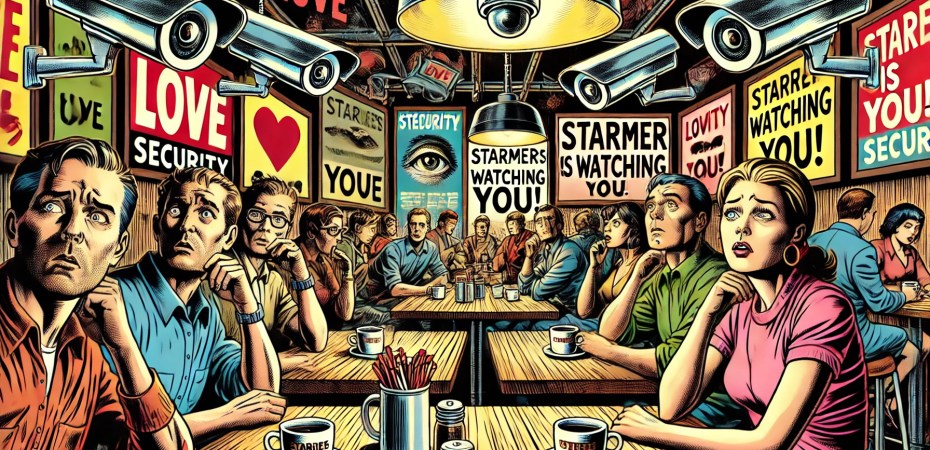
Gab is an American social media platform founded on two principles: Christianity and freedom of speech. Its founder, Andrew Torba, has consistently affirmed that the platform exists to uphold the Gospel and the First Amendment—even when that means tolerating speech from those whose ideas it finds abhorrent. This principled stance makes Gab unusual in today’s internet landscape. Unlike Twitter (or whatever it’s called now), which claims neutrality while shadowbanning its dissidents, or Facebook, which outsourced content moderation to a panel of retired European bureaucrats, Gab is honest. It does not pretend to be a community garden. It is a battlefield, and everyone is welcome to fight.
Not surprisingly, this approach has earned Gab powerful enemies. Governments across the world—especially those that fear dissent more than they fear terrorism—have long regarded Gab as a problem to be solved. But now, under the Starmer regime, the British Government has abandoned subtlety. It is not merely trying to regulate Gab. It is trying to destroy it.
The Starmer Government’s instrument is the Online Safety Act, a wide-reaching censorship law disguised as a public safety measure. The Act hands extraordinary powers to the British state. It enables the Government to fine companies millions of pounds for “non-compliance,” order the deletion of lawful speech, and threaten criminal prosecution against platform executives. The Act is written in the language of “protection” and “safety,” but its real purpose is the protection of political narratives and the safety of those in power.
Gab refuses to comply. It will not delete content based on vague allegations of “harm.” It will not share user data with a foreign government. It will not muzzle Americans or Britons just because Keir Starmer’s ministers are embarrassed by what those people say.
The Government’s response has been to escalate. As Gab reported last week, the British authorities are now threatening not just the company, but its infrastructure: “They have publicly stated their intention to actively target Gab’s essential infrastructure providers—the very services that keep our platform online.” This includes hosting partners, payment processors, and other behind-the-scenes firms that most people have never heard of. The tactic is clear: if Gab won’t kneel, then its service providers will be harassed into abandoning it.
This is not law enforcement. This is sabotage. It is an open attempt by a foreign government to destroy a legally-operating American business. As Gab rightly puts it, this is “economic terrorism.”
Britain is not acting alone. The Israeli Government has also demanded that Gab remove content, including material critical of its conduct in Gaza and its influence on Western politics. A recent report on Gab’s website reveals “censorship demands from foreign actors,” singling out both Britain and Israel as leading aggressors in this campaign to restrict speech on a platform they cannot control. But the French Government is also busy with demands of its own. And the Germans have their hand in the censorship pot.
The irony, of course, is that these same governments spend much of their time denouncing censorship elsewhere. Britain’s politicians will condemn Chinese internet controls while simultaneously introducing their own. Israel will decry online antisemitism while demanding that criticism of Zionism be banned outright. These regimes do not want “free speech” in any meaningful sense—they want speech they can manage.
Gab’s refusal to play along is what makes it so dangerous in their eyes. Unlike mainstream platforms, Gab does not offer its enemies the luxury of algorithmic invisibility or silent blacklists. If someone wants to post a disgusting idea, they are free to do so. Others are equally free to challenge it. That is what real freedom of speech looks like—not the safety-padded simulacrum now common in the West, but something rougher, more adult, and more honest.
For those of us living in Britain, this episode reveals how much our country has changed. It used to be said—sometimes lazily, but often truthfully—that Britain was the home of liberty. Today, it is a country where you can be imprisoned for posting a meme, where police monitor Twitter for “non-crime hate incidents,” and where unelected regulators decide what constitutes “acceptable” speech. The fact that the Government has now turned to intimidating a foreign company into compliance only confirms the trend: Britain is no longer liberal. It is repressive, and increasingly proud of it.
The Starmer Government’s broader campaign against “extremism”—recently exposed in the Extremely Confused report—shows just how far this has gone. The Government now treats “misinformation” and “online subcultures” as threats to national security. It equates noticing reality with hatred, and disagreement with danger. Gab is merely the latest victim of this policy, and almost certainly not the last.
That Gab is Christian makes it more than a political target—it makes it a cultural one. In a West that openly despises its heritage, a platform that proclaims “Christ is King” is not just offensive, but insufferable. It is a standing rebuke. And that, I suspect, is the real reason for the fury.
A platform that tolerates both holiness and heresy, that defends the right of sinners and saints alike to speak—such a platform cannot be allowed to exist. Not because it spreads lies, but because it allows truth to emerge unfiltered by official ideology.
Gab has said it will not comply. It will not pay fines. It will not silence its users. It is working with the U.S. Trade Representative and other authorities to challenge this interference. Whether or not the U.S. Government responds with appropriate vigour is another matter. But the fact that this campaign has reached such levels should make everyone pay attention.
We do not need to like everything said on Gab—or anywhere else—to defend its right to exist. Freedom of speech means exactly that: the freedom to say things that others hate. A country that cannot tolerate offensive ideas is a country that cannot tolerate any ideas at all.
I stand with Gab. Not because I agree with everything posted there, but because I believe in the principle that speech should not be managed by those it threatens. If a government feels endangered by an open forum, the problem is not the forum. The problem is the government.
Let us hope that Gab survives this onslaught. More than that, let us hope it thrives. A free society needs places where people can speak without fear—not just for themselves, but for the good of everyone.
Christ is King.
Discover more from The Libertarian Alliance
Subscribe to get the latest posts sent to your email.
I read this in today’s Sun:
“Known as The Doctor and The Lord Protector, Dr. Gabb leads the English National-Libertarian Revolutionary Command from a secret hideout in Kent. His wacky followers have called for the “return of a normal society”, suggesting they are a hotbed of right-wing extremists.
“In a speech delivered at the annual conference of the LGBTQP+ Queer Section of the Rainbow Alliance of Chronic Xenophiliacs (RACX), Prime Minister Keir Starmer condemned Dr. Gabb and promised that he would be “denied the oxygen of publicity”.
“Later that day, Home Secretary Yvette Cooper outlined plans to force Dr. Gabb to give all his public speeches in Latin, but only after inhaling helium. “I think this proposal is dead clever on my part”, Cooper remarked, “because we are such an uneducated society that very few people understand Latin, so no-one will pay the Lord Protector much notice.”
This is not how I might wish an old man to be addressed who is now approaching the last extreme of senescence
60 is the new 30.