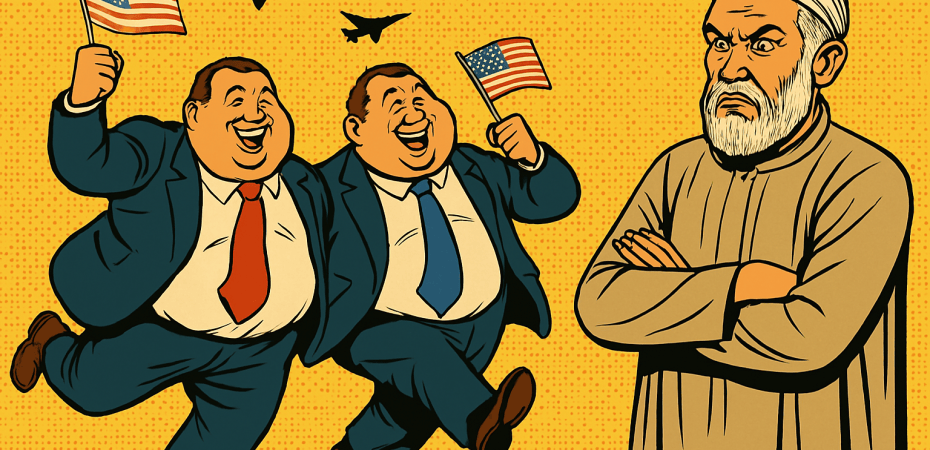
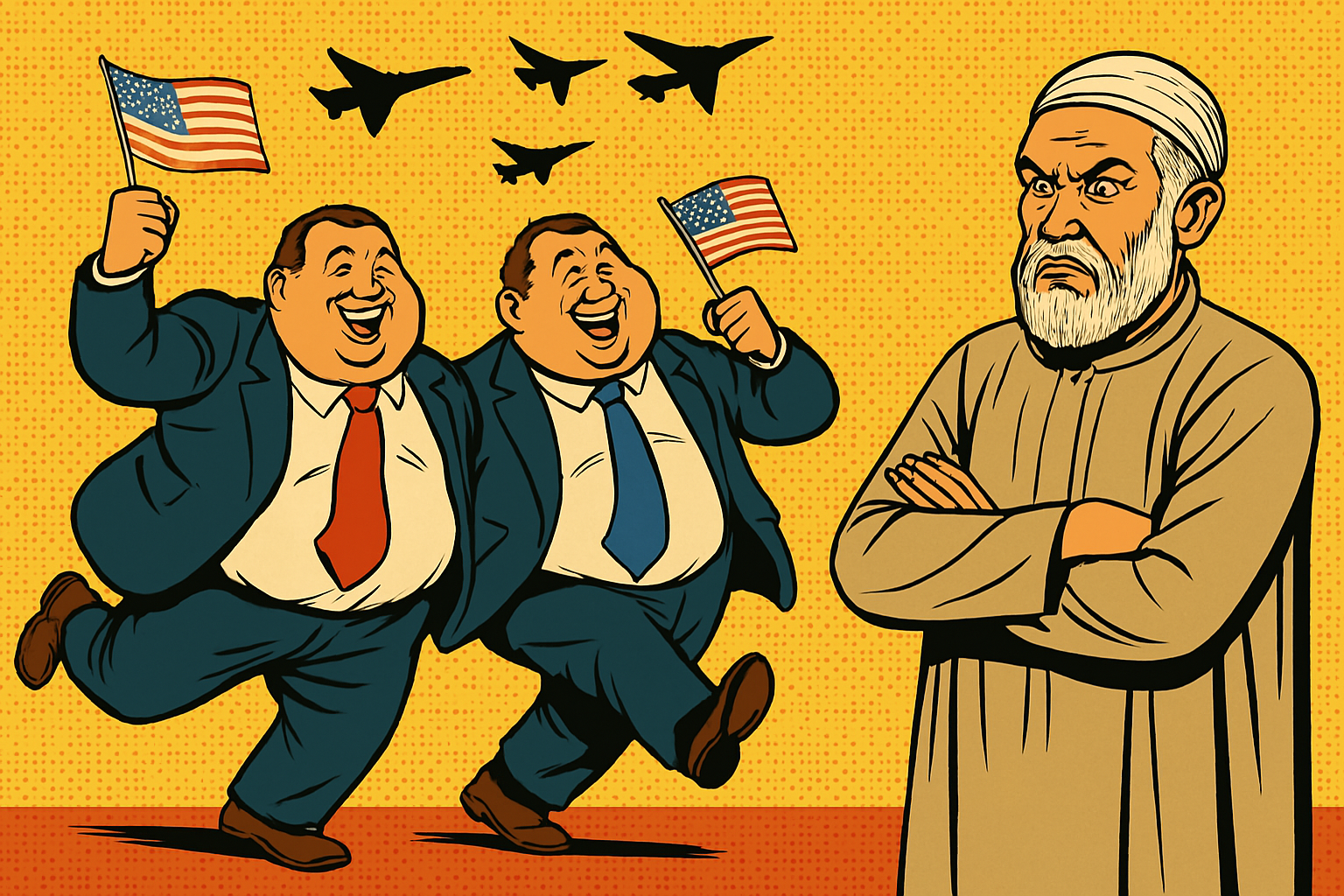
On 5th April 2025, Veterans Today published a brief but sobering report: “US Attack on Iran Imminent.”¹ The headline was direct. It referred to the quiet build-up of American carrier strike groups in the Gulf, the hardening tone from the National Security Council, and what appears to be a deliberate strategy of provocation: impose impossible demands on Iran, then use non-compliance as justification for military action.
That this strategy is being pursued by a legitimate president is not in question. Unlike Joe Biden, Donald Trump fairly won in 2024, but in a country more divided than ever. But the rationale for war remains opaque. Iran has not attacked the United States. No treaty obliges American involvement in the region. Oil markets, though sensitive to disruption, are globally diversified. Why, then, is America—overstretched and socially fragmented—on the verge of launching yet another war in the Middle East?
The current posture of the Trump administration toward Iran is not reactive. It is calculated. In April 2025, investigative journalist Mike Whitney detailed how Trump’s negotiators insisted Iran dismantle its missile program before any diplomatic progress could be made.² Yet Iran’s missiles are neither illegal nor extraordinary. They fall well within the scope of Article 51 of the UN Charter, which affirms every nation’s right to develop conventional weapons for self-defence.
Other stipulations include halting all cooperation with Russia and China, the withdrawal of support for militias in Iraq, Lebanon, Syria, and Yemen, and the dismantling of uranium enrichment facilities that are under IAEA inspection.³ These are not terms for peace; they are conditions for surrender. The demands are absurd, and designed to be refused.
The pattern here is familiar. From Cuba in 1898 to Iraq in 2003, American wars often begin with an ultimatum designed to be rejected. The ensuing conflict is then presented as defensive, even reluctant. In this case, however, the script is showing its age. Iran is not a fragile state. It is a regional power with strategic depth, ideological resilience, and a highly developed doctrine of asymmetrical warfare.
If America were to attack, the first days would likely unfold as predicted by Washington’s hawks: air superiority would be quickly established; radar, missile sites, and known nuclear facilities would be targeted; Revolutionary Guard Corps bases would be struck from land and sea. Iran’s conventional air force and navy would be neutralised within 72 hours.⁴
But such achievements are not victory. They are the beginning of a war that would become unmanageable.
Iran’s response would not follow American assumptions. It would retaliate asymmetrically and globally. The Quds Force, which helped develop the lethal EFP technology used against US forces in Iraq and Afghanistan, has extensive experience in sabotage, insurgency, and targeted assassination.⁵ Its intelligence service, VEVAK, is widely regarded as among the most capable in the Middle East.⁶ Iranian-backed militias in Iraq—the Popular Mobilisation Forces—would attack US bases and supply lines. Hezbollah would open a front against Israel. Oil infrastructure in Saudi Arabia and the UAE would be targeted with drones and cruise missiles.
Iran’s missile arsenal is sophisticated and geographically dispersed. The Emad missile, equipped with a manoeuvrable re-entry vehicle, is designed to evade Aegis and THAAD systems.⁷ The Bavar-373 air defence system, based on an illicitly acquired S-300, is capable of tracking multiple targets across a wide radar spectrum.⁸ Iranian fast boats and mini-submarines, equipped with supercavitating Shkval torpedoes, would threaten shipping through the Strait of Hormuz.⁹
Even one or two successful strikes on US warships would transform the political landscape at home. A large naval loss—or a strike on a US base resulting in hundreds of casualties—could force an escalation the Pentagon is not prepared for. Iran, for its part, has already rehearsed this scenario. It does not plan to win in the field. It plans to make victory impossible for its enemy.
A proper US invasion of Iran would require at least 500,000 ground troops.¹⁰ Iran is three times the size of Iraq and far more mountainous. Its population is over 85 million, the majority of whom are likely to rally behind the state in the event of a foreign invasion. Urban resistance would be fierce. Ambushes in the Zagros Mountains would tie up armoured columns. Suicide attacks, car bombs, and snipers would become daily occurrences. American supply chains stretching from Basra and Kuwait would be vulnerable to near-constant disruption.
The United States would also face a serious legitimacy crisis. Even nominal allies—Turkey, Iraq, and possibly India—might withhold cooperation. Iraq’s parliament has already passed resolutions opposing the use of Iraqi territory for strikes on Iran. Shi’a militias control much of Iraq’s military and internal security forces. Should the US launch an invasion, the entire Iraqi state could collapse, engulfing the region in chaos.
This is not speculation. It is drawn from military simulations, past campaigns, and the testimony of those who have fought in the region. A March 2024 op-ed in The Hill warned that a war with Iran “would be disastrous,” not because of a lack of firepower, but because of unachievable objectives, complex terrain, and the certainty of insurgent resistance.¹¹
Meanwhile, the United States is in no position to fight such a war. The national debt exceeds $36 trillion. Its military remains dependent on a volunteer force that is already strained by recruitment shortfalls. Any serious campaign would require a draft—an unpopular and potentially destabilising move in a deeply polarised society.
Iranian retaliation could extend to cyberattacks on US infrastructure, assassinations of American officials abroad, and even terrorist attacks on US soil. Commentators have speculated—plausibly—about the ease with which Iranian agents could down commercial aircraft, sabotage power grids, or release toxins into municipal water supplies.¹² Iran does not need to win outright. It only needs to ensure that America bleeds, politically and economically.
In the event of war, Iran’s allies would not remain passive. China has already vowed to ignore US sanctions and continue purchasing Iranian oil.¹³ Russia has collaborated with Iran in Syria. Even India might resist US pressure if its energy supplies were threatened. A naval blockade of Iran could trigger a wider confrontation, including in the South China Sea. History offers a grim precedent: America’s embargo of Japanese oil in 1941 helped precipitate Pearl Harbor.¹⁴
The central question remains unanswered: why is the United States—distant, head over heels in debt, domestically unstable—pursuing war with Iran?
The justifications offered are thin. Iran does not threaten American cities. Its military posture is defensive. Its influence in the region is considerable but not hegemonic. If anything, the eagerness for war seems to stem from internal, not external, factors. American elites have become addicted to war. War creates the illusion of unity. It allows the state to posture as decisive. It distracts from economic and political incompetence and the steady erosion of civil trust.
But illusions do not last. The United States could destroy Iran’s army, occupy its cities, and kill its leaders. But Iran is not Iraq. It is not Afghanistan. It is a nation of engineers and guerrillas, of history and honour. It will not be conquered quickly, and it will not be subdued cheaply. A war against Iran would be a war of attrition—military, moral, and economic. It would not restore American strength. It would expose its limits.
Those who speak of easy victory are lying—or worse, deluding themselves. The only winning move is not to play.
Footnotes
- Veterans Today, “US Attack on Iran Imminent,” April 5, 2025.
- Mike Whitney, “Trump Orders Iran to Give Up Its Perfectly Legal Defensive Weapons,” The Unz Review, April 2025.
- Ibid.
- Nairaland Forum, “WW3: USA vs Iran Military,” 2019.
- VT Foreign Policy, “Quds Force and EFPs,” 2024.
- Carnegie Endowment, “Iranian Intelligence Capabilities,” October 2024.
- Defense Update, “Could Tehran’s EMAD Missile Outsmart Israel’s Arrow 3?”
- Ibid.
- Wikipedia, “VA-111 Shkval.”
- Military projections based on 2003 Iraq invasion scale.
- The Hill, “Despite Washington’s Confidence, a US War with Iran Would Be Disastrous,” March 2024.
- Compilation of asymmetric warfare scenarios, VT Foreign Policy.
- Reuters, “China Defiant on Iranian Oil,” May 2019.
- US Naval War College Archives, “Events Leading to the Attack on Pearl Harbor.”
Select Reading List
Carnegie Endowment for International Peace. “Cooperation Between China, Iran, North Korea, and Russia: Current and Potential Future Threats to America.” October 2024. https://carnegieendowment.org
Defense Update. “Could Tehran’s EMAD Missile Outsmart Israel’s Arrow 3?” https://defense-update.com
McCormick, Mitchell, et al. Historical Evidence on Roman and Post-Roman Climate, 100 BC to 800 AD. Harvard University, 2012.
The Hill. “Despite Washington’s Confidence, a US War with Iran Would Be Disastrous.” March 2024. https://thehill.com
Unz Review. Whitney, Mike. “Trump Orders Iran to Give Up Its Perfectly Legal Defensive Weapons.” April 2025. https://www.unz.com
Veterans Today. “US Attack on Iran Imminent.” April 5, 2025. https://vtforeignpolicy.com
Wikipedia. “VA-111 Shkval.” https://en.wikipedia.org/wiki/VA-111_Shkval
Discover more from The Libertarian Alliance
Subscribe to get the latest posts sent to your email.
“A proper US invasion of Iran would require at least 500,000 ground troops.”
Naaaa! The USA will go the “shake and bake” route – the admitted redundancy of bombing these champions of death into the Stone Age.
This article hinges on that false “boots on the ground” premise and one more: The supposition that there does not exist a civilized constituency in Iran robust enough to bury the hate-spewing towel-heads that currently rule them, once a chance is offered.
But make no mistake, the proof of who’s right here will definitely be in the pudding: The USA WILL annihilate every nuclear and nuclear-support facility in Iran because its ally Israel cannot sustain keeping armies in the field forever. There has been merely a prudent delay because, with Trump’s tariff upheaval, the resulting spike in oil prices following the strike would have plunged the entire West into recession. Early October, bombs away!