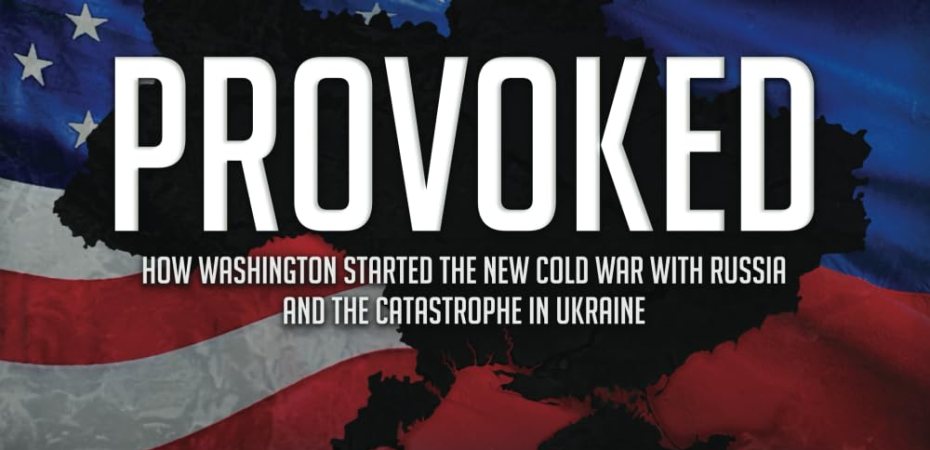
Provoked: How Washington Started the New Cold War with Russia and the Catastrophe in Ukraine,
Scott Horton, The Libertarian Institute, 21 November 2024; ISBN: 978-1733647373
If you only read the headlines, you’d think Russia woke up one day in 2022 and decided to invade Ukraine for fun. But in Provoked, Scott Horton lays out how that’s not remotely true. He argues that Washington spent decades pushing Russia into a corner, breaking promises, meddling in Ukraine, and setting the stage for a war that could have been avoided. This isn’t some wild theory—it’s backed up by over 7,000 sources, making it impossible to dismiss as just another take.
Horton starts with the end of the Cold War, when Russia was actually open to working with the West. Instead of welcoming them in, America treated them like a defeated enemy. NATO, which was supposed to be pointless after the Soviet Union collapsed, kept expanding right up to Russia’s borders. Then came the 2014 coup in Ukraine, where America and its allies helped topple the government and replace it with one friendly to the West. Russia saw this as a direct threat—because it was.
By the time 2022 rolled around, it wasn’t a question of if there would be war, but when. The U.S. had built a time bomb in Ukraine, and eventually, it went off.
At the heart of this disaster is the neoconservative movement—an unelected, unaccountable group of foreign policy “experts” who have been wrong about every war for the last 30 years but keep failing upwards. These are the same people who pushed for Iraq, who said Libya would be better off after Gaddafi, and who still pretend Afghanistan was a success right up until the Taliban walked back into Kabul. They claim to spread democracy, but what they actually spread is chaos.
Horton rips into how these people hijack Western foreign policy, making sure America is always involved in some war or another. They don’t care who gets hurt, because they never do. They sit in Washington think tanks, writing reports that get turned into actual government policy, all while pretending their track record isn’t a complete joke. And now, they’re setting their sights on China, using the exact same tactics that led to the Ukraine disaster.
The people who profit from these wars aren’t ordinary Americans or Europeans. They’re the elites who turn war into a business model. Every crisis is just another opportunity for military contractors, banks, and the bureaucrats who shuffle between government jobs and lobbying firms. The same people who scream about “Russian aggression” had no problem bombing Iraq into the Stone Age or wrecking Syria.
The reality is, this isn’t about protecting democracy. It’s about protecting a global order where the same tiny group of people controls everything. They don’t want independent nations. They want an empire run by bankers, bureaucrats, and corporate parasites who skim wealth off the top while the rest of us get left with the consequences—economic collapse, migration crises, and the constant risk of an actual nuclear war.
What makes Provoked so important is that it isn’t just another book complaining about the war. It’s a forensic breakdown of how we got here, written by someone who actually understands foreign policy instead of just repeating propaganda. Horton doesn’t excuse Russia, but he makes it clear that this war didn’t happen in a vacuum. It was built, step by step, by a Western elite that thrives on endless conflict.
And if they aren’t stopped, Ukraine won’t be the last disaster they create. These people are already laying the groundwork for war with China. If they get their way, the 21st century will be one long, pointless conflict that benefits no one except the same parasites who have been running things since the Cold War.
If you want to understand what’s really happening—not just the PR version—Provoked is essential reading.
Discover more from The Libertarian Alliance
Subscribe to get the latest posts sent to your email.
The neoconservatives! When they first rose to prominence, the Trotskyite origins of the movement attracted much comment. But class and economics never seemed to interest them. They were not right wing because they never had been left wing (and for that reason they had a very poor grasp of political motive). The numerous Jews among them were a familiar type: semi-orthodox pseudointellectuals more akin to Velikovsky than von Mises. There was never anything to them. Then their hour came: the first terrible hour of 911 when it might have been World War Three. Suddenly, cranks found willing ears.
And my point is this. When I was Mr Wang’s age, I spent too much time trying to imagine recent events which I did not remember. Now, after forty odd years of cabinet resignations, stock exchange crashes, political scandals and snap elections I know that very few of the people in charge rise above the intellecual level of Rachel Reeves, and the same is true of their advisers. Perhaps Mr Wang should spend more time on Platonism and less on Alcibiadism.