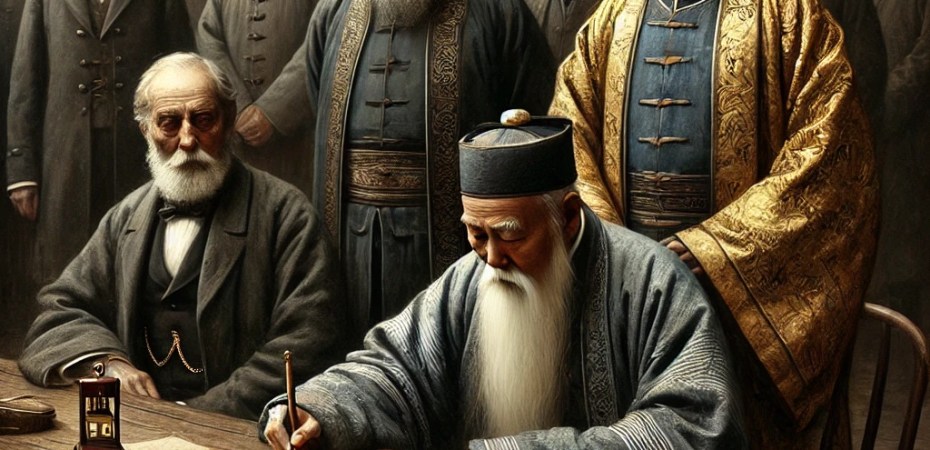
Though largely forgotten in the country that won it, the First Opium War (1839–1842) was as much a war that shaped the modern world as the more glamorous duel with Napoleon. It was the collision of two civilisations—one industrial and liberalising, the other agrarian and tradition-bound—each convinced of its own superiority. At stake was more than commerce: it was about sovereignty and the emerging global order. For Britain, the war marked the enforcement of free trade principles abroad. For China, it inaugurated the “Century of Humiliation”—a term still used today in political discourse and school curricula.
It is essential to begin with a key fact too often glossed over: opium was legal in Britain at the time. Sold in chemist shops as laudanum, administered as a painkiller to children and adults alike, and regulated only for quality, opium was treated as a commonplace medicinal substance. As the Quarterly Review noted in 1839, “It is not within our custom to moralise upon commerce; a thing is not made infamous by its use in Asia if it be tolerated in London.”1 The drug’s legality at home explains why it was treated by British merchants as an ordinary trade good abroad.
Chinese trade policy in the late 18th and early 19th centuries reflected a blend of ancient cosmology and pragmatic control. Under the Canton System, all foreign trade was restricted to the single port of Guangzhou and conducted through a guild of officially licensed Chinese merchants known as the Cohong. Foreigners were not permitted to reside permanently or travel inland. From the Qing perspective, this was not arrogance but stability. As the Emperor Qianlong famously told George III in 1793:
We possess all things. I set no value on objects strange or ingenious, and have no use for your country’s manufactures.2
While Britain’s demand for Chinese goods—tea, silk, and porcelain—increased, Chinese demand for British goods remained minimal. With no reciprocal market, the East India Company and its successors were forced to pay for Chinese exports in silver, leading to a chronic trade imbalance.
Opium, produced in British-controlled India, provided a solution. Though illegal under Chinese law since 1729, it was purchased with enthusiasm by Chinese smugglers. Sales of opium allowed British traders to acquire Chinese goods without exporting silver. The profits from this triangular trade were immense. As one British merchant boasted in a private letter from 1836, “Our Indian poppy finds more favour than Her Majesty’s woollens.”3
By 1838, an estimated 40,000 chests of opium—each weighing around 140 pounds—were entering China annually. Lin Zexu, the imperial commissioner appointed to suppress the trade, saw both the health consequences and the broader threat to Chinese sovereignty. In a now-famous letter to Queen Victoria, Lin wrote:
Surely you do not wish to make your own people suffer from opium… how then can you bear to profit by such means from the people of China?4
When Lin confiscated and destroyed 20,000 chests of British-owned opium in 1839, the conflict became unavoidable.
Britain’s war strategy was swift and effective. Industrialisation had given it modern naval firepower and steam-powered vessels like the HMS Nemesis. Chinese forces, though brave and often individually skilled, were poorly coordinated and technologically inferior. As the Times observed in 1842:
The Chinese fight with the courage of desperation but the tools of antiquity. They are not so much outgunned as out-centuried.5
The British targeted key coastal cities and river ports, blockading Guangzhou and eventually capturing the vital city of Zhenjiang. Battles at Chuanbi, Kowloon, and the Yangzi campaign highlighted the stark mismatch between Qing defences and British firepower.
Qing officials frequently misreported defeats as victories. Emperor Daoguang was led to believe the war was winnable long after British troops had taken critical cities. By August 1842, the Treaty of Nanjing was signed aboard the HMS Cornwallis, bringing the war to a formal end.
The terms were devastating to China:
- Cession of Hong Kong to Britain.
- Payment of a £21 million indemnity.
- Opening of five ports to foreign trade: Guangzhou, Shanghai, Ningbo, Xiamen, and Fuzhou.
- Abolition of the Cohong monopoly.
- Granting of extraterritorial rights to British subjects.
No clause addressed opium. The trade, while not officially legalised, continued and expanded.
The psychological effect of defeat was as profound as the material loss. For millennia, China had seen itself as the “Middle Kingdom”—the civilised heart of the world. To be beaten by a maritime power from a distant island challenged not only China’s geopolitical position but its cosmology.
Subsequent defeats—the Second Opium War, the loss to Japan in 1895, and the Boxer Protocol—only deepened the trauma. As Sun Yat-sen later lamented:
China is a vast nation with a proud past, now reduced to a playground for foreign devils.6
The Opium War thus became the symbolic origin of national decline. In the modern People’s Republic, the war is taught not simply as a military conflict but as a moral lesson: a warning against complacency and weakness.
Today, Chinese leaders invoke the memory of 1839 to justify assertive policies. In 2010, Foreign Minister Yang Jiechi famously remarked:
China is no longer the China of old, bullied by foreign powers.”
This memory shapes China’s dealings with Britain, whose historic role remains part of the background in every diplomatic exchange.
The First Opium War began because one power believed it could impose its commercial model on another. The tables may now be turning. Britain in the nineteenth century was energetic and confident. It had sound money, low taxes, and a small but effective state. Trade flourished because government, for the most part, did not interfere.
Today’s Britain bears little resemblance to that older country. The state now accounts for nearly half of all GDP. The currency is increasingly worthless, pushed down by government debt and its monetisation, and by a private monetary expansion that almost no one understands. Productivity is stagnant; competitiveness declines year by year. What Britain once was to China—an advancing, confident power—China now is to Britain.
If the roles of 1842 are not to reverse entirely, Britain must take urgent steps. These do not begin with slogans or diplomatic bluster, but with serious internal reform:
- Reduce the size and scope of government.
- Restore fiscal discipline and end inflationary policy.
- Rebuild productive industry and encourage capital formation.
- Reform education to foster competence, not conformity.
The alternative is grim. Britain risks becoming the same sort of soft, bloated empire that the Qing dynasty became—proud, inward-looking, and unable to respond when real challenges arrive. If it is not to suffer its own Century of Humiliation, it must cease imitating the weaknesses of those it once defeated.
Selected Reading List
- Fay, Peter Ward. The Opium War 1840–1842. University of North Carolina Press, 2000.
- Hevia, James. Opium, Empire and the Modern World. Duke University Press, 2003.
- Lovell, Julia. The Opium War: Drugs, Dreams and the Making of China. Picador, 2011.
- Spence, Jonathan D. The Search for Modern China. W.W. Norton, 1999.
- Perdue, Peter C. China Marches West: The Qing Conquest of Central Eurasia. Harvard University Press, 2005.
- Lin Zexu, Letter to Queen Victoria (1839), translated in Teng & Fairbank, China’s Response to the West. Harvard University Press.
- Martin, Robert Montgomery. China: Political, Commercial, and Social. London: John Madden & Co., 1847.
- Gelber, Harry. Opium, Soldiers and Evangelicals: Britain’s 1840–42 War with China and its Aftermath. Palgrave Macmillan, 2004.
Endnotes
- Quarterly Review, Vol. 64 (1839), p. 47. ↩
- Emperor Qianlong, letter to King George III (1793), in J.L. Cranmer-Byng (ed.), An Embassy to China, p. 337. ↩
- Private correspondence, Jardine Matheson archives, 1836, quoted in Gelber (2004), p. 88. ↩
- Lin Zexu, Letter to Queen Victoria, 1839, trans. Teng & Fairbank, in China’s Response to the West, p. 18. ↩
- The Times, 3 September 1842. ↩
- Sun Yat-sen, quoted in Spence, The Search for Modern China, p. 232. ↩

Discover more from The Libertarian Alliance
Subscribe to get the latest posts sent to your email.