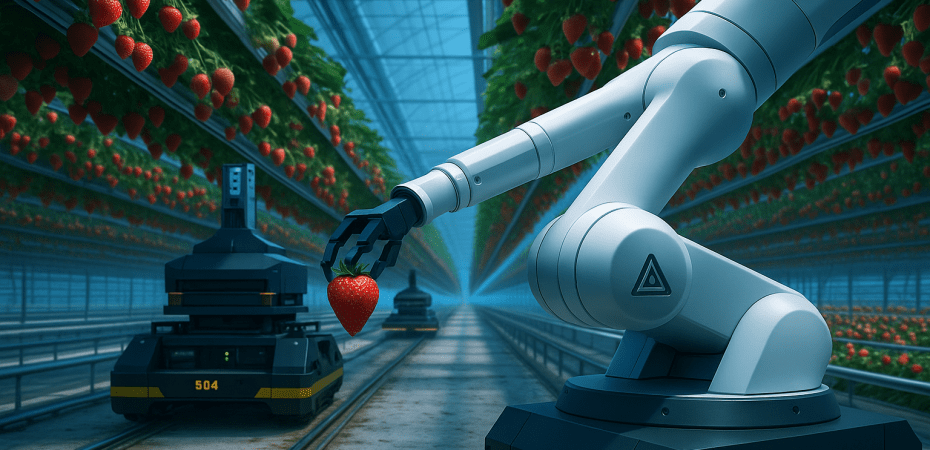
Here, for once, is an inspiring story from The Daily Telegraph:
Strawberry-harvesting robots could spell the end for Britain’s foreign fruit pickers, experts have suggested.
The latest range of robots can pick 200kg of strawberries a day, about the same as a human, using cameras to detect when the fruit is ripe.
Such technology is expected to bring an end to Britain’s dependence on the tens of thousands of seasonal workers who arrive each spring to harvest fruit and vegetables.
Dogtooth Technologies, a Cambridge-based start-up which displayed its fifth-generation strawberry-picking robot at the RHS Chelsea Flower Show this week, is expecting record sales this year.
Dr Duncan Robertson, its co-founder and chief executive, told The Telegraph: “It is becoming harder and harder to recruit enough labour and so we’re forced to import it from further and further afield.
“If you look at the cost of employing people for harvest, it’s gone up and up and up. Suddenly robots are beginning to look quite appealing, and not just as a piece of future science fiction.” (“Strawberry-picking robot could spell end of need for foreign fruit workers,” The Daily Telegraph, 24th May 2025)
The machine has been developed by Dogtooth Technologies, a company based in Cambridgeshire. The arrival of British-built agribots capable of working “day and night without stopping” is the best news of the week. It is a glimpse into the only kind of future that a civilised people should desire: one where machines do the work, and people are spared the squalor of bending over in the rain to fill boxes with low-margin fruit. I will go further: any job that can be done by a machine, should be. And any country that can build such machines, should rejoice.
For millennia, the whole tendency of economic life—slow at times, even in reverse at others, though always forward in the long term—has been to liberate human beings from drudgery. The plough ended the backbreaking toil of the hoe. The threshing machine freed us from flailing grain by hand. The combine harvester did away with entire armies of seasonal workers. And now, the strawberry-picking robot promises to end a practice that is miserable, and—most tellingly—almost entirely nowadays dependent on imported labour. A shortage of human labour is precisely the spur that drives investment in labour-saving machinery. And once the machines exist, they do not just fill the gap. They improve the terms of trade for everyone not stuck doing manual work.
A robot does not need to sleep. It does not need subsidised housing. It does not complain of racism, organise strikes, or grope the strawberries. It costs money to build, yes—but it does not need a new visa every year. More importantly, the productivity it brings lowers the unit cost of every strawberry. It allows for more abundant production, at lower prices, with no additional burden on the welfare state or the criminal justice system. For all the talk of mass immigration “doing the jobs Brits won’t do,” the truth is that there is no job so essential that it cannot eventually be done by a machine.
This, of course, brings us to the broader point. As I argued in my earlier article on artificial intelligence, automation is not a threat to prosperity. It is the very condition of prosperity. It is what transforms a society from one where ninety percent of the people labour to feed the other ten, into one where the great mass of the population can afford to live as leisured gentlemen—if they choose to.
There is a false and endlessly repeated cliché that automation destroys jobs. It does no such thing. It destroys some jobs, often the worst ones, and replaces them with others—often better paid and more dignified. But even if it did not replace them, the truth would still stand: work is not an end in itself. The goal of civilisation is not full employment, but full enjoyment. If a robot can do your job better and cheaper, you should not mourn the loss. You should thank God that you are now free to do something else—ideally, something more profitable or more pleasant.
I have said before that most fears of automation are built on the bad economics of Plutonia—the fantasy land in which all human demand vanishes as soon as a machine takes over a task. In the real world, cheaper strawberries mean more strawberries bought. And the money not spent on picking them is spent elsewhere, creating new demand, and thus new employment. Indeed, it is only in the idiotic Keynesian world of the Treasury that destroying work is seen as a net loss.
There is also the moral benefit of removing human labour from the lowest strata of the workplace. I do not wish to see another news report about a Romanian woman living in a Portakabin and picking fruit for twelve hours a day in a field of Kent. Nor do I wish to be told that she is contributing to the British economy. She is not. She is contributing to the continued downward pressure on wages, the inflation of the housing market, and the steady erosion of the national culture. If a machine can do her job, let the machine have it.
This also applies to British workers. One of the best arguments for automation is that it removes the temptation to fill our countryside with sprawling encampments of seasonal labour. That alone would justify any investment. But it also means that our own people—those who might otherwise be forced into such work—can do something better. If we had a functioning education system, they might even be taught to design the next generation of robots.
A further point: every technological breakthrough that removes the need for low-skilled labour chips away at the great lie used to justify open borders. We are constantly told that Britain needs immigration because it cannot function without cheap foreign workers. That was never true, and it is even less true now. Robots do not claim asylum. They do not radicalise in mosques. They do not take over town centres and demand halal meat in every school canteen. They just do the job, and then shut down until tomorrow.
This is not just an economic fact—it is a political weapon. Every British-designed robot that replaces ten imported strawberry-pickers is a small blow against the coalition of bureaucrats, NGOs, and limp-wristed conservatives, and malevolent leftists who have built their careers on the pretence of necessity. Let us celebrate the arrival of these machines not just as an industrial innovation, but as a form of national self-defence.
What lies ahead, if we choose rightly, is a society in which food is grown, harvested, packaged, and delivered with minimal human input. Where every process from planting to pruning to picking is done by a machine, operating continuously, faultlessly, and cheaply. Where the cost of producing the necessities of life continues to fall, and the surplus generated can be spent on higher things.
It is a future where ordinary people live better than kings once lived. And not because they “worked hard,” or “earned it,” but because machines did the heavy lifting. As I wrote elsewhere, there may come a time when the worst-paid man in Britain eats better and lives more comfortably than the average middle manager of the 2020s.
That will not happen through subsidy. It will not happen through the minimum wage or green investment. It will happen through technology—British technology, designed by engineers and applied by capitalists. And it will happen in direct proportion to our willingness to ignore the wails of the egalitarians and the romantic nostalgists who want us all back in the fields with a wicker basket and a public sector pension.
So let the strawberries be picked by robots. Let the lorries drive themselves. Let the factories run on code. Every job replaced is a step towards a society in which work is optional, not mandatory. And if we get there quickly enough, we might even outrun the bureaucrats who would regulate it all out of existence.
For once, The Telegraph has got it right. But it should have gone further. This is not the end of fruit-picking as we know it. It is the beginning of something far better: a future where British minds build the machines, British farms run without foreign labour, and the British people are finally freed from the lie that toil is their highest calling.
Discover more from The Libertarian Alliance
Subscribe to get the latest posts sent to your email.
Brilliant essay. There’s little else to say except to express the hope that some influential person reads it and takes heed.
This story might be a good trigger to help the public separate robots from AI in their minds. Robots take drudgery away from humans. Whereas AI tries to imitate humans. Robots are benign to humanity (except if they go wrong), while AI is dangerous to humanity because of the likelihood of its mis-application. To mis-quote Orwell, robots good, AI bad.
It always amuses and baffles me in equal measure, when a product is described as “hand-made”. In most cases, machines can do the work required with greater accuracy, consistency, and speed, than all but the most skilled human operatives. Unfortunately for us, the Chinese appear to worked this out.