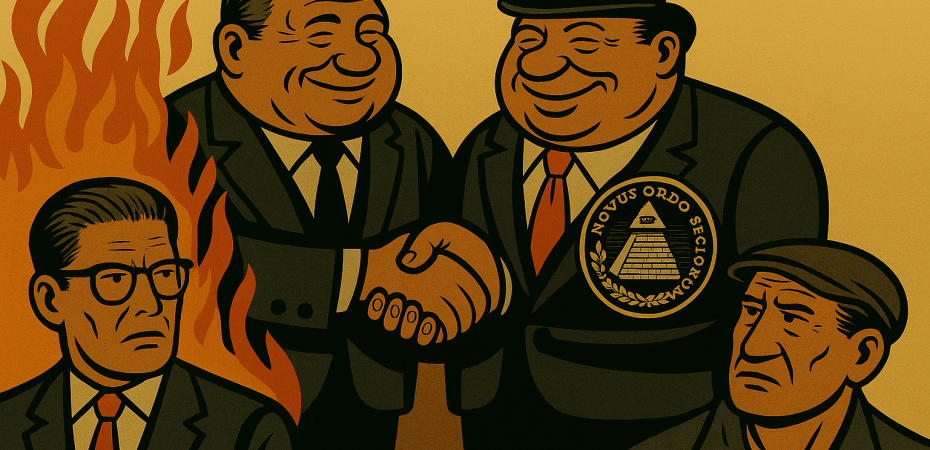
Various American news sources are filled with speculation about the attempted burning of Keir Starmer’s house. I find much of this entirely credible, but do not choose to discuss it. I live in a police state where comment out of turn is dangerous. It is also a place where the news media is closely censored. This makes whatever it is allowed to report increasingly worthless, except as a reminder of what we are not allowed to know or discuss. For those who are interested, not in the probable facts of the matter, but in the scale of British State censorship, here is a summary of all that we are allowed to know about the fires.
But it is in the dim light of this that I turn to a discussion of something that has been allowed into the media. The British newspapers are presently crying up a set of claims by Dominic Cummings that the Reform Party may win the next general election, and that Nigel Farage will be the next Prime Minister. See, for example, GB News on 28 May 2025:
Ex-Vote Leave mastermind Dominic Cummings has predicted Nigel Farage could become Prime Minister but insists the Reform UK leader must listen to his advice if he wants to win the keys to No10.
He suggested that with a new leader and support from himself and others, Reform could remain the leading party in the opinion polls:
If he does what I’m suggesting, and actually sets out a path for how Reform is going to change, how Reform is going to bring in people, how it’s structurally going to alter, what it’s going to build, how it is going to do policy, how it can recruit MPs, etc.
I will not take issue with these claims. Mr Cummings is too intelligent to speak plainly. His predictions are all in the subjunctive—conditioned on the assumption that the Reform Party will take his advice. That the British media has reported these as statements of intent is predictable. The duller sections of our press can never distinguish a conditional clause from a promise. As ever, what is offered as an invitation to thought is paraded as the inevitable.
What I will say instead is that Labour will win the next election. It will win not because it deserves to win, or because anyone much wants it to win, but because it is the only viable governing instrument presently available. If it continues to misread the shifting priorities of the ruling class, its current leaders will be replaced. But the apparatus will remain in place. Labour has time to learn. Its opponents have no time and no capacity.
To explain my confidence in this claim, I will once again describe the basic structure of power in modern Britain. There is no democracy in the meaningful sense. Parliament is not the seat of power. Elections do not determine direction. The contest between Labour and the Conservatives is not a battle of philosophies but a job interview conducted within the parameters of elite consent. Britain is ruled in layers.
At the top is the monied interest—a consortium of bankers, lawyers, asset managers, and global speculators whose primary instrument is the City of London. These people do not attend hustings or canvass in Croydon. They sit in Zurich and Dubai. Their wealth does not come from producing anything but from managing decline: shorting currencies, selling debt, arbitraging chaos. They do not rule directly. They shape outcomes. They underwrite them. And they expect a return.
Below them comes the governing class: the politicians, bureaucrats, regulators, quangocrats, media managers and other certified mediocrities who translate oligarchic preference into usable law. They do not invent policy. They interpret signals. Their main skill is knowing how to adapt in place. Beneath these come the client groups—the NGOs, activist networks, university departments, trade unions, and subsidised corporations who provide legitimacy in exchange for funding. These serve as a reservoir of ideological noise. They generate crises to justify interventions. They provide personnel and cover for the decisions made above. They are the moral camouflage of the regime. They bark on command and retreat on cue. Together they form an authoritarian mass that administers decline in exchange for salaries and pensions.
This structure has held since at least the 1980s, and its ends have been to make Britain user-friendly as a base for a monied interest that has less concern for the long-term progress of the country than I have for the size of the Great Red Spot on Jupiter. Its achievements have been:
- The empowerment of managers: Bureaucratic power has been placed in the hands of an obedient caste of credentialled cretins. These are not entrepreneurs. They are not thinkers. They are the sorts of people who used to be assistant librarians, now given regulatory dominion over vast sectors of public life. What legitimising ideologies these people take up is less important than that they are used to scare people out of thinking and acting for themselves.
- The encouragement of disintegration: Immigration is promoted not for humanitarian reasons, but because it pulverises solidarity. It renders national resistance incoherent. To repeat, the ideologies attached to it—equity, inclusion, pride—are disposable. What matters is that the native population is demoralised and divided.
- The liquidation of industry: A country with factories must also have men. Men cause problems. They form unions. They remember their fathers. They know what things cost to make. Better a country of data analysts and Deliveroo riders than one with coal and steel. It may be that Britain has lost certain comparative advantages it held after 1750: the total collapse of industry was a designed outcome.
That was the old strategy. It was successful for a time. But it has begun to fail. The expectation was that China would remain a vast sweatshop under Western financial control. Instead, it has become a rival centre of capital accumulation. Worse, it has become a laboratory of competent authoritarianism. The attempt to smack China down by breaking Russia has failed. Sanctions have wounded Europe. NATO has shown itself to be technologically backward. The British Government dare not try conscripting its own people for a serious war. The fixed idea after 1991 was that every part of the world could be covered with the inlets of so many feeding tubes, all sucking wealth towards a globalised elite that just happened to have its headquarter buildings on the same planet as the rest of us. Borders and national loyalties were an impediment to the extraction. That fixed idea has now collapsed, and must be put off until after victory in a new cold war against the uncooperative.
For this reason, there has been a falling-out within the ruling class, and the more realistic faction appears to have won. The main strategy has not changed—perpetual global dominance as a rent-extracting oligarchy—but the tactics are changing. The winners in the dispute understand that to maintain their power, the host body must be kept alive. You cannot steal from those who turn out to be armed without weapons of your own; and rent-enforcement armies cannot be recruited from men who have been told since childhood that they are evil, or convinced to castrate themselves in the name of personal growth. The faction now fronted in America by a repurposed Donald Trump knows that the West must be made strong again—not for the sake of its people, but so it can continue to serve as the enforcement arm of the New World Order. They want an end to the green policies that are abolishing industry. they want to slow the demographic collapse of their own two-legged livestock. They want to ensure that the young males will once again be willing to fight and die when commanded.
It is, in short, Glasnost and Perestroika all over again—a tactical liberalisation designed not to overthrow the system, but to save it from its own excesses.
Now, what does this mean for Labour? It means a recalibration. The present ministers must begin, as a minimum, to do these things:
- Cut public spending and then taxes
- Abandon immigration as a tool of national policy
- Scrap net zero policies that make energy unaffordable
- Rebuild some part of the industrial base
- Give people back at least the appearance of free speech and political diversity
If they do not do these things, they will be dismissed. They will be dismissed by scandals and by career attrition. The civil service will play its part. The media will assist. In due course, a new team will emerge. But the party label will remain. It will remain because the Conservatives are finished.
Since I used to know many of the private enablers of the Conservative record for 2010-24, I can speak with some authority on the scale of the moral collapse, though I suppose I should forbear. These were and remain contemptible people—not so much men as a cast of grotesques. They were the low-level trash in the Conservative Party—the mob of fixers and middlemen essential to modern government. But the public face of Conservative government was bad enough. Every election victory was followed by greater betrayal. The Conservative leaders mouthed liberty while completing the leftist police state. They preached economic prudence while printing and taxing and borrowing on a combined scale never before seen. They promised to leave the European Union, while trying their best not to. At last, they gave us two years of biosecurity dictatorship, complete with semi-compulsory and almost certainly dangerous vaccines.
The only surprise of the 2024 election was that the Conservatives were shattered, rather than obliterated. But they have done nothing since then to recover. They have not provoked the hatred of their former voters: hatred is compatible with unwilling admiration. They have provoked their disgust. Thinking of the Conservatives, I am reminded of a story I once read in the correspondence of Machiavelli. Cesare Borgia had sex in the dark with a prostitute. Afterwards, a lamp was brought, and he saw that she was a diseased and shrivelled crone. He vomited on her. That the Conservatives can be brought back to replace Labour is probably unthinkable.
This brings me to the political fantasy that is Reform UK. It is a fantasy because it does not exist in any operational sense. It is not a party. It is a pressure group with a Twitter account. It offers nothing but slogans wrapped about a personality cult. Nigel Farage’s involvement in Reform UK is sporadic, and his interest appears tactical. He has never demonstrated an ability—or perhaps a desire—to build a party fit for government. He has created no clear chain of command, no embedded local structures, no evidence of competent policy development. His policies, such as they are, mean nothing. He says he wants lower taxes—but refuses to specify what he would cut. He says he wants national renewal—but will not touch the City institutions, or the courts, or the universities. What he offers is Thatcherism with angry emojis. He presides over a cargo cult of 1980s politics, lacking both the discipline and the courage of its supposed inspiration. His party will win more votes, perhaps a few more seats, and then collapse under the weight of its own vacuity. The status quo will remain.
Therefore, Labour will win. It will win even if it bleeds votes on every side. It will win because that is the nature of elections: someone has to come first. The task of government must go on. And in the absence of competition, the ruling class will make do with a reshaped Labour Party. It has always preferred Labour any way. The old party of workers has long been the party of functionaries. Its leaders do not think. They comply.
This is why the Starmer Government’s recent conduct has been so irritating to the now-dominant faction of the ruling class. The decision to abandon the grooming inquiries was not merely wicked—it was stupid. The entire structure of power is now leaning away from multicultural indulgence. A smarter party would have seen the opportunity to hold a purge. The inquiries could have served as theatre. Some lesser functionaries could have been sacrificed. The victims could have been mourned. The regime could have washed its hands. Instead, silence, protection of the guilty, fear of alienating the Moslem vote in a handful of Northern seats. It was the sort of mistake one expects from people who have never understood the system they serve.
And so, the cull will begin—not of the regime, but of those in it who have failed to keep pace. The Labour Party will remain in office. But the faces will change. The slogans will change. The policies will adapt. This is not because the public wants it. The public has no voice. But because the ruling class requires it.
And, if you spend as much time looking at disapproved American news sources as I do, this may explain why those Ukrainian “male models” were allowed to get as close as they did with their boxes of matches.

Discover more from The Libertarian Alliance
Subscribe to get the latest posts sent to your email.
Could you please provide links to the American news articles cited so we can learn for ourselves?
I just don’t understand what they are trying to achieve with these actions
Do your own research. Probably get a VPN first.
A persuasive thesis but I’m not sure it holds up. You may be proved right but it seems to me that Reform is a fundamental shift. They have more than a Twitter account. They have established a significant foothold in local government with a much more solid basis than the BNP two decades ago.
[…] let me start with a review of Alan Bickley’s recent essay, The Fire Under Keir Starmer. What I like about this is it stands out in a sea of empty commentary for its intelligence […]
[…] June this year, I wrote The Fire under Keir Starmer and Why Labour Will Win the Next Election. In this, I argued: the ruling class had tired of the Conservatives; their corruption and […]
[…] purpose now is to explain why those forces are turning—to restate, once more and without apology, the structure of power in Britain, and why the system that has governed us since 1945 has begun to go unstable. I will also suggest […]
[…] I wrote The Fire under Keir Starmer last year, I argued that Mr Starmer’s political future depended much less on public opinion than […]