My friend Sebastian Wang has asked if I am capable of writing anything that does not show what he calls an “excessive self-regard” or a wish for most of the boys in my class to die and to suffer horribly before they do. I find his question hyperbolic. Undoubtedly, I am pleased with my appearance and abilities. But who would not be if he were me? I also do believe that the national gene pool would be much improved if the fat slugs about me were not in it. But yes—I am fully capable of controlling my vanity and intemperacy. Sebastian only needs to look at my archive on this site to remind himself what else I can do. Nevertheless, here is one of my A-Level essays. It contains not a word that is either vain or intemperate. It is also more relevant to a libertarian site than much of what the pair of us write. So here are my thoughts on to what extent history can be made a science. (BM)
Can History Be Made into a Science?
Bryan Mercadente
The question asked is as much philosophical as it is methodological. It asks what kind of knowledge history offers, and whether this knowledge can ever be held to the same standard as physics or chemistry. My general answer is that it cannot. Even so, there are ways in which history can advance beyond guesswork and wishful thinking, in terms both of narrative accuracy and of causal connections, towards the highly probable.
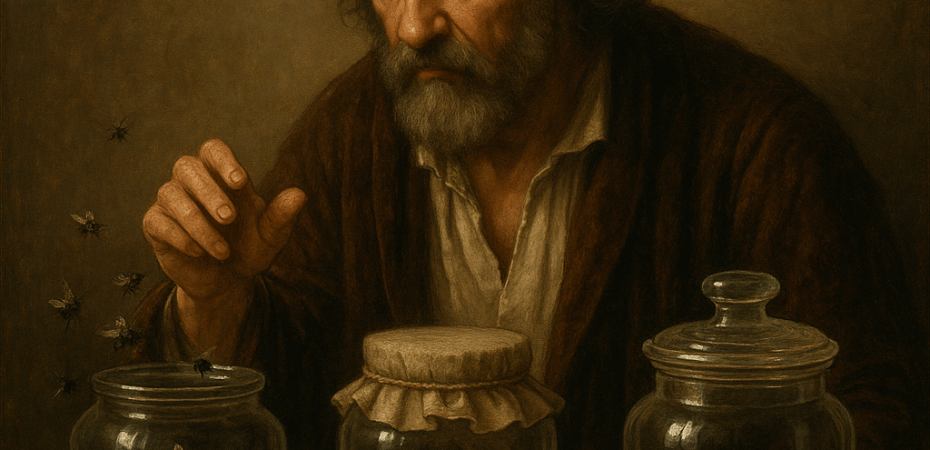
In most people’s minds, “science” means experiment. The ideal scientific process is one in which a hypothesis can be tested, falsified, and—if successful—replicated under similar conditions. The Italian physician Francesco Redi provides a classic case. In 1668, he set out to challenge the long-standing theory of spontaneous generation, used since the pre-Socratics to explain why flies appeared around rotting meat: that they were created by some vital force from the heat of putrefaction. He placed meat in various jars—some open, some sealed, and some covered with fine gauze. Maggots only appeared in the uncovered jars. The conclusion? Flies do not come from meat. They probably come from eggs laid by other flies—an alternative hypothesis that was then supported by using early microscopes to see what had not so far been visible.
What made this experiment so convincing was not the cleverness of the design, but its testability. Anyone with jars and meat could repeat it. He would get the same result. Here was a hypothesis that could be tested over and over again, and so accepted or discarded according to evidence. This is the model of empirical reasoning: hypothesis, control, testing, replication, modification, prediction. But history is not meat in a jar. It’s both complex, and non-repeatable.
The most obvious reason history cannot be an experimental science is that its subject matter—human events—is unrepeatable. You cannot re-run the French Revolution, varying only the character of Louis XVI, or leaving out the Icelandic volcano, to see what difference it makes. There is no controlled environment in which to isolate the effect of Enlightenment pamphleteers from the effect of grain prices. The past, once gone, does not return for retesting.
Add to this problem of unrepeatability the nature of the data. If I want to repeat the Redi test for spontaneous generation, I not only control all the variables: I also know what they are. I am fully aware of all facts touching the experiment. If I overlook anything, it may still come to my notice in a repeat of the experiment. Where history is concerned, this degree of knowledge is simply not possible. It is the nature of matter to behave predictably. In human affairs, motivations are obscure, outcomes are tangled, every event resists or denies simplification. That is when we believe we have the facts. But, in history, the facts themselves are a problem. For the ancient world, which is my main area of interest, and even of expertise, what remains is little more than fragments. More than ninety per cent of everything written and preserved at the time has vanished. Indeed, much of the sort of material we take for granted in historical research was never gathered and written down at the time. The literary fragments all show various kinds of bias, often amounting to falsification. The non-literary evidence is also fragmentary. Everything that has survived of whatever kind has survived largely at random. For the modern period, there is the opposite problem: the material can fill miles of shelving, and no one can read it all, let alone digest it.
This does not make history unknowable, or a matter of personal taste. But it does mean that the collection and treatment of evidence must follow different methods from those of the experimental sciences. One of these is the comparative method. While we cannot re-run events, we can compare similar events in different contexts to see what they have in common.
As an example of this, I will give the work of Crane Brinton. In his 1938 book The Anatomy of Revolution. He asked a simple but difficult question: what causes revolutions? To answer it, he looked not at one revolution, but at four—the English (1640s), the American (1770s), the French (1789), and the Russian (1917). He reasoned that, if these revolutions were similar in structure, cause, and course, then perhaps a general pattern could be identified. He concluded that revolutions tend to follow a predictable sequence: a build-up of social tension, a breakdown of state authority, a moderate phase, a radical phase, a reign of terror, and then—often—a restoration. He likened it to a fever: a symptom of disease, a violent crisis, and then recovery.
In more detailed summary, Brinton’s theory unfolds in six distinct stages, each of which captures something recurring and recognisable in revolutionary dynamics:
- Symptoms and Warning Signs: Before the outbreak, revolutions simmer. Brinton identified economic strain, social inequality, ineffective leadership, and growing intellectual dissent as preconditions. These were present in all four revolutions. The ancien régime doesn’t collapse by accident—it rots before it falls.
- The Moderate Stage: The initial overthrow is usually carried out by moderates who do not want chaos. In England, this was Parliament’s assertion over the King; in France, the National Assembly; in Russia, the Provisional Government. They promise reform without destruction, but they rarely satisfy the revolution’s underlying energy.
- Radicalisation and the Seizure by Extremists: Moderates falter, and more extreme factions take over. These are Jacobins, Bolsheviks, or military authoritarians. This stage sees the revolution shift from reform to transformation.
- Reign of Terror: This is the violent and paranoid climax. The guillotine, the Red Terror, Cromwell’s dictatorship—revolutions devour their own. Ideological purity tests replace deliberation, and violence becomes routine.
- Thermidor or Reaction: Eventually, the violence burns itself out. Sanity—or something like it—returns. Napoleon rises from the ashes of Jacobin terror. Lenin dies, and the New Economic Policy attempts to stabilise Russia. Cromwell is replaced by the restored monarchy.
- The Aftermath: Often, the new regime retains elements of the old. The England of Charles II, for example, existed within the radical constitutional and legal changes made in 1641 by the Long Parliament: there was never a return to the England of the Early Stuarts. The revolution may not fulfil its own ideals, but it changes the structure of power permanently.
Brinton’s framework does not apply universally. Not every revolution fits perfectly within his scheme. Most that I have studied, however, do. His approach remains one of the most coherent attempts to find order in revolutionary chaos without descending into dogma.
The comparative method has further uses. You can look at the outbreak of wars, and the conduct of wars. You can look at the progress and outcome of pandemic diseases—and this is another area of my own expertise. Take the Plague of Justinian in the sixth century. Our materials for this are less than abundant. But what we have is enough to tell us that it was a catastrophic blow to what seems to have been so far a flourishing and advancing civilisation. We can take the fragments we have of that history, and reconstruct a more detailed narrative and causal scheme from what we know about the much better-evidenced pandemics of the fourteenth century and later. Like causes, after all, have like effects. So long as we are reasonably sure of the causes, we can speak confidently about effects we cannot clearly see in the sources. We can look at the Bills of Mortality for London in 1665, or at the statistics collected during the Spanish Flu, and from this we can know more about the impact of disease in Constantinople than Procopius himself knew, and he was there at the time and recording events to the best of his ability.
Again, we know that the Black Death carried off most French teachers in England. This fact soon brought about a shortage of French speakers in England, which in turn brought about the return of English after three hundred years as the nearly exclusive language of government in England. In the light of this we look again at the laws made by Justinian after 542, suddenly allowing the administrative use of Syriac in cities where Greek had been the main language for not far off a thousand years. Does this tell us of a Greek elite so far dominant that had lost its critical mass? Does it help explain the ease of the Arab conquests in the next century? These are further questions where much progress is still to be made towards answers—but I have said enough to indicate the general value of the comparative method for producing a more confident view of the past.
Brinton was not alone in his effort to make history more scientific. Marxist historians attempted to go further. For them, history followed laws of class struggle, and revolutions were not just similar—they were inevitable. But this model is deterministic and often forced. It struggles to account for cultural factors, individual agency, or the failure of expected revolutions to materialise. The Marxist framework is too rigid to account for the unpredictability of human action. It also refuses to take account of exogenous events like plagues and volcanic eruptions.
Other models are more cyclical. Polybius and Machiavelli both saw history as repeating in spirals of rise and fall—monarchy giving way to tyranny, aristocracy to oligarchy, democracy to mob rule, before returning to monarchy again. This model has intuitive appeal, but it is unfalsifiable. The very act of applying the model risks forcing events into its pattern, rather than letting them speak for themselves.
Cultural models, such as those developed by Spengler or Toynbee, emphasise the decline of civilisations as cultural organisms. Again, these have value, but they tend towards impressionism. Their tone is often elegiac, their conclusions sweeping and vague. None of these frameworks offers the methodological discipline of the natural sciences. But all of them reflect attempts to make historical reasoning more than anecdote.
Then, while history is not itself a science as we nowadays understand the word, the empirical sciences have a supporting place in historical research. Techniques like radiocarbon dating, dendrochronology (tree-ring dating), and isotope analysis provide tools of occasional precision. Radiocarbon dating, for instance, measures the decay of carbon-14 in organic remains. This technique allows historians to date items—bones, wood, textiles—with a margin of error of only a few decades. Similarly, DNA analysis has transformed our understanding of migration and kinship. From the graves of the Scythians to the remains of Richard III, scientific methods now supplement the textual record. They allow us to fix dates, trace movements, and reconstruct environmental conditions.
These techniques, I repeat, do not make history a science. But they give history some of the same evidentiary tools. They are most useful where the written record is silent. A Roman grave without an inscription may still give up its secrets through the bones and teeth it contains. Pollen samples from a lake can reveal when agriculture began in a region. Ice cores can confirm volcanic eruptions mentioned in ancient chronicles. In these cases, science does not replace historical interpretation, but it narrows the field of possibility.
Ultimately, history is a discipline of reasoned judgment, not experimental proof. Its task is less to discover laws, than to understand causes. That means weighing sources, assessing probabilities, and making arguments. It is more like jurisprudence than chemistry. Yet even legal reasoning requires rules: standards of evidence, criteria of relevance, habits of fairness.
A historian, like a judge, must assess witnesses—some reliable, some partisan, some contradictory. He must piece together events from fragments, always aware of the gaps. And he must resist the temptation to bend facts to fit a theory. This is difficult, especially in our own time, when history is politicised at every turn. But it is necessary.
The comparative method—of which Brinton’s is a good example—helps here. By looking across cases, the historian gains perspective. What seemed unique may turn out to be typical. What seemed causal may be merely coincidental. The method does not remove ambiguity, but it disciplines speculation.
If I sound hesitant, it is because I am. There is a danger in overstating how scientific history can be. The past is not a dataset. It is lived experience, full of contingency and contradiction. There will always be room for interpretation and debate. The danger comes when historians pretend otherwise.
Too often, we hear the phrase “the science says”—as if that ends the conversation. This is dangerous enough in medicine and climate policy. It is worse in history. There, the temptation is to impose ideological narratives and call them scientific. But a narrative is not a theory. A claim of inevitability is not a law. The historian must remain open to revision, aware of complexity, and willing to admit ignorance.
This is not an excuse for relativism. It is a recognition that in human affairs, causes are multiple, and motives are mixed. No one knows why Islam took hold so quickly among the Arabs, nor why Heraclius was so useless against them. And yet, we do try to understand.
So, can history be a science? If by that we mean an experimental science like physics, the answer is no. But if we mean a disciplined, empirical, comparative inquiry into the causes of human events, then yes—it can come close. Tools like Brinton’s comparative method, techniques like carbon-14 testing, and the patient sifting of evidence allow us to approach history with something like the rigour of the sciences—without mistaking it for them.
Bibliography
Brinton, Crane. The Anatomy of Revolution. New York: Vintage, 1965.
Carr, E. H. What Is History? London: Penguin Books, 1990.
Collingwood, R. G. The Idea of History. Oxford: Oxford University Press, 1946.
Diamond, Jared. Guns, Germs, and Steel: The Fates of Human Societies. New York: W. W. Norton & Company, 1997.
Gaddis, John Lewis. The Landscape of History: How Historians Map the Past. Oxford: Oxford University Press, 2002.
Hobsbawm, Eric. The Age of Revolution: 1789–1848. London: Abacus, 1995.
McNeill, William H. Plagues and Peoples. New York: Anchor Books, 1976.
Redi, Francesco. Esperienze Intorno alla Generazione degl’Insetti. Florence: All’Insegna della Stella, 1668.
Renfrew, Colin, and Paul Bahn. Archaeology: Theories, Methods, and Practice. London: Thames & Hudson, 2016.
Tosh, John. The Pursuit of History. London: Routledge, 2015.

Discover more from The Libertarian Alliance
Subscribe to get the latest posts sent to your email.