
by Len D. Pozeram
The recent attack by British libertarian writer Bryan Mercadente on the wholesale surrender of Britain’s remaining technological capacity deserves serious attention—not because it’s new, but because it’s being said in plain English on a libertarian site. Alphawave IP, a promising chipmaker, has just been swallowed by Qualcomm. This follows the earlier disappearances of ARM and DeepMind into the American corporate abyss. The pattern is clear, and the intention behind it is even clearer: the systematic deindustrialization of Britain through foreign acquisition.
But let’s not pretend this is some unfortunate accident of laissez-faire economics. It’s not capitalism running amok—it’s imperial strategy by other means. Britain, once the heart of an empire, is now a test case in how to hollow out a first-world country without firing a single shot, and transform it into a client state for globalist capital.
The myth at the heart of modern economics—that capital flows to its most productive use—is just that: a myth. The reality is far more sinister. Capital, in its current form, flows to its most controllable use. That means eliminating domestic rivals, neutralizing independent innovation, and embedding nations into global supply chains in ways that make autonomy impossible.
What we are witnessing in Britain is not a market failure, but a geopolitical success. A success for American and transnational interests who, through so-called “strategic acquisitions,” remove any possibility that Britain might develop technological or industrial sovereignty. Every promising firm is targeted. Every sector is infiltrated. And every public narrative is shaped to portray this as a triumph of liberal values and “global opportunity.”
It would be comforting to believe that this is just the work of foreign predators. But the truth is darker. Britain’s own elite class—its policymakers, think tankers, and financial intermediaries—are willing collaborators in this national liquidation. Trained in the same Ivy League institutions as their American counterparts, these people are the empire’s internal agents. They mouth Hayek and Friedman while pushing policies that serve neither liberty nor efficiency, but rather corporate centralization and transatlantic subservience.
The revolving door between the City of London, Westminster, and American finance is not incidental. It is the conduit through which sovereignty is sold off, piece by piece, under the banner of modernity and growth. Why does London never finance British bidders for British companies? Because London is not a British financial center anymore. It is a colony of Wall Street, a node in a system whose very purpose is to extract, offshore, and consolidate.
What makes these corporate takeovers so deadly is the nature of what’s being acquired. It’s not just factories or assets—it’s intellectual property: patents, algorithms, chip designs, software architectures. This is the real currency of modern power. And once it enters the American legal and regulatory system, it disappears into the same black hole that consumed Bell Labs and Xerox PARC—never to be used for public good, only for corporate hegemony.
This is a form of conquest far more effective than any boots-on-the-ground operation. By capturing the IP and moving it under U.S. legal jurisdiction, British innovation is effectively erased from independent existence. It cannot be used to build national capacity. It cannot be licensed freely. It becomes part of a private arsenal, guarded by U.S. courts and weaponized through trade law.
This process is not confined to one sector. Britain’s auto industry? Gone. Nuclear capability? Sold. AI research? Absorbed. Energy infrastructure? Owned by multinationals. Even the British Army can’t function without foreign components. What’s left is a hollowed-out shell of a nation, run by bureaucrats who still parrot the language of “efficiency” as the ground collapses beneath them.
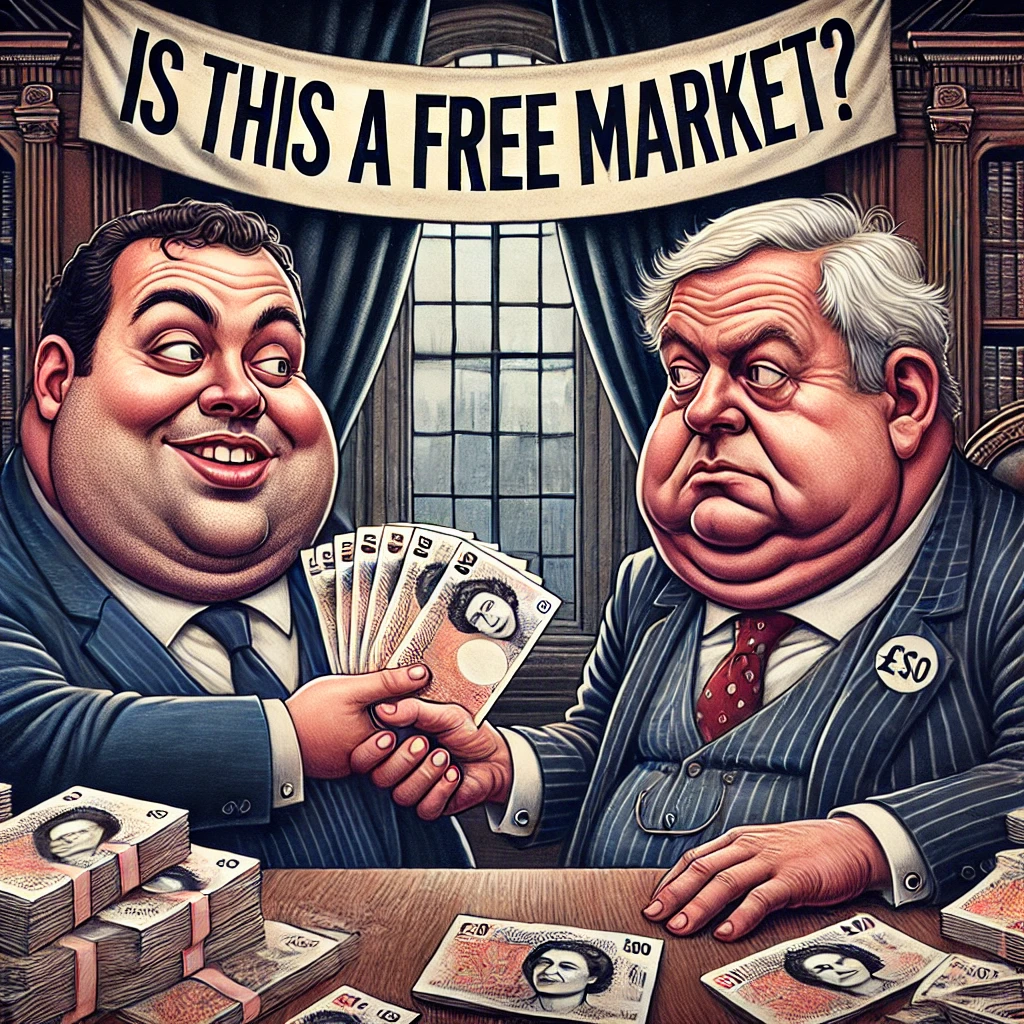
This isn’t the free market. It’s economic warfare, and it’s being carried out with the enthusiastic cooperation of Britain’s own managerial caste—those bald, bloated Oxbridge functionaries who fetishize GDP while presiding over national suicide.
Consider the parallels to the post-WWII American strategy of appropriating German scientific and industrial capacity under Operation Paperclip. What we are seeing today is a global, privatized version of that same playbook. The U.S. identifies strategic sectors in its allies, targets their brightest stars, and then uses the tools of finance—not tanks—to seize them.
Just as German rocket science was looted for NASA, so too is British AI, chip design, and quantum computing being stripped for Silicon Valley. The difference? Back then, the Germans had lost a war. Britain, on the other hand, has surrendered without firing a shot.
Mercadente floats a modest proposal—restricting shareholder voting to British citizens. A fine start, but wildly insufficient. If Britain is to survive as a real country, it needs to renationalize its economy, impose capital controls, and implement an industrial strategy that rejects globalist orthodoxy. That means rebuilding factories, training engineers, banning hostile takeovers, and treating finance as a tool—not a master.
The myth that this would “hurt efficiency” is meaningless in a society where efficiency means handing your country over to foreign creditors. Better a hundred inefficient factories in British hands than one Google-owned AI lab staffed by temporary foreign workers on six-month visas.
The ongoing foreign acquisition of Britain is not a policy failure. It is a colonization project disguised as economic liberalism. Every time a promising British company disappears into the maw of global capital, a little more of the country dies. If this trajectory continues, the next generation of Britons will not be citizens—they will be tenants in a managerial empire where every job, every innovation, every decision is made somewhere else.
You must reject the neoliberal lie, expose the collaborators, and reclaim your nation—or be written out of history entirely.
Discover more from The Libertarian Alliance
Subscribe to get the latest posts sent to your email.
“Britain the Colony” has a lot of contradictions woven into a complaint about a problem but provides no solutions. The problem noted is more a symptom of a country that has become so socialistic that it lacks both the capital and entrepreneurial spirit required to be a real economic force. It even lacks these things to such an extent that its passion for its national sport lacks the resources to own many of its long-established football clubs. It has been overrun by rampant immigration from cultures antithetical to its own.