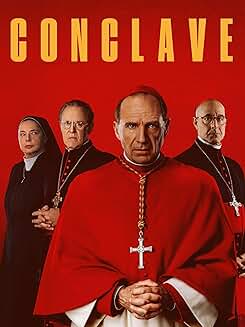
Conclave (2024)
Directed by: Edward Berger
Starring: Ralph Fiennes, Stanley Tucci, John Lithgow
Based on the novel by Robert Harris
Available on: Amazon Prime, Apple TV
I watched Conclave out of curiosity. Sebastian Wang, my best friend—whom I insult more than I praise and praise less than I should—is a convinced Roman Catholic. When he isn’t quoting St Augustine at me or re-reading Evelyn Waugh, he’s defending papal infallibility with such solemn vigour that I sometimes wonder how he puts up with me. Naturally, I consider it my civic duty to keep him tethered to this world by reminding him that his Church, for all its stained glass and Latin mumblings, is as riddled with nonsense as anything L. Ron Hubbard ever scribbled. But still—he is my best friend, and I care what he thinks.
So when I saw that Conclave was available to stream—and that it had been made with some cooperation from the Church itself—I set aside my usual preference for South Korean sicko-horror and gave it a watch.
Big mistake.
I don’t mean that the film is poorly made. On the contrary, its sets and costumes are ravishing. The Vatican interiors glow with candlelit reverence. The actors wear their cassocks like they were born in them. The cinematography has that polished prestige-film haze that tells you awards season is approaching. The performances are uniformly excellent. Fiennes does a marvellous job as Cardinal Lomeli, the “liberal” protagonist who grimaces his way through plot twist after plot twist like a man suffering from spiritual constipation. Tucci plays a power-hungry American with just the right mixture of suave menace and bureaucratic fatigue. The whole cast is superb. Everything looks real. The atmosphere of ritual and secrecy is as thick as incense.
And then it all collapses in on itself like a soufflé made of dog turds.
Spoiler alert—not that you should care, because I’m about to save you from wasting two hours of your life: the Pope they elect is a Mexican priest from Kabul who looks like Colonel Gaddafi and turns out to be a woman. I did not make that up. That is the twist. That is the climax. That is the point.
There—I’ve ruined it for you. Except I haven’t. I’ve spared you the slow, reverent build-up to what might be the single stupidest ending I’ve seen since Jupiter Ascending, and even that had the decency not to drape itself in liturgical solemnity.
Now, one might argue—if one were an imbecile—that the film is trying to make a point about universal dignity, or gender fluidity, or whatever warmed-over Human Rights Watch platitude was being quoted in the writers’ room. We are all equal in the eyes of God. Isn’t that beautiful? Shouldn’t the Church change with the times?
No. It shouldn’t. Because the point of a religion is not to reflect back the values of the managerial class in clerical drag. It is to stand as a fixed pillar in the ruins of time. A religion is not useful because it is true. It is useful because it organises the instincts of millions into a functioning order. It’s the mortar in the civilisational wall. You chip away at it for the sake of a social justice moment, and you get rubble.
This film does not challenge Catholicism. It neuters it. It turns the ancient rites of Rome into a soft-focus TED Talk about empowerment. It’s the cinematic equivalent of hanging a rainbow flag from the Aurelian Walls and expecting the Huns to be impressed.
Yes, I am aware that the claims of the Church are—and I am putting this mildly—hard to credit. So are those of Islam and Mormonism. You could argue that, so far as probable truth is concerned, there is no essential difference between St Paul and Joanna Southcott, or even the beady-eyed frauds of Silicon Valley. They all assert the unprovable and the unlikely. But that misses the point. i will repeat myself: Christianity—especially its Catholic flavour—is not valuable because it is true or even arguable. It is valuable because it sits within the core of our civilisation.
Europe without the Church is just a geographical expression. It belongs to whoever happens to occupy it at any one moment. Add the Church, and Europe is a civilisation. The Pope, whatever one thinks of his theology, sits in a line of succession that begins with St Peter. And his title Pontifex Maximus didn’t pop into existence to grace the successors of St Peter. It predates Christ. It was first held by Romulus. It was held by Numa. It was held by Julius Caesar, then by Augustus and all his successors down to Constantine. It is our only institutional connection with the civilisation of the Ancient World. To treat it as a prop in some inclusive Netflix-friendly fantasy is not just in bad taste—it’s civilisational sabotage.
Now, I’m not suggesting the Roman Church should be above mockery. During the days when it burned heretics and banned books, mockery was a kind of moral disinfectant. But that was when the Church was still dangerous. Now it is one of the last brittle pillars holding up what remains of the West. Mocking it now is like mocking the fire brigade while your house burns down.
Conclave is not just a bad film. It is a blasphemy—not in the theological sense, but in the cultural one. It takes one of the few remaining symbols of continuity and gravity, and turns it into a panto with Latin subtitles.
I’m sure Sebastian will say I’m overreacting. He’ll tell me the film is harmless, that art should be free, that the mystery of the Holy Spirit moves in unpredictable ways. He’ll probably quote Newman at me. That’s fine. But let me say this: if this film has the approval of any Christian denomination, then I, for one, will welcome the return of Torquemada.
Discover more from The Libertarian Alliance
Subscribe to get the latest posts sent to your email.