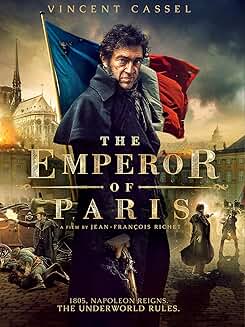
The Emperor of Paris (2018)
Directed by: Jean-François Richet
Starring: Vincent Cassel, Olga Kurylenko, Fabrice Luchini, Denis Ménochet
Available on: Amazon Prime
Before you watch The Emperor of Paris, you’ll want to know a little about its subject—unless, like the screenwriters, you assume your audience was educated sometime before 1980. Eugène François Vidocq was a thief, a deserter, a prison escapee, a police informant, and, ultimately, the founder of modern criminology. By the time he died in 1857, he had invented the forensic science of ballistics, founded the Sûreté Nationale, and created the first known private detective agency. He also wrote memoirs that were so lurid and obviously self-aggrandising that they became required reading for criminals and police across Europe.
The film is not based on those memoirs. Instead, it gives us a version of Vidocq who exists somewhere between the Godfather and a Regency-era Batman. Played by a brooding, battered Vincent Cassel, he escapes from prison, fakes his death, returns to Paris, and offers his services to the police as a freelance crime-smasher. The price? A pardon. The tool? A gang of informers and ex-criminals, ready to bludgeon and betray on command. If you want subtlety, you’re in the wrong arrondissement.
What the film gets gloriously right is Paris itself. Not the Paris of pastries, poodles and people on bicycles playing the accordion—but the pre-Haussmann sewer that festered under Napoleon. The production design is a triumph of filth: piss-soaked alleys, meat markets crawling with flies, and courtrooms where powdered wigs do nothing to hide the rot. This isn’t the picturesque dystopia of Les Misérables, where squalor is a metaphor for virtue. It’s the real thing—maggot-eaten, disease-ridden, and brutally indifferent.
More than just a backdrop, the setting captures the essence of post-revolutionary France. This is not a land of Liberty, Equality and Fraternity. It’s a place where scum has risen to the top and remains there by stabbing or bribing anything that moves. The elites are venal. The revolutionaries are dead. The police are indistinguishable from the gangs. It is a libertarian’s nightmare and vindication all at once: the absolute failure of the central State to create order, and the emergence of a private alternative—albeit one run by a sociopathic ex-con with a good tailor.
This, I think, is the real reason to watch the film. It’s not the plot, which is aimless and oddly weightless. The main villain appears for about four scenes, and one of them is his death. The rival gangs are interchangeable. There’s an aristocratic love interest who appears to be in a different film entirely. Characters flit in and out, making threats and then disappearing. It feels less like a story than a collection of loosely connected assaults.
But underneath the wandering structure is a sort of ideological clarity. Vidocq works because he doesn’t follow rules. He solves crimes faster than the police because he doesn’t believe in their methods. He assembles a private militia of street toughs who, for all their brutality, do more to establish public order than the entire Ministry of the Interior. It’s not hard to draw the libertarian conclusion: that systems of spontaneous order can outcompete State bureaucracy, especially when the State is in terminal decline.
And decline is the film’s other unspoken theme. Nobody in this world believes in anything. The Revolution has failed. The monarchy has failed. Napoleon has failed. What’s left is cynicism dressed up as legality. Joseph Fouché (played with appropriate sliminess by Fabrice Luchini) drifts through the film like a ghost of State power—omnipresent, amoral, and oddly impotent. No one explains who he is, or why he matters. You are simply expected to know, which is one of the film’s nicer intellectual touches. It assumes you’ve read a book, or at least been awake in a classroom (though not one in my school).
But if the script trusts your historical knowledge, it doesn’t always reward your emotional investment. I found it hard to care who lived or died, including Vidocq. Cassel plays him as a man so ground down by life that he can barely emote. This works, up to a point. But when every scene is grim, and every decision is made with a scowl and a snarl, the film loses its dramatic stakes. The violence, though lavish and convincingly nasty, becomes numbing. There’s a sword fight in a pigsty that’s so gratuitous it almost veers into comedy. I say almost because nobody in this film ever smiles. Even the prostitutes look clinically depressed.
Which is a shame, because there’s intelligence here. The film wants to be about power, legitimacy, and survival in a world where moral authority has collapsed. And sometimes, it is. There’s a running tension between Vidocq’s desire to go straight and the fact that his methods will always keep him outside the system. He is too effective for the bureaucracy, too principled for the underworld. He belongs nowhere—which is probably why he ends up becoming a legend.
The cast mostly struggle. Cassel can brood, but he can’t save a script that often reads like it’s been assembled from scraps of untranslated Dumas. Olga Kurylenko is wasted. The villains are even worse: introduced with theatrical menace and then disposed of like minor inconveniences. It’s as though the film doesn’t trust itself to linger anywhere long enough to develop tension.
Still, I would recommend it. Not because it’s a great film—it isn’t. But because it offers a rare, unflinching look at one of the most chaotic periods in French history, and because it gives us a protagonist who, for all his violence, represents something genuinely subversive. Vidocq is not a hero. He is a man who imposes order in the absence of legitimacy. And in a world where law is just another racket, that makes him oddly admirable.
Discover more from The Libertarian Alliance
Subscribe to get the latest posts sent to your email.