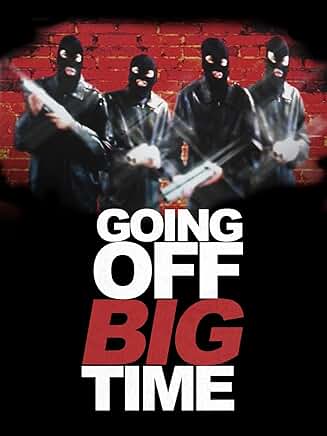
Going Off Big Time
Directed by: Jim Doyle
Written by: Jim Doyle
Starring: Neil Fitzmaurice, Nicholas Lamont, James McMartin, Tony Maudsley
Release Date: 2000
Available on: DVD, Amazon Prime
There is no shortage of British crime films that mistake drabness for authenticity. Going Off Big Time is one of them. It is yet another low-budget, semi-realistic gangster flick about the rise and fall of a nobody who fancies himself a player. The performances are solid, and the ideas are, in theory, interesting. But the execution is so dreary, so utterly uninspired, that watching it feels less like entertainment and more like a slow punishment for sins in a past life.
The worst crime a film like this can commit is to be boring. And this, despite its best efforts at grittiness and shock, is a bore.
The story follows Mark Clayton (Neil Fitzmaurice), a regular bloke who, after a stint in prison, finds himself sucked into the world of organised crime. He starts at the bottom, works his way up, and inevitably discovers that being a gangster is not quite the glamorous enterprise he had in mind. The ingredients are all here—betrayal, paranoia, ambition, revenge—but none of it lands with any real weight.
The film tries very hard to be bleak and unflinching. It wants to be Goodfellas, or at least Get Carter, but it lacks the energy of the former and the raw menace of the latter. Instead, we get a series of grimy, badly lit locations, dialogue that often sounds like it was lifted from a mediocre stage play, and a sense that everything is happening in slow motion.
Crime dramas like this live or die on their characters. Here, the characters exist, but they do not live. Mark is neither compelling nor particularly tragic—just a man wandering through a series of unfortunate events with all the urgency of someone waiting for a bus.
The real tragedy of Going Off Big Time is that the acting is actually quite good. Neil Fitzmaurice carries the film well enough, doing his best to inject some charisma into a protagonist who is never as interesting as he needs to be. He also contrives to look rather like David Cameron, which at least makes the end moderately entertaining. Tony Maudsley and James McMartin turn in strong performances, with McMartin in particular giving his role a bit more weight than the script deserves.
But acting alone cannot save a film that lacks momentum. Even the best performance is wasted when the film itself refuses to move. The story meanders, the tension fizzles out whenever it threatens to appear, and every scene overstays its welcome.
Jim Doyle’s direction aims for gritty realism, but too often confuses drabness with depth. There is a fine line between making a crime film that feels true to life and making one that simply looks and feels cheap. The pacing is sluggish, the cinematography flat, and the dialogue stretches even the most forgiving patience.
There are moments—flickers of what the film could have been—where it threatens to be engaging. But they are brief, quickly swallowed by the endless grey of its execution.
And then there is the ending.
Some films earn their bleak conclusions. Some films do not. This one belongs firmly in the latter category. A well-executed tragic ending can be powerful; a badly executed one is just a slap in the face. Going Off Big Time opts for the latter. It does not feel inevitable, nor does it carry any emotional weight. It is not a gut punch—it is a shrug. The sort of ending that makes you wonder why you bothered sitting through the previous ninety minutes at all.
A good crime film should leave you exhilarated, disturbed, or at the very least, satisfied. This one just leaves you checking the time and wondering what else you could have watched instead.
Going Off Big Time is not offensively bad. It is just unnecessary. The performances are strong, the premise is fine, but the film itself is so plodding, so lacking in energy, that by the time it reaches its unwelcome ending, the only real feeling it provokes is mild irritation.
If you are in the mood for a British crime drama, there are better options. If you are in the mood for a bleak character study, there are better options. If you are in the mood for a film that does not feel like watching a wet weekend in Blackpool unfold in real time, there are better options.
Some films fail because they overreach. This one fails because it never reaches at all.
Discover more from The Libertarian Alliance
Subscribe to get the latest posts sent to your email.