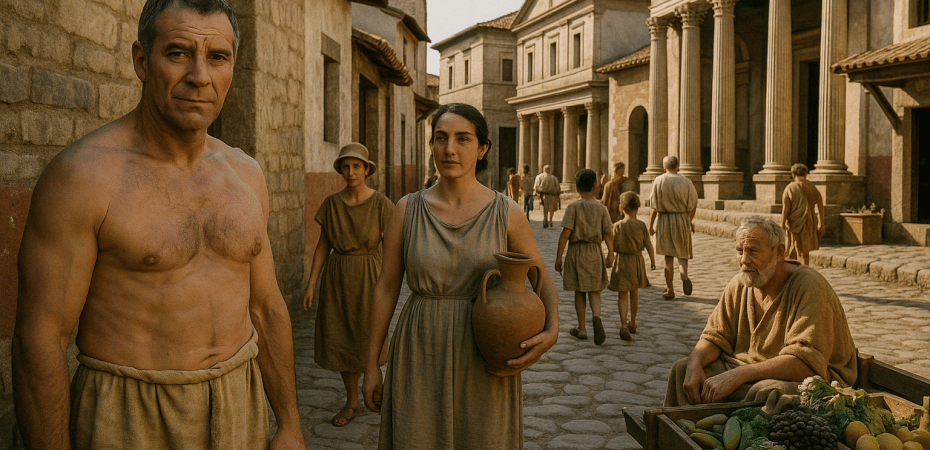
I’ve read Sebastian Wang’s article on GDP and income distribution in the Roman Empire. It is, as always, intelligent and extensively researched. If I were marking it for school, I’d give it full marks. But I don’t agree with it. Or rather, I agree that the Roman Empire was poorer and more unequal than modern societies—but this is hardly a surprise, and hardly a reason for scorn. Rome wasn’t the modern world. It was the ancient world at its absolute best. To judge it against suburban America or postwar Norway is not just unfair. It’s unhistorical.
Let me instead compare the Roman Empire with the rest of the pre-industrial world, and with the early-modern one. Let me also argue that much of the pessimism about Roman health and wellbeing is based on fantasy models, ideological prejudice, or statistical fraud. We are not dealing with the Dark Ages in togas. In some ways, especially those that matter, Rome was ahead of almost everything until the 1920s. It deserves better than the smug derision of those who live in centrally heated housing and think state-funded injections are a moral achievement.
Here, I’ll make a confession. Like Sebastian, I’m structuring this article round previous work. Sebastian uses the Friesen and Scheidel article from 2009. I’m using a 2012 article by Geoffrey Kron—see the Bibliography for details. Again, like Sebastian, I’m supplementing this with my own reading and prior understanding.
This having been said, or confessed, I move to the body of my argument. Let’s begin with life expectancy. You will hear it said again and again that the average Roman could expect to live 25 years, give or take. This is supposed to show how miserable their lives were. It’s also rubbish. Geoffrey Kron has shown that the sources for these numbers are either misused or irrelevant. Most of them derive from modern UN life tables based on populations in the late colonial period—populations crippled by war and the beginnings of industrial urbanisation. These are then projected onto ancient societies where the demographics, social structure, and disease environment were completely different (Kron 2012, 193–195).
In fact, where we do have real data—height, for example—the Roman world compares extremely well. The average Roman male stood about 168 cm tall. That’s better than the average Englishman in 1850, who came in at just over 165 cm (Fogel 1994). It’s also taller than most of Italy managed until the 1950s. This doesn’t just mean that Romans were good at growing bones. It means they had enough to eat, and that what they ate contained actual nutrients. Roman skeletons across multiple sites—Isola Sacra, Herculaneum, and Vagnari—show robust frames and no signs of widespread childhood stunting (Kron 2012, 207). Their long bones grew without interruptions. Their teeth formed without the Harris lines or enamel hypoplasia so common in industrial Britain. These are not the markers of a population eking out calories. They’re the physiological residue of a well-fed society.
And it wasn’t just food in the belly—it was variety. The Roman diet included wheat and barley, but also lentils, chickpeas, onions, garlic, leeks, dates, figs, pears, apples, olives, and a whole range of fish and shellfish depending on region. The poor ate boiled pulses and coarse bread, but even they had oil and wine rations—more than the average Georgian peasant. In the eastern empire, particularly in Egypt, ostraca recording grain allowances for the army show a daily adult male intake of 3,000–4,000 calories, often including some meat or cheese (Kron 2012, 200; Lo Cascio 2006). That’s military-level nutrition. And this wasn’t wartime rationing. It was routine provisioning.
Roman foodways were underpinned by something even more important: logistics. The annona system shipped grain from Egypt to Rome via a state-organised fleet. The Monte Testaccio rubbish dump in Rome contains the remains of 53 million amphorae, most from Spain, used to transport olive oil. The scale of state-monitored redistribution was staggering. And it didn’t just feed senators. Grain doles reached 200,000 citizens in the capital alone under Augustus. Modern commentators sneer at this as bread and circuses. I call it caloric security.
Nutrition matters, because it ties directly to immunity, growth, and resistance to infection. If you’ve got clean water, good food, and enough of it, you don’t die young. If you breastfeed your infants for two years, as Roman women often did (Pliny the Elder, Natural History, Book VII.15), they’re less likely to die of diarrhoea. If you survive infancy with decent nutrition, you’re less likely to be crippled by rickets or scurvy, or knocked out by respiratory disease. Infant mortality was high, yes—but this was true everywhere until penicillin. What matters is relative performance. And as Kron notes, infant burial density in Roman cemeteries is often lower than expected, even after correcting for underreporting and the exclusion of perinatal deaths from formal gravesites (Kron 2012, 200–202). You don’t get that in the slums of 18th-century London or 19th-century Naples.
Let’s not forget disease environment. Modern pessimists love to bang on about malaria and tuberculosis. Yes, both were endemic. But again, context matters. Romans knew to drain swamps. They knew to site villas uphill. They ran sewer systems under the forum. They weren’t stupid. They were adapting to their environment with what tools they had. And in many places—Pompeii, for example—those tools were good enough to outlive the population that built them.
So yes, they died younger. But they didn’t die worse. They died in stone houses, not mud huts. They cooked with oil, not dung. They bathed in water piped from the hills, not scooped from ditches. If that isn’t success, I don’t know what is.
Add in urban sanitation, and the story gets better. Cities like Rome and Carthage had sewers. They had scheduled waste removal. They had bathhouses and public toilets. According to De Aquis Urbis Romae, Rome delivered 1.2 million cubic metres of fresh water per day through its aqueduct system (Frontinus, De Aquis, I.4). That’s roughly 1,000 litres per person—higher per capita than modern Paris. And it wasn’t all for elite fountains. Water was distributed to 591 public fountains and 1351 basins (Rodgers 2004, 23–25). The system was regulated, audited, and defended from private theft.
Let me not be misunderstood. I am a libertarian. I believe that the state is usually inefficient, coercive, and self-serving. But even I recognise that some collective infrastructure is necessary—especially where voluntary coordination is impossible. Water supply is one of those areas. Aqueducts and sewers are non-rivalrous, non-excludable goods. Their construction requires long-term investment and complex engineering. In the absence of a functioning capital market or insurance system—neither of which the Roman world developed—a state capable of coordinating large infrastructure projects was the least bad option. The Roman state did this well.
More than that, the state didn’t simply build aqueducts. It protected springs. It maintained systems. It forbade private monopolisation of water flows. That’s not socialism. That’s the assertion of common right over oligarchic exploitation—something a free society must always guard against. Frontinus, Rome’s water commissioner under Nerva, took his job seriously. He tracked illegal diversions. He insisted water was for public use first, private indulgence second. That’s not collectivism. It’s civilisation.
Compare this with Victorian Britain. London’s water supply was so foul by 1858 that the Thames was bubbling with sewage. The response wasn’t to clean it. It was to hang curtains soaked in chloride of lime to block the smell from Parliament. Meanwhile, in Rome, the state delivered water free. The plebs urbana had public fountains within fifty metres of their homes. The poor drank clean water. The baths were open to everyone. This is not the hallmark of a failed society. It is not a sign of cruelty or incompetence.
Let us turn to mortality again. Most of the horror stories about early death come from industrial Europe. Urban mortality in Manchester, Liverpool, and Paris in the 19th century was shocking. In some places, life expectancy dipped below 27 (Wrigley and Schofield 1981, 240). People died not from ignorance but from indifference—from the refusal of governments and elites to take responsibility for urban living conditions. The Roman Empire was not utopia. But it was at least built on the assumption that public space matters and that the city should not kill its citizens.
We can now talk seriously about inequality. This is where Sebastian’s piece is strongest, and hardest to rebut. Rome was unequal. It had a top-heavy wealth structure, and a senator was not the same as a provincial artisan. But this is not unique to Rome. Pre-industrial societies were all like this. The important question is: did inequality make life unbearable? In Rome’s case, not really. If the top 1% consumed 16–25% of income (Scheidel and Friesen 2009, 73), that’s high—but it’s still lower than the USA today. And unlike modern billionaires, Roman elites spent their wealth locally. They patronised bathhouses, games, temples, roads, schools, aqueducts. There was a performative obligation to give back. They didn’t build data centres in tax havens.
Rome also built systems which distributed certain goods and services across class lines. Bread was subsidised or free. Public entertainment was free. Clean water was free. Roads were free. Justice—though not always fair—was accessible. A slave could be manumitted and become a citizen. Even emperors came from the provinces. The army offered pay, retirement pensions, and Roman citizenship. That’s better than what you get in most British zero-hours contracts.
And let’s not forget the sheer scale of economic complexity. The Roman Empire had a market economy. It had long-distance trade routes from Syria to Spain, from Britain to the Red Sea. Grain from Egypt fed Rome. Olive oil from Baetica lit its lamps. Amphorae and coin hoards show us the density and volume of commerce. Prices in Egypt were posted in the agora. Contracts were recorded. Interest rates were known. Temples offered banking services. This wasn’t subsistence peasantry occasionally taxed. This was a Mediterranean network of autonomous actors, using currency, courts, and commercial logic. There is more freedom in a Roman market town than in a British high street under net zero regulation.
Even more important, status in Rome was not wholly rigid. It mattered, yes. But it could be earned. It was visible, not hidden. And the benefits of it could be redistributed without the hypocrisy of Victorian philanthropy or the redistributive tyranny of modern technocracy. In other words, Rome functioned not because it was fair in the modern sense—but because it was honest. There was no permanent underclass. There were poor people, but there were also ladders. There was cruelty, but also structure. There were clear rules about status and behaviour. And they were rules that allowed for mobility.
In short, Rome did not operate on the simple theft model of later aristocracies. It gave back. It invested. It built. It left behind bridges, roads, aqueducts, and ports that were still in use 1500 years later. No one will say that of the average American megacorp.
And on that point—let’s talk about capitalism. There is a modern tendency, especially among American academics, to read ancient history through the lens of economic growth. If Rome didn’t have GDP per capita like Belgium in 1950, then Rome must have failed. This is idiotic. GDP is a recent invention. Economic wellbeing isn’t the same as wealth. It’s the combination of material sufficiency, security, and meaning. On all these measures, Rome was at least competitive with most of the world before 1900.
The Roman economy was not driven by quarterly returns. It wasn’t run by financialised monopolies. It functioned through a decentralised network of producers, merchants, landowners, and smallholders. It allowed people to work and live with relative security. It had high levels of urbanisation for the time. It had long-distance trade. And it had cities that were not merely survivable, but admirable.
Yes, there was poverty. Yes, there was exploitation. But show me a period before the welfare state that didn’t involve these. The question is not whether Rome was rich. It wasn’t. The question is whether it did better with what it had than others did. And the answer is clearly yes.
To sum up, we should resist the tendency to sneer at the past. The Romans lived shorter lives than we do. But they lived better lives than most of our ancestors. They lived with dignity, in beautiful cities, under laws that they could understand, and with access to public goods that weren’t just for the rich. Their world was clean, functional, and built to last. If that doesn’t qualify as success, I’m not sure what does.
Ancient Sources
- Frontinus. De Aquis Urbis Romae. Edited and translated by R. H. Rodgers. Cambridge: Cambridge University Press, 2004.
- Pliny the Elder. Natural History. Translated by H. Rackham. Loeb Classical Library. Cambridge, MA: Harvard University Press, 1938–63.
- Suetonius. The Twelve Caesars. Translated by Robert Graves. Revised edition. London: Penguin Classics, 2007.
- Vitruvius. On Architecture. Translated by Frank Granger. Loeb Classical Library. Cambridge, MA: Harvard University Press, 1931.
Modern Sources
- Fogel, Robert. “Economic Growth, Population Theory and Physiology: The Bearing of Long-Term Processes on the Making of Economic Policy.” NBER Working Paper No. 4638, 1994.
- Kron, Geoffrey. “Nutrition, Hygiene and Mortality: Setting Parameters for Roman Health and Life Expectancy.” In L’impatto della “peste antonina”, edited by Elio Lo Cascio, 189–226. Bari: Edipuglia, 2012.
- Lancaster, H. O. Expectations of Life: A Study in the Demography, Statistics and History of World Mortality. New York: Springer, 1990.
- Lo Cascio, Elio. “The Urban Graveyard Effect Reconsidered.” Annales de Démographie Historique 1 (2006): 41–75.
- Rodgers, R. H. Frontinus: De Aquis Urbis Romae. Cambridge: Cambridge University Press, 2004.
- Scheidel, Walter, and Steven Friesen. “The Size of the Economy and the Distribution of Income in the Roman Empire.” Journal of Roman Studies 99 (2009): 61–91.
- Wrigley, E. A., and R. S. Schofield. The Population History of England, 1541–1871: A Reconstruction. London: Edward Arnold, 1981.
Discover more from The Libertarian Alliance
Subscribe to get the latest posts sent to your email.