
In polite company, we are not meant to say it. We speak of “fiscal headwinds,” “debt challenges,” “difficult choices.” What we mean—though we rarely dare to admit it—is that Britain is becoming insolvent. The numbers are no longer numbers. They are warnings. Public sector net debt stands at 96.3% of GDP. The Office for Budget Responsibility (OBR) says this could rise to 270% by 2070 if current policies remain in place. These are not the projections of political cranks. They are the sober conclusions of the state’s own official budgetary watchdog.
Britain is not yet bankrupt. But we are no longer far from the point where debt interest swallows half the tax revenue, where currency devaluation becomes the irresistible option, where serious cuts can no longer be put off. And this crisis—the whole rotten edifice—was constructed by successive Conservative governments who abandoned both prudence and principle. Labour, too stupid or too timid to know what to do with the mess they have inherited, will most likely intensify it until the crisis bursts through all pretence.
The Conservative era from 2010 to 2024 will be remembered for two things: slogans and debt. Having inherited a post-crisis economy, they spent fourteen years speaking of “fiscal responsibility” while practising the opposite. By March 2023, general government gross debt stood at £2.537 trillion—over 100% of GDP. This was not wartime spending. It was the price of bribing voters with their own money, of soothing every problem with short-term debt. In the financial year ending March 2025, borrowing hit £151.9 billion—£14.6 billion more than forecast. The 2008 “emergency” never ended. It became a way of governing.
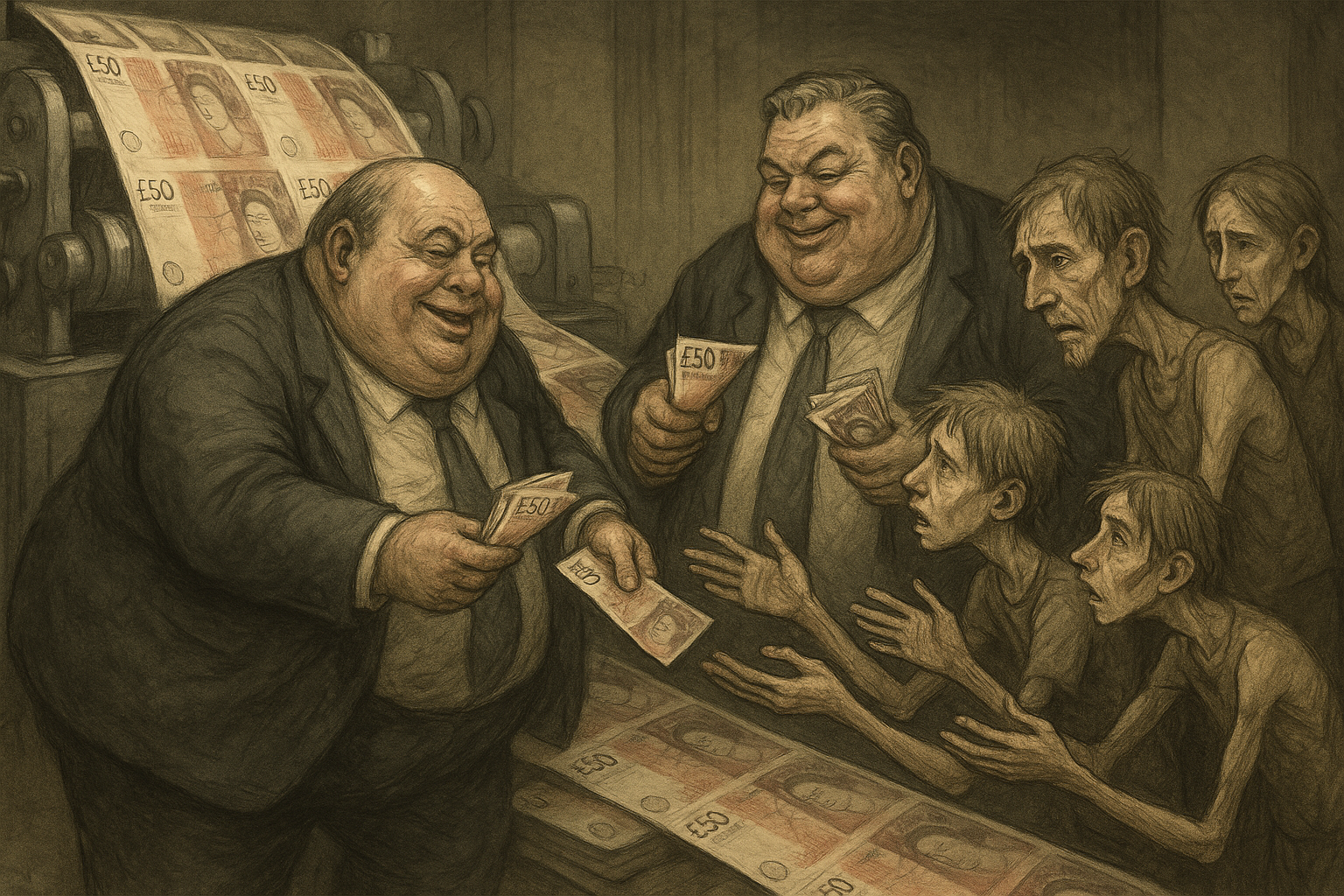
Then we have monetary policy. The Bank of England’s massive quantitative easing programme meant the government could borrow cheaply for years. But the trick has backfired. About a quarter of the national debt is index-linked. When inflation surged—RPI rose 1.7% in April 2025—the government’s interest bill exploded. June 2025 alone saw £16.4 billion spent on interest payments. This is not fiscal policy. It is financial arson.
Yet even this is not the whole story. The Conservatives repeatedly rewrote their own fiscal rules. George Osborne promised a budget surplus by 2020. He gave up in 2016. Since then, each chancellor has followed the same path: declare a new rule, then abandon it. “Sound money” became a slogan for press conferences, not a principle for policy. The OBR calls this “ratcheting up” of debt. In plainer terms: they lied.
There was no real plan to boost productivity or restructure the economy. Infrastructure spending was cut, not expanded. The supposed party of enterprise oversaw stagnant growth, collapsing high streets, and near-zero gains in real wages. By 2029, the OBR projects productivity will be 1.3% below earlier expectations. In short, we now owe more, produce less, and grow slower—all thanks to decisions taken while waving the Union Jack and mumbling about hard choices.
It would be comforting to think the new government could change course. But Labour’s early record suggests not conviction, but cowardice. In June 2025, the Labour Government released its Spending Review. It raised capital investment by £113 billion through 2029–30. It expanded departmental spending by £55.3 billion per year above Conservative plans. It offered more money for childcare, for defence (2.6% of GDP by 2027), for green infrastructure. No programme was cut. No department shrank. This is a budget written by people who believe growth will arrive just because they have announced it.
To fund this, Labour has turned to tax. Not sweeping reform, not supply-side liberalisation—they have frozen income tax thresholds and raised National Insurance. This does not reduce spending. It merely delays reckoning. According to the OBR, these taxes may slow employment and suppress wages. It means a smaller economy, and eventually—more borrowing.
Then there are the new fiscal rules. Chancellor Rachel Reeves has pledged to balance the current budget and reduce net financial debt by 2029–30. But the “headroom” is small: just £9.9 billion of surplus is forecast for 2029–30. One inflation shock or a 0.1% productivity drop—and it’s gone. Reeves is not imposing discipline. She is praying for miracles.
Labour faces other constraints. The unions. The civil service. The media. The new anti-extremism regime. All of these discourage austerity or reform. Indeed, even discussing unequal policing is now labelled a sign of “extremism”. The state cannot pay its bills, but it finds money to spy on dissidents and blacklist ordinary citizens for noticing reality. A government that cannot cut a single programme without collapsing its own vote is happy to arrest people for misgendering others online.
When faced with these constraints, Labour responds not with courage but with studied vagueness. Their language is managerial: “sustainable growth,” “fiscal responsibility,” “strategic investment.” But these are vapours. They conceal the fact that public finances are now hostage to forces no one in Westminster seems willing to confront: a bloated welfare state, unaffordable pensions, a civil service that exists more for itself than for the public.
Even under Labour’s most optimistic assumptions, debt will remain over 96% of GDP until 2030. If interest rates rise, or growth stalls further, we shall see that number climb. To repeat, the OBR warns that if nothing is done, debt could exceed 270% of GDP by 2070. These are not abstract projections. They imply national bankruptcy. Already, interest payments eat up 7–8% of government receipts. With 25% of our debt index-linked, every tick upward in inflation inflates our liabilities. Add to that rising costs from climate policy, demographic ageing, and the post-Ukraine defence budget—and there is little room left for denial.
The same OBR warns that “fiscal tightening of 1.5% of GDP per decade” is needed just to stabilise debt. In plain English: spending must fall, or taxes must rise dramatically. There is no painless path. The British state now pays vast sums just to keep the illusion of solvency alive.
And for what? What are we buying with this borrowed money? Not roads. Not innovation. We buy political silence. We pay off the NHS unions. We cover the pensions of civil servants. We bribe the police not to enforce the law too aggressively in sensitive areas. We subsidise endless diversity offices, think tanks, and public campaigns warning us not to offend.
The Conservative Governments may have built the debt. But Labour has built a system in which even stating the problem is now suspicious.
Eventually, reality asserts itself. At some point in the next Parliament, Labour may be forced to do what it has spent its entire political life condemning: make serious cuts. They will not call it austerity. They will say it is “structural reform,” or “targeted efficiencies.” But cuts are coming. They will likely be disguised at first—hiring freezes, wage caps, stealth rationing in public services. But if the numbers continue their current trajectory, deeper action will become inevitable.
It may begin with pensions. Or education. Or NHS access. But some pillar of the post-war welfare consensus will have to be restructured. And if Labour refuses to act, the markets may act for them. The bond vigilantes who sacked Truss are still watching. Britain can no longer rely on the kindness of strangers to fund its delusions.
When this happens, the Left will cry sabotage. The Right will pretend it warned us all along. But both parties are complicit. The Conservatives built this system to avoid hard choices. Labour now maintains it to avoid telling the truth.
What we are watching is not just a fiscal crisis. It is a political collapse in slow motion. Britain is run by a class that has lost the ability—and the courage—to govern. Our rulers are not evil geniuses. They are frightened careerists. The only thing they know how to do is borrow, bribe, and censor.
Compare this to Britain in the nineteenth century. Back then, the state took less than 10% of GDP. Money was sound. Spending was minimal. Britain built the world’s largest empire while running balanced budgets and issuing currency backed by gold. Today, the state consumes nearly half the economy and cannot even manage to house its own citizens or secure its own streets.
The answer is obvious, though no one dares speak it. We must shrink the state. Slash departments. Reform pensions. Rebuild productivity through real deregulation and a lower tax burden. Shift money from consumption to investment. This means fewer managers and more producers. Fewer bureaucrats and more builders. Fewer slogans and more sweat.
It also means political courage—something neither the Conservatives nor Labour has shown in decades. The problem is that most of the present spending is undesirable in principle and inefficient in its practice: it is also essential. Let me give a comparison that Bryan Mercadente may appreciate. If you want to look good without diet or exercise, you can put on a corset. It will constrain and shift organs. It will cause muscles to waste. In the long term, it may shorten your life. Until then, you will fit into some very smart clothes. Or, if you do eventually feel obliged to leave it off, the result will be months of joint and muscular pain and uncontrolled sagginess. It is the same with the present extended British State. Compared with a developed system of restrictive covenants and focussed torts, the present planning system is a mess. So too the National Health Service compared with a private insurance system and radically deregulated and decorporatised medical markets. We can say the same for pensions, for education, for virtually every area of state spending. But these alternatives do not presently exist, and cannot be called overnight into existence. Make substantial cuts to present spending, and the pain will be immediate, and may continue for several years.
That is where courage comes in. We need politicians who are prepared to make heavy cuts to spending. There is obviously room for cutting budgets that do not benefit ordinary people—cuts that will even bring immediate benefits. I think of Net Zero, which simply enriches a small class of parasites at the general expense. Administrative costs are always inflated for political benefit, and could be cut without affecting the quality of front-line services. But these front line services also need to be at least trimmed to avoid fiscal collapse. We need politicians with the courage to make these cuts, and the personal integrity for their explanations to be believed. We need politicians who can be trusted not to spare well-connected interests and to shift all the pain of adjustment onto ordinary people. I look at the Labour ministers, and I do not see these politicians. They will wait for the collapse, then burble about “global markets,” while hoping it will be others who are pulled by angry crowds from their shiny black cars and disembowelled in the street.
Meanwhile we wait. And we wait without hope. None of this will end well.
Discover more from The Libertarian Alliance
Subscribe to get the latest posts sent to your email.
Agreed. The Tories were awful.
Labour WANT to increase debt to feed their incontinent spending