
Sherelle Jacobs, in her Daily Telegraph column of 14 August, proclaims that “Ukraine has lost the war against Russia. The conflict is likely to come to an end sooner rather than later – and on terms that favour Putin. Britain must accept that the Ukraine war is all but over – and prepare for an even bigger brewing conflict.”
This is propaganda disguised as reflection. It recognises defeat, then turns immediately to the demand that Britain arm for war with Russia—a war that this country has no legitimate reason to join, and that it cannot fight and cannot win.
Ukraine is lost. Russia holds all its strategic gains: the Black Sea is closed to Kiev; the Zaporizhzhia nuclear station and Ukraine’s mineral and industrial base are in Russian hands. The Ukrainian military is shattered. Ukraine’s economy lies in ruins. Millions are displaced. Western intervention has only prolonged the bloodshed. More weapons now would only lengthen the lists of dead on both sides.
The only rational response is disengagement. Britain has no stake in Ukraine’s fate. Russia poses no threat to us. We have no treaty obligations, and our military is plainly incapable of fighting anyone beyond a handful of untrained rebels. Yet Jacobs urges us to prepare: “Putin will be emboldened… full‑scale Europe‑wide conflict could break out within the coming decade.” She may believe it, or she may be writing what it is her job to write.
But she is not alone in this panic. She is not the only stenographer for the war lobby. Charles Moore wrote in May that “Labour won’t stop Putin by hunting for Nazis at home. In rhetoric both main parties back Ukraine to the maximum. But in truth we are not giving the full backing necessary,” implying that Britain must do more (Telegraph). And at the end of June, another Telegraph headline claimed, “Despite Trump cajoling Europe to pay up, Putin is the victor… The West’s defence spending may be ticking up, but there are still reasons for the Kremlin to be relaxed.” (Telegraph).
This is delusion. Russia is not mobilising for a march on Paris. It wants buffer zones to be free from encirclement. Beyond that, it wants to build on its trade opportunities with Asia rather than with us. Yet here we are told to imagine the Kremlin expanding into Moldova, Georgia, Western Europe—without a shred of evidence.
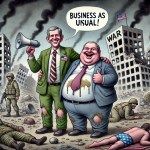
Words like “dark age,” “perilous moment,” and references to 1939 litter these columns—a litany Moore, Jacobs, Daley and others recite whenever new budgets are requested. Europe is always in September 1939. Always. The use of “Europe’s most perilous moment since 1939” is a large, leaking cliché used to soften public opinion for spending on weapons.
Meanwhile, talk of “weaponisation of inconvenience” that will make “streaming a film at night” impossible is not analysis but inflation of mundane bureaucratic failures into acts of war (en.wikipedia.org). This is war-mongering of the most trivial kind: everything broken becomes an act of Russian sabotage. You really should struggle to read this journalistic sludge without laughter. Our services are collapsing already. Trains do not run because they are mismanaged. Hospitals fail because they are bureaucratic empires. Prices rise because of monetary policy, not Putin. Russia did not break Britain. Britain was broken by its rulers.
But the propaganda has its uses. It distracts. If your energy bill doubles, blame the Kremlin. If you cannot see a doctor, blame Russian hackers. If your pension vanishes, blame sabotage of the banking system. Claim anything but the truth—that the ruling class squandered the wealth of our nation and is now covering its failure with foreign bogeymen.
But notice who benefits. It isn’t the British people. We pay the taxes and freeze in the dark. The gain is for the usual suspects: arms manufacturers, contractors, lobbyists. For decades they profited from an American-backed empire. That empire is now dying. Their answer is not retreat but a breaking gambler’s double-down—one more spin at the table, even if it ends in ruin.
This pattern is not new. The form changes, but the substance is always the same: the ruling class defends its decline with war rhetoric. But Britain is no longer a “great military power.” The Navy can barely keep its carriers at sea. The Army is too small to garrison Kent, let alone Europe. The RAF is reduced to flying antique Typhoons on borrowed parts. To imagine that this country can face Russia is delusion bordering on madness.
Britain cannot fight Russia. Nor should we. The only logical path is to accept reality: Ukraine is lost, sanctions have failed, and we must trade and rebuild. Pretending otherwise is lunacy.

Discover more from The Libertarian Alliance
Subscribe to get the latest posts sent to your email.
Related posts:

Powered by YARPP.