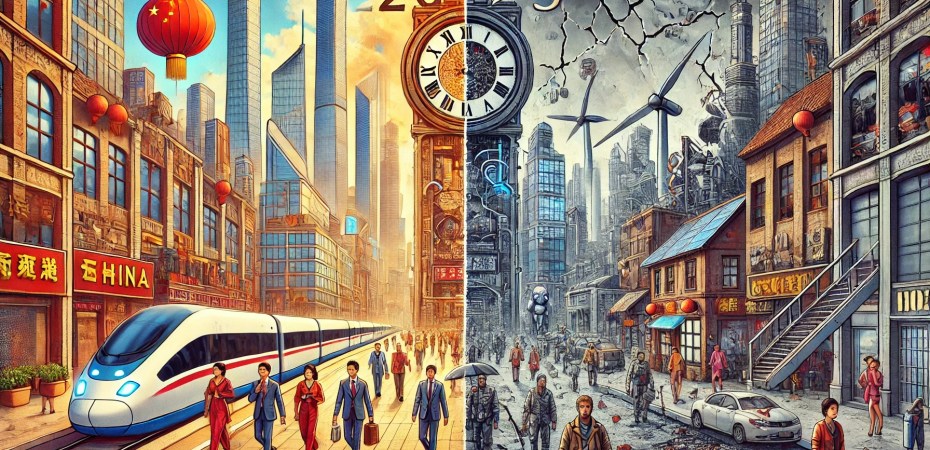
I get the same cracker barrel assurances every day from the guests in my motel. The West leads the world. America, we’re told, is the beacon of freedom, innovation, and prosperity. Europe is its wise, if fading, partner. The rest of the world—China included—is supposedly playing catch-up. I smile and get on with adding up the check. But this picture is delusional.
China is not catching up. It’s pulling ahead. Fast. Over the past 40 years, China has experienced the most rapid economic transformation in history. Since Deng Xiaoping launched his market reforms in 1978, China’s economy has grown by nearly ten percent a year, lifting over 800 million people out of poverty. It has gone from a poor, agrarian backwater to a global industrial superpower, and it’s now the world’s largest trading nation, its second-largest economy, and by purchasing power parity (PPP), already the largest. And it’s not stopping.
But what really explains this explosion of wealth and success? Certainly not liberal democracy. Nor is it merely the result of policy tweaks or copying Western capitalism. No, the roots go much deeper—into a thousand years of cultural and biological selection.
This isn’t just about economics. This is about evolution. For centuries, the Chinese population was shaped by relentless Social Darwinist pressures—the kind that eliminated the weak, rewarded the intelligent, and produced a people uniquely suited to modern success.
In Europe, aristocracies lived off the labor of serfs, passing down titles and land for generations. In China, something else entirely happened. Starting with the Tang and institutionalized under the Song Dynasty, China created the most meritocratic system the world had ever seen: the imperial examination system.
For over a millennium, any boy—no matter how humble—could rise to power if he mastered the Confucian classics and passed an exam. This wasn’t just about education. It was about mass selection for intelligence, discipline, and diligence. By the Ming and Qing dynasties, over 30% of high-ranking officials came from families with no previous elite status.
Think about that. In the West, upward mobility was limited, constrained by birth and class. In China, it was baked into the system. But it came at a brutal cost. Families would spend all their resources educating a son for the exams. Most failed. Only the brightest and most driven made it. This system didn’t just shape social outcomes. It reshaped the gene pool.
Here’s the truth the mainstream won’t admit: traditional Chinese society was a human crucible, applying Darwinian pressure generation after generation. This wasn’t some abstract idea. It was mathematical.
In a highly commercialized agrarian society with no fixed aristocracy, success meant survival, and failure meant extinction. China’s population skyrocketed from 65 million in 1393 to 430 million by 1850. Land was scarce. Resources tight. In this world, intelligence was survival.
While Indian peasants were locked into caste roles and European serfs toiled under feudal lords, Chinese peasants were free to rise or fall in an open, vicious economic system. Land was bought, sold, and mortgaged. Interest rates exceeded 10% a month. Peasant families had to calculate, trade, and strategize or die.
Failure wasn’t theoretical. It meant your son wouldn’t marry—because of the gender imbalance caused by female infanticide—and your family line would end. Historian Edwin Moise documented how poorer families literally vanished from the demographic record, while wealthier ones multiplied.
This process repeated for centuries. The most competent had more children. The least competent had none. The result? A slow but relentless selection for cognitive ability and staying power. Don’t believe it? Just look at where Chinese populations thrive—everywhere. In the U.S., Chinese-Americans make up 1.5% of the population but routinely account for 15–20% of students at top universities like Harvard and MIT. The same pattern holds in Canada, Australia, and the U.K. Everywhere they go, Chinese outperform. Not just in school, but in business, science, and engineering.
This isn’t cultural alone. It’s not just “Confucian values” or “Tiger Moms.” It’s something deeper—something that only makes sense when you understand that the Chinese people were forged in a thousand-year Social Darwinist pressure cooker that selected for the very traits modern societies reward.
Westerners often scoff at this theory. They’d rather believe it’s all about institutions or incentives. But those theories fall apart the moment you try to explain why Chinese succeed within Western systems, not just in China. Economists like Acemoglu and Robinson argue that institutions make or break nations. According to them, if China doesn’t adopt Western-style liberal democracy, it will eventually falter. They said the same about Singapore. And about Hong Kong. But those predictions have all failed.
China’s hybrid model—state-directed capitalism—has beaten every expectation. Westerners said the internet would bring political liberalization. It didn’t. They said top-down control would stifle innovation. It didn’t. They said demographics would sink China. It hasn’t yet—and maybe never will. Why? Because China doesn’t depend on borrowed ideas. It doesn’t need American-style institutions. It has human capital—and a population shaped to thrive under precisely these conditions.
By contrast, the West has taken an entirely different path. In Europe, primogeniture preserved wealth in elite families, reducing downward mobility. The dumb son of a nobleman still inherited. In India, caste locked people into rigid social roles, reducing pressure to adapt or innovate.
And today? The West is selecting for nothing at all. Welfare policies reward dysfunction. Immigration policies import low-IQ labor. Education has become anti-meritocratic. Elite universities like Harvard now discriminate against Asians in order to make room for underperforming groups. It’s as if the West is now actively selecting against intelligence and against discipline. The very traits China spent a thousand years honing are being discarded as “problematic” in America and Europe.
No wonder the West is stagnating. Its institutions are hollow. Its social fabric is fraying. Its leaders are incapable of honest introspection. While China builds high-speed rail and dominates global manufacturing, America obsesses over pronouns and DEI mandates.
The one thing the Western media won’t touch is the genetic component. Yet it’s staring them in the face. The Beijing Genomics Institute (BGI) has quietly been analyzing genes linked to cognitive performance for years. Western researchers—under ideological pressure—ignore or denounce these findings. But the data is there. Studies have shown selection for educational attainment in Chinese and other East Asian populations. In one Guangdong village, the descendants of a single merchant clan grew to dominate the region genetically—because they succeeded economically and reproduced prolifically.
Even if these studies remain controversial, they align perfectly with the observable outcomes: a high-performing, low-crime, achievement-oriented population that succeeds globally, no matter the system.
Western elites pretend this is a coincidence. But they know better.
Yes, China’s fertility rate has dropped—now down to around 1.1. Western media insists this spells doom. But this ignores two facts.
First, the West has the same problem, only worse. Its solution? Mass immigration from low-IQ, low-performing populations that strain welfare systems and fragment society. China has rejected that path.
Second, a lower population doesn’t mean lower power. Japan has had sub-replacement fertility for decades and remains a high-functioning society. Quality matters more than quantity—and China’s quality remains high.
More importantly, the legacy of centuries of selection remains. China doesn’t need a billion people to compete. It needs a capable elite, a motivated middle class, and a disciplined population. It has all three.
The implications are clear. The 21st century won’t be led by a decadent, self-flagellating West. It will be led by China—a country that values competence, order, and achievement. For the West to compete, it must abandon its fantasies about “universal values” and its smug belief in institutional superiority. It must recognize that success is biological and cultural, not just political.
The rise of China is not some anomaly or miracle. It’s the result of thousands of years of cultural and biological refinement, driven by a relentless meritocratic system that selected for intelligence, discipline, and success. Western institutions once had an edge. No longer. China has the people, the culture, and the momentum. And it’s not slowing down.
The West must wake up and confront this new reality. That means embracing merit again, and abandoning the false egalitarianism that is rotting its foundations. Because the future isn’t Western. It’s Chinese.
Reading List
- Acemoglu, D., & Robinson, J. A. (2020). Why Nations Fail: The Origins of Power, Prosperity, and Poverty – Western institutionalist perspective, increasingly contradicted by China’s success.
- Clark, G. (2007). A Farewell to Alms: A Brief Economic History of the World – Explores demographic selection and economic history.
- Cochran, G., & Harpending, H. (2009). The 10,000 Year Explosion: How Civilization Accelerated Human Evolution – Crucial for understanding genetic change and cognitive selection.
- Moise, E. E. (1977). “Downward Mobility in Pre-Revolutionary China.” Modern China, 3(1), 3–31. – Groundbreaking work on demographic selection.
- Pomeranz, K. (2000). The Great Divergence: China, Europe, and the Making of the Modern World Economy – Explains how East Asia’s development diverged from Europe.
- Ho, P.-T. (1959). “Aspects of Social Mobility in China, 1368–1911.” Comparative Studies in Society and History, 1(4), 330–359. – Empirical foundation for meritocratic mobility in Chinese society.
- Rindermann, H., Woodley, M. A., & Stratford, J. (2012). “Haplogroups as Evolutionary Markers of Cognitive Ability.” Intelligence, 40(4), 362–375. – Evidence for genetic markers and cognitive differences.
- World Bank (2023). World Development Indicators – Source for GDP and demographic statistics.
- OECD (2019). PISA 2018 Results (Volume I): What Students Know and Can Do – Clear evidence of academic outperformance by Chinese students.
- Hinton, W. (1966). Fanshen: A Documentary of Revolution in a Chinese Village – Firsthand view of the pressures and strategies in Chinese rural life.

Discover more from The Libertarian Alliance
Subscribe to get the latest posts sent to your email.
[…] Article by Len D. Pozeram. […]