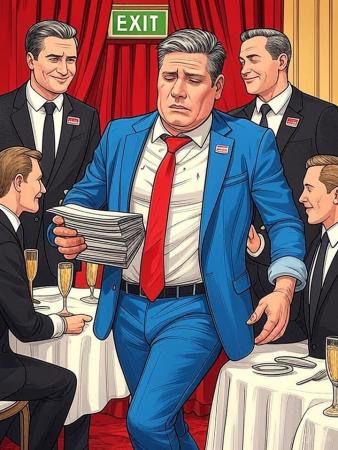
Alan Bickley’s analysis of Keir Starmer’s Labour government, published here on September 10th, offers a sharp overview of the post-2024 political moment—a moment that, as Bickley rightly notes, represents a managerial regrouping by a ruling class in disarray. But what Bickley underplays—or perhaps diplomatically sidesteps—is the accidental nature of Starmer’s premiership, and how his inner circle, particularly Peter Mandelson, is now being sacrificed to pave the way for a more compliant and less tainted replacement.
The reality is this: Keir Starmer was never meant to govern. When Starmer was given the Labour leadership in 2020, the expectation—shared by everyone who mattered—was that the Conservative Party, despite its endless parade of sleaze, would remain in power at least until 2029. Brexit had been “done,” Corbynism crushed. Starmer was installed not to lead, but to wait. His job was to project a mild aura of competence while losing elections respectably—nothing more. The real talents of the Labour Party were kept in reserve. Why waste them on a shadow cabinet that was supposed to rot in opposition for another decade?
The game was up, however, when Boris Johnson’s government collapsed faster than anticipated. His clownish reign of scandal and cronyism—combined with a piss-poor economy and widespread public contempt—delivered Labour a majority nobody in the Establishment expected. The regime found itself in an awkward bind: a man chosen to lose was now Prime Minister.
And from day one, Starmer governed like the placeholder he was always intended to be. His policies were a continuation of what was wanted between 1997 and 2020. He lacked vision because he was never supposed to have one. He and his colleagues, failed to understand that the real power players—the security services, the transnational tech firms, the energy lobbies, the US-UK “Atlanticist” consortium—had moved on to a new agenda, one that demanded an end to the national atomisation the Blairites oversaw after 1997. The new agenda requires reindustrialisation and remoralisation: Britain is needed again as an enforcer of a New World Order that has turned out to be less permanent than expected. Starmer’s crew couldn’t keep up.
Enter the Mandelson implosion, now conveniently timed to coincide with growing establishment dissatisfaction with Starmer’s leadership. Of course, Mandelson was never clean, and everyone knew it. The list of his ethical failures is practically a summary of regime corruption: secret loans, fast-tracked passports for billionaires, yacht holidays with oligarchs, a revolving door between public office and EU trade policy, and now—most damningly—a documented personal relationship with Jeffrey Epstein, whom Mandelson referred to as his “best pal” and allegedly coached through a prison release strategy.
None of this is new. Much of it was public knowledge for years. Yet the media mostly held their fire—until now. Why?
Because Mandelson is expendable, and his fall offers a twofold benefit for the regime: first, it purges an operator with too much baggage and an unmanageable level of personal toxicity; second, it provides a vector to bring down Starmer by association. By letting Mandelson twist in the wind, the system signals a reset—one that allows for the replacement of a failed government without the inconvenience of asking the people to vote.
It’s worth noting that Starmer initially defended Mandelson even after the Epstein birthday book surfaced, and even after emails showed Mandelson directly intervening to assist a convicted sex trafficker. Starmer said he had “full confidence” in him. Within 24 hours, he was forced to sack him—not out of principle, but because the orders had come down: the asset was burned.
This is the Thermidor that Bickley predicted earlier this year—a housekeeping exercise by the deep machinery of the Anglo-American state, shedding malfunctioning components in order to retain overall control. As Bickley points out, Starmer has no base of his own. He is surrounded by second-stringers and careerists. With Mandelson gone and the Epstein scandal metastasizing, Starmer now exists solely at the mercy of the networks that installed him. And those networks are already calculating his replacement.
Don’t be fooled into thinking this is some morality play about poor judgment or compromised friendships. The elite didn’t suddenly discover Mandelson’s relationship with Epstein. They just decided now was the time to use it. Starmer was given the keys to the country on a clerical error. He and his cronies were tolerated only so long as they didn’t get in the way. Now that they have, they’re being shown the door—politely, of course, and with the kind of media choreography that ensures no one asks too many questions.
In the coming months, expect to see a new face—someone fresher, more polished, with no apparent ties to the Epstein cesspool, and no visible commitment to the old policies of controlled national demolition. And that person will be marketed as a break with the past, a return to integrity, a new hope. But it will be nothing of the sort. The regime is not reforming itself. It’s just rotating front-men. And as always, the real power remains untouched and unaccountable.

Discover more from The Libertarian Alliance
Subscribe to get the latest posts sent to your email.