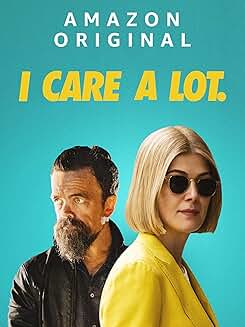
I Care a Lot (2020):
Directed by: J Blakeson
Starring: Rosamund Pike, Peter Dinklage, Dianne Wiest
Release Date: 19 February 2021 (UK, Netflix)
Available on: Amazon Prime
I tend to avoid films with titles like I Care a Lot. It suggests some dreary middlebrow drama, full of tears and platitudes and—inevitably—“strong female leads” being “strong” in ways that mostly involve shouting at men. But then I read the plot synopsis, and realised what this really was: a savage, nihilistic satire of the State’s caring professions. A film where every social worker is bent, every doctor on the take, and every judge a slack-jawed puppet in a gavel hat. In short, a libertarian film—though I doubt the writer knew it.
The premise is brilliantly monstrous. Rosamund Pike plays Marla Grayson, a sleek-haired sociopath who makes a living by getting old people sectioned. With the help of tame physicians and a legal system allergic to common sense, she convinces judges that these pensioners are mentally unfit and in need of state guardianship. She is then appointed as their legal carer, sells their assets, locks them in a care home, and lives off the proceeds. It’s not a scam around the edges of the law—it is the law. And what makes the film so powerful is that no one objects. The courts wave her through. The care homes collude. The police smile and nod. Everyone gets their cut. This isn’t crime in spite of the system. It’s crime by the system.
Now, I know what you’re thinking. Surely there must be some good characters? Some moral centre? Some boy scout who tries to set things right? No. The only thing that interrupts Marla’s assembly-line of state-backed theft is the appearance of a new victim—Jennifer Peterson, played by Dianne Wiest, who turns out to have connections. Very dangerous connections. Without spoiling anything, let’s just say that Marla may finally have met someone as amoral as she is. What follows is not a redemption arc. It is a turf war.
Pike’s performance is cold, slick, and perfect. She plays Marla not as some misguided idealist, but as what she is: a predator operating within a system designed to reward predation. Her self-justifications—about how she’s helping people, how the elderly are better off in institutions—are exactly the sort of thing a government pamphlet might say. That’s the point. When evil wraps itself in the language of care, it becomes invisible to the people most meant to stop it.
The supporting cast are equally sharp. Peter Dinklage turns up as a gangster with a taste for yoghurt and vengeance. He is violent, unscrupulous, and—unlike the state—honest about his interests. The film doesn’t make the mistake of pretending he’s a hero. But in a world where all the suits are villains, it’s hard not to admire a man who at least admits he’s a crook. Dianne Wiest is quietly wonderful as the woman who seems like a victim, until she starts smiling at just the wrong moments. There’s a particularly tense scene where she calmly informs Marla that she’s “in trouble now.” The understated menace is more chilling than any scream.
Of course, there are critics who don’t like this film. They say it’s too cynical. That it offers no one to root for. That it doesn’t tell us how to fix the system. But that’s exactly why I Care a Lot works. It’s not an appeal for reform. It’s a demonstration of what happens when power escapes scrutiny. It’s a reminder that government care often means the abolition of choice—and that “safeguarding” can be a euphemism for asset-stripping the vulnerable. The film doesn’t explain how to dismantle this machine. It just shows us how it runs. That’s enough.
And best of all, it has a happy ending. I won’t say what happens. Only that it restores a certain cosmic order. You can call it karma. I call it justice.
Discover more from The Libertarian Alliance
Subscribe to get the latest posts sent to your email.