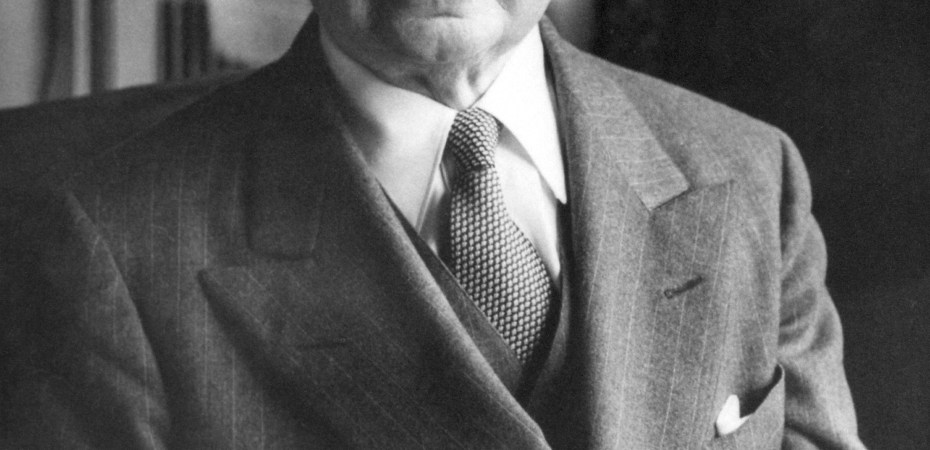
by Oscar Grau
In an article, originally delivered as a lecture at Princeton University in 1958, Ludwig von Mises argued that government is “essentially the negation of liberty.” Where government jurisdiction spreads, there is no liberty, but coercion. More precisely, according to Mises, government is not a necessary evil, nor an evil, but “the only means available to make peaceful human coexistence possible.” The means that makes the social system of cooperation work “smoothly” without being disturbed by the violent acts of domestic or foreign gangsters.
Mises affirms that government is the beating, imprisoning, and hanging. Everything a government does is “ultimately supported by the actions of armed constables.” Whatever such government operates, “the funds required are collected by taxes, i.e., by payments exacted from the citizens.” And yet, Mises goes further, his theory of government becomes no less than a theory for human civilization:
If we take into account the fact that, as human nature is, there can neither be civilization nor peace without the functioning of the government apparatus of violent action, we may call government the most beneficial human institution.
For Mises, liberty is the restriction of government interference—it is freedom from the government. And freedom is only found in the sphere in which the government does not interfere. Men can thus act freely in fields where they have the opportunity to choose the way in which they want to proceed. These fields are what Mises calls “civil rights,” which are meant to be the statutes that circumscribe “the sphere in which the men conducting the affairs of state are permitted to restrict the individuals’ freedom to act.”
In Mises’ view, men establish a government for the “ultimate end” of making possible “the operation of a definite system of social cooperation under the principle of the division of labor.” Here, he refers to the “laissez-faire” system, where there is “a field in which individuals are free to plan for themselves.” This system allows and protects the market economy, in which men are free to choose “the way in which they want to integrate themselves into the frame of social cooperation.”
Social Cooperation and Division of Labor
Mises places considerable emphasis on social cooperation and division of labor in his economic treatise Human Action. There, he explains:
If and as far as labor under the division of labor is more productive than isolated labor, and if and as far as man is able to realize this fact, human action itself tends toward cooperation and association; man becomes a social being not in sacrificing his own concerns for the sake of a mythical Moloch, society, but in aiming at an improvement in his own welfare. Experience teaches that this condition—higher productivity achieved under division of labor—is present because its cause—the inborn inequality of men and the inequality in the geographical distribution of the natural forces of production—is real.
Another important insight of Mises is that the higher productivity of the division of labor makes men dependent on each other, and their recognition of the benefits of this dependence in social cooperation allows them to develop feelings of mutual companionship:
Within the frame of social cooperation there can emerge between members of society feelings of sympathy and friendship and a sense of belonging together. These feelings are the source of man’s most delightful and most sublime experiences… However, they are not, as some have asserted, the agents that have brought about social relationships. They are fruits of social cooperation, they thrive only within its frame; they did not precede the establishment of social relations and are not the seed from which they spring.
Moreover, in speaking of human development and the circumstances of human life, Mises stresses the conduct of rational man in social life:
We may also assume that under the conditions of earlier ages the inclination for aggression and murder was favorable to the preservation of life. Man was once a brutal beast… But one must not forget that he was physically a weak animal; he would not have been a match for the big beasts of prey if he had not been equipped with a peculiar weapon, reason. The fact that man is a reasonable being, that he therefore does not yield without inhibitions to every impulse, but arranges his conduct according to reasonable deliberation, must not be called unnatural from a zoological point of view. Rational conduct means that man, in face of the fact that he cannot satisfy all his impulses, desires, and appetites, foregoes the satisfaction of those which he considers less urgent. In order not to endanger the working of social cooperation man is forced to abstain from satisfying those desires whose satisfaction would hinder establishment of societal institutions… However, man has made his choice. He has renounced the satisfaction of some desires incompatible with social life and has given priority to the satisfaction of those desires which can be realized only or in a more plentiful way under a system of the division of labor. He has entered upon the way toward civilization, social cooperation, and wealth.
The choice of the fathers does not impair the sons’ freedom to choose. They can reverse the resolution. Every day they can proceed to the transvaluation of values and prefer barbarism to civilization, or, as some authors say, the soul to the intellect, myths to reason, and violence to peace. But they must choose. It is impossible to have things incompatible with one another.
The Incompatibilities of Mises
Man’s ability to choose is paramount for Mises, and no government is mentioned as a requirement. But if only government can make possible the peace implicit in social cooperation, then man’s reason and choice, that is, his rational conduct, is not the essential cause of social cooperation. The cause would rather be man’s fear of the government apparatus of violent action.
In all fairness, Mises faces a dilemma. Either men choose to cooperate with each other in the manner described by Mises, which fundamentally enables peaceful coexistence among human beings, or the government is solely responsible for this. Nevertheless, if men are capable of agreeing that a group of people called the government should rule society through the action of armed agents to make peaceful coexistence possible, they could also agree to cooperate and make that same coexistence possible without that government, or despite it. And any disruption to the system of social cooperation may also be managed based on this cooperation, which is, in fact, how law emerged as a social institution. In parallel, Mises was also clear about the internal workings of society in his 1958 lecture:
Within society everyone depends on what other people are prepared to contribute to his well-being in return for his own contribution to their well-being. Society is essentially the mutual exchange of services. As far as individuals have the opportunity to choose, they are free; if they are forced by violence or threat of violence to surrender to the terms of an exchange, no matter how they feel about it, they lack freedom.
However, if people do not want to pay taxes, only violence or threat of violence can force them to surrender to the terms of an exchange, like gangsters force their victims to pay in exchange for not suffering any other undesirable consequence. But accepting this exchange as one of the mutual exchange of services in which people contribute to each other’s well-being means that stealing is as much a contribution to the well-being of people as any other voluntary exchange.
Looking at reality, a government is simply a group of people with their own interests, but who can use the specific means of government to achieve their own goals. The violent acts of this group are legally permitted in ways that are prohibited for anyone else outside the government. Thus, so-called civil rights are actually the result of the discretionary imposition of a group of people who enjoy legal privileges at the expense of everyone else.
Furthermore, the question arises as to what and how much the government should tax in order to make possible the operation of a definite system of social cooperation. Taxes are funds upon which the citizens have not been able to plan freely—so they are not allocated as in the market economy. Consequently, the lower the level of taxation, the greater the level of free planning that citizens can enjoy with their own funds, and the lowest possible level of taxation is that at which the taxes collected by the government tend toward zero. And yet, any level of taxation is really arbitrary and contrary to the functions of the market economy, and the free integration of people into the frame of social cooperation is actually hindered by the same government.
In conclusion, either Mises was right about man’s choice toward social cooperation, or he was right about the supreme benefit of government for peace and civilization. Indeed, it is impossible to have things incompatible with one another.

Discover more from The Libertarian Alliance
Subscribe to get the latest posts sent to your email.


I believe Mises was unable to embrace anarchism because he came out of a time when “anarchy” meant bomb-throwing Socialists. So I read Mises’ “government” as society’s commitment to using institutions and mechanisms for conflict resolution and thereby eschew violence. Limiting govt is also the limiting violence. The problem is govts tend to grow until they kill their host.
The leap of logic which Mises never made was to realize any society with the self control required to maintain a minarchy doesn’t need one.