
by Alan Bickley
Kemi Badenoch’s latest article for The Daily Telegraph (“The Tories will use the lessons of Thatcher and Reagan to make this country great again” —17th October 2025) is what happens when a political corpse twitches. It is the sound of an exhausted party talking to itself. The prose reads like the output of an ill-tempered chatbot trained on back issues of The Spectator and ministerial press releases. If the algorithm were fed half a dozen clichés about “freedom,” “enterprise,” and “strength,” and told to produce 1,000 words of self-congratulation, it would look exactly like this.
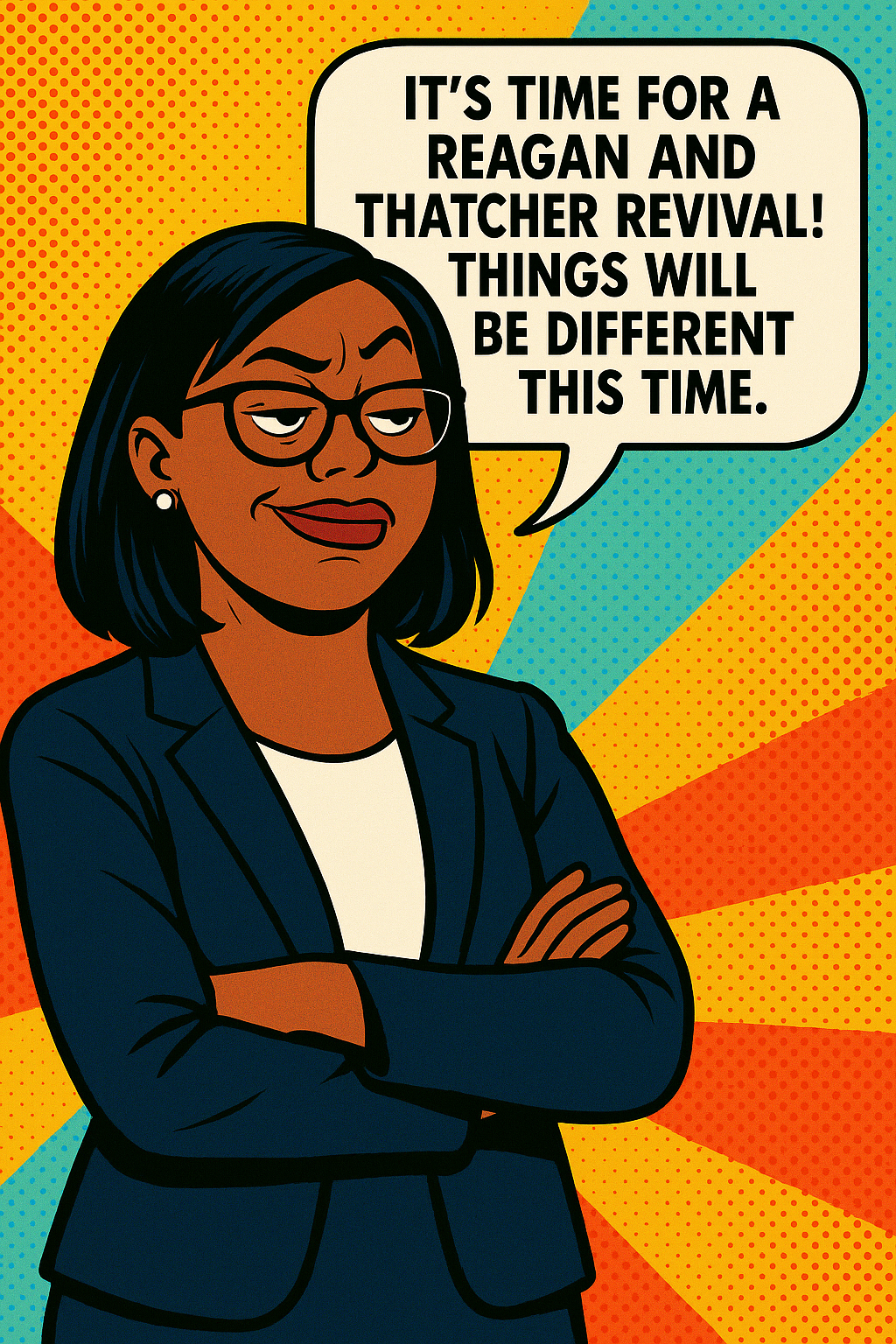
Mrs Badenoch promises that “this time it will be different.” That is, after all, the Tory slogan of every generation. The only difference it has ever meant is that it was worse than before.
The lesson of Reagan and Thatcher is that peace and progress are born from strength and weakness invites danger.
Yes, and the lesson of modern Conservatism is that slogans invite ridicule. Reagan and Thatcher may have stood for strength; the Conservatives under Mrs Badenoch stand for compliance. Between 2010 and 2024, they governed with the zeal of administrators in a Soviet satellite. They taxed more than Labour, censored more than the Church, and spent more time explaining their principles than acting on them.
My family lived briefly in Omaha, Nebraska in 1985 and 1986.
How moving. No doubt those were golden years—though her party’s voters in Doncaster or Dover might prefer fewer American reminiscences and more functioning infrastructure. It is charming that Mrs Badenoch felt safe in Reagan’s America, but less charming that British citizens were treated as suspects in their own homes during the “strong” Conservative government she served.
They believed in individual freedom, not big government.
That is debatable, but we always did, before the Conservatives redefined “freedom” as the right to download your own vaccine passport. The only “big government” larger than theirs was God’s, and even He had the decency to rest on the seventh day.
They tamed inflation, broke the power of militant unions, and stared down the Soviet Union until it blinked.
And what, exactly, have you done, Mrs Badenoch? You presided over a debt-to-GDP ratio that would have made the 1970s blush, you armed the police with pronoun manuals, and you built the Online Safety Act—a censorship engine designed to make free speech as quaint as coal mining. If Thatcher broke the unions, you broke the habit of liberty.
They showed that peace is achieved not by kowtowing to tyrants, but by standing firm against them.
Standing firm? The Conservatives spent years bowing to every lobby that could spell “diversity.” They funded every war Washington asked for, then told the electorate that patriotism means paying more for electricity. They shouted about sovereignty while outsourcing every decision to a quango. The modern Tory can no longer stand firm because he has no spine left to stiffen.
It’s a reminder that real progress comes from invention, not intervention. From the bottom up, not the top down.
Fine words—if only they came from a party that hadn’t run the country like a public-health asylum. The Conservatives were the intervention. They shut the economy, paid people not to work, and built a police state to protect the bureaucracy from embarrassment. Their “bottom up” approach consisted of letting Amazon and Goldman Sachs tell them what to do.
They talk about fairness, yet punish effort. They believe government is the solution to every problem.
Every Conservative government since 2010 has said the same about Labour—while governing exactly the same way. It is difficult to see much difference between the “fairness” of Keir Starmer and the “prudence” of Rishi Sunak. Both run the same state, serve the same interests, and punish the same people. The Conservatives no longer deserve distrust; they deserve indifference.
Mrs Badenoch concludes by assuring us that “we may have drifted from our principles before, but no longer.” This is the funniest sentence in the English language since “the cheque is in the post.”
The Conservatives always drift from their principles because the principles themselves are props. They are not ideas but decoys, designed to occupy their voters while they continue the managerial programme of every government since Blair. Mrs Badenoch’s invocation of Thatcher and Reagan is not homage but necromancy: the empty ritual of a party that can no longer remember why it ever mattered.
Drill in the North Sea. Back our industries. Unleash our innovators.
She might as well promise to resurrect the dodo. The Conservatives spent fourteen years strangling industry with energy levies and environmental sermons. They are not going to “drill in the North Sea.” They will hold a “consultation” and outsource it to a firm that donates to both parties.
“Protect free speech like Reagan protected liberty.” This from the party that criminalised tweets. The Online Safety Act remains the final monument of their rule: a piece of digital barbed wire stretched across the public mind. Mrs Badenoch voted for it. She defended it. She will never repeal it.
“Stop treating profit like a dirty word.” The Conservatives treated profit like a tax bracket. They hollowed out enterprise and replaced it with subsidy. Britain no longer has capitalism. It has corporate welfare and bureaucratic extortion. The entrepreneur now works for HMRC by appointment of the Treasury.
It’s why we’re the only party brave enough and competent enough to deliver a stronger economy and stronger security.
The bravery of a party that hid behind experts. The competence of a party that couldn’t issue passports or fill potholes. Their “strong economy” is a £2 trillion overdraft; their “security” is a police force that arrests pensioners for misgendering.
There is no point in despising the Conservatives any longer. Despising implies that one still expects something of them. They have become irrelevant even to their own mythology. Mrs Badenoch’s invocation of Reagan and Thatcher is not a call to arms but a eulogy. The party is finished—ideologically, morally, and intellectually. It does not represent a side in politics, only a function of the State: the reserve battery of the ruling class, wheeled out to recharge the system when Labour runs low on voltage.
Reform UK, of course, is not much better. It is Conservatism with louder shirts and louder lies. But it will do for now—until something genuinely new and untainted comes along. For the moment, any alternative will do, if only to ensure that the final twitch of this dying party does not disturb the peace of the nation it has so thoroughly betrayed.
When Mrs Badenoch writes that “freedom and progress are not accidents of history,” she is correct. They are achievements—and her party spent fourteen years abolishing both.
Discover more from The Libertarian Alliance
Subscribe to get the latest posts sent to your email.