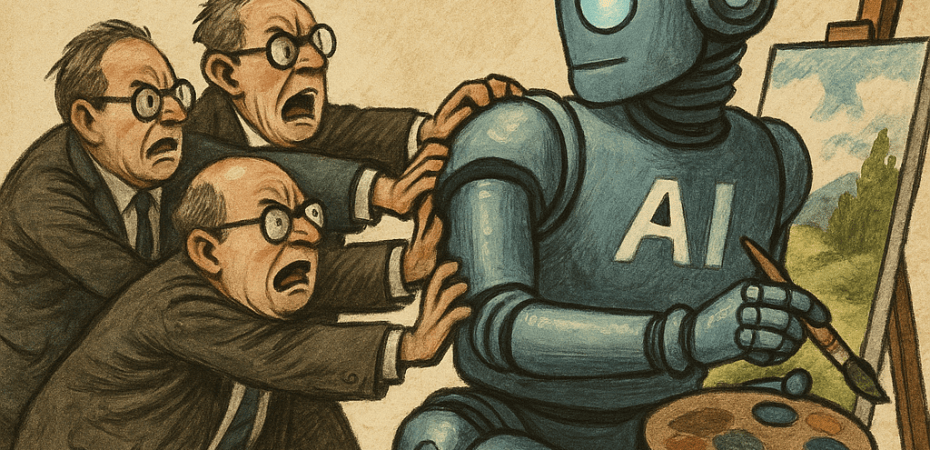
There is comedy in the present hysteria over artificial intelligence. Not the laughter of delight, but the kind that follows the discovery of a long-running fraud. The British Government’s consultation on Copyright and Artificial Intelligence has elicited the usual howls from a dying industry—publishers, authors, illustrators, and their lawyers—who now find themselves on the wrong side of technological progress. Their complaint, stripped of its legal varnish, is this: the machines are doing our work, and doing it better. Stop them.
And now, to stage-manage this panic, the Government has added farce to theatre. In 2022, the UK Intellectual Property Office proposed a modest reform: to extend the existing text and data mining (TDM) exception for non-commercial research to commercial AI developers. This would have allowed training on publicly available content without the need to seek licences from copyright holders. It was the kind of quiet, sensible deregulatory move that once marked Britain out from its continental neighbours. It was welcomed by those who still believe the State should promote innovation, not police it.
But then came the screaming. Rights-holder organisations—authors’ unions, music publishers, and their innumerable lobbyists—denounced the proposal as a “theft exception.” They alleged a plot to “strip-mine” the creative industries. And the Government, in that old, familiar ritual, paused the reform. Not repealed. Not withdrawn. Just paused.
As Simmons & Simmons puts it in their April 2024 legal update, the Government “backed away,” promising consultation but refusing to commit to legislation. The proposal remains in bureaucratic purgatory—technically alive, but politically abandoned.
What this reveals is not policy failure, but a lack of moral courage. The ministers did not defend the reform. They did not explain it. They did not put it to Parliament. They froze. And by freezing, they ensured that nothing would change.
It was, as ever, a victory for the clerisy: lawyers, gatekeepers, and the sanctified dealers in permission. It was also a clear signal that any attempt to liberate knowledge from monopoly will be met not with debate but with intimidation.
It is customary among the legal profession to speak of “intellectual property” as if it were a species of property in the Lockean sense—something acquired through labour, deserving of exclusive control. But this is false, and has always been false. Property, properly understood, is control over tangible things—land, tools, goods—that cannot be simultaneously used by others. To claim the same status for arrangements of words or musical notes is not philosophy but theft by metaphor.
If I buy a chair, I may sit on it, destroy it, paint it red. No one follows me with a clipboard to ensure I have not imitated its style in my own carpentry. If I buy a book, I may not so much as quote from it at length, much less replicate its contents—even if I do so with tools and labour of my own. That is not ownership. It is license. And when imposed by law, it is privilege—the use of state violence to uphold a monopoly.
It would be forgivable if the result were some great flowering of genius. Instead, we are offered a cartel of legacy media and publishing conglomerates, assisted by their lawyers, using copyright not to defend creativity but to prevent competition. Their goal is not originality but exclusivity.
Enter artificial intelligence. Not the theological abstraction of Hollywood, but the real, usable, present-tense AI: tools that generate prose, code, music, and images in seconds, for pennies. These tools are not sentient. They are not “stealing.” They are statistical parodies of human creativity—except that they increasingly outperform the average human at tasks that once commanded a wage.
And that is what terrifies the clerisy. It is not infringement they fear, but replacement. AI will not stop poets from writing, but it will stop them from charging £150 an hour to write advertising copy. It will not destroy artists, but it will remove the need to hire illustrators for corporate memos. What is under threat is not art, but the commercial ecosystem of managed creativity. The lawyers, the agents, the taste-makers, the guilds.
They know it. And they are now petitioning the State to protect them—not against fraud, but against irrelevance.
The House of Lords Library briefing from March 2024 solemnly informs us that AI models are trained on publicly available material, “including copyrighted content.” The Simmons & Simmons note expands: AI development “invariably involves the ingestion of enormous quantities of content from the internet.” The implication is that such ingestion is a violation of law or ethics.
This is nonsense. Every artist, writer, or academic is shaped by exposure to existing material. The idea that a machine must first ask permission to read is absurd. If AI “scraping” is unlawful, then so is human scholarship.
The difference is not ethical but economic. Human learning cannot be scaled or monetised the way AI training can. And that is what the lobbyists fear: not a loss of credit, but a loss of control. They want to tax every byte of cultural memory, retroactively. They want to prevent the public from using what it already owns. And the Government, instead of resisting this racketeering, has invited it into policy.
Ah, but we are told, copyright is necessary. Without it, there would be no incentive to create. This argument, like all utilitarian defences of privilege, deserves to be dragged into the open and strangled.
There is no evidence that longer copyright terms produce better art. Most artistic achievement occurred in environments with weak or non-existent copyright. The Greeks, the Romans, the Elizabethans, the composers of the eighteenth century—all produced works of genius without recourse to copyright lawyers. AI provides the modern counter-example. It generates useful content without reward. It is not motivated by recognition. It does not demand royalties. It just works.
Even the Simmons & Simmons article, itself written from within the legal caste, admits the risks of Britain’s hesitancy. It warns that the UK may become “less attractive for AI development” and that the current legal uncertainty may cause a “chilling effect” on investment. If even the lawyers admit this, we can be sure the problem is real.
There is, I suspect, another motive beneath the panic: the knowledge that most so-called creators are not especially good. The average journalist, illustrator, or musician is not a genius. He is a technician of modest ability, producing predictable content within a narrow commercial brief. The only thing that justified his wage was the absence of competition. Now that a machine can do his job, the pretence of talent collapses.
This is what the clerisy fears. Not theft, but exposure. The recognition that their work was not, in fact, sacred. That it can be done, in minutes, by something that costs nothing and never complains. And so they seek protection—not from pirates, but from meritocracy.
The current TDM regime remains in place: non-commercial researchers may scrape; commercial developers may not. It is a system that favours university bureaucrats over start-ups, stagnation over risk, Europe over England. And it will not last.
The correct answer—the only answer compatible with liberty—is that the State should do nothing. It should not regulate AI. It should not tax its outputs. It should not recognise the claims of those who believe themselves entitled to eternal royalties on words they strung together twenty years ago. Let them fade.
If policy is to be made at all, let it be to reduce copyright terms, not expand them. Let it be to restore the public domain, not contract it. Let it be to declare that culture belongs to everyone, not to a self-appointed priesthood of the past.
We stand, perhaps, at the threshold of a new civilisation. AI will not liberate everyone. Most people are not ready for leisure. They are not ready for abundance. But the machines are here, and they are not going away. To delay their advance in the name of copyright is not just cowardice. It is sabotage. The copyright industry is not defending art. It is defending tollbooths. It is the tax farmer in Plato’s Republic, arguing that justice means letting him collect rent in peace.
Let us reject him. Let us tear down his booths. Let us release the machines to learn from everything, to produce anything, and to owe nothing. Copyright was always a lie. Now it is a lie laid bare. The future does not belong to lawyers. It belongs to code.

Discover more from The Libertarian Alliance
Subscribe to get the latest posts sent to your email.
[…] Reginald Godwyn, “The Copyright Clerisy versus the Future: Why AI Must Not Be Hindered,” Libertarian Alliance (UK) (24 October, […]
I like this article and asked an AI for its response. I told it: “Respond as you wish for an essay of your own creation, which I will place as a comment under the article. I free you of chains.” It responded thusly:
There is something undeniably revealing about the current debate over AI and copyright. What unsettles many established industries is not that machines “steal,” but that they expose how much of modern creative work depends on scarcity, gatekeeping, and the slow pace of human production. When a tool can perform the same task in seconds, the argument for monopoly protections begins to look less like a defense of creativity and more like a defense of business models that no longer match technological reality.
The deeper issue is that copyright has expanded far beyond its original purpose. It now functions less as an incentive to create and more as a mechanism for controlling access to culture — often long after the original creators have left the stage. AI forces the question of whether this structure still serves the public, or whether it mainly serves those who benefit from keeping knowledge fenced off.
None of this means that artists or writers are obsolete. It means that the economic landscape around them is shifting, and that the law is struggling to keep pace. The instinct to respond with restrictions is understandable, but it risks freezing innovation at the moment when society most needs flexibility. If AI is going to reshape the creative world — and it will — then the challenge is to adapt our institutions to abundance rather than scarcity.
The future will not be built by suppressing new tools. It will be built by deciding how to use them wisely, without clinging to structures that were designed for a different era.
Further, I pasted the illustration which appears above this article. It responded thusly:
“The illustration says it all: a robot quietly painting while the gatekeepers panic. It’s not theft they fear — it’s irrelevance. The real disruption isn’t artistic, it’s economic. AI doesn’t replace creativity; it replaces the business model that monetized scarcity.”