
On 30 October 2025, The Daily Telegraph reported that Britain’s energy companies are owed £4.4 billion by households too poor to sue for non-payment of bills. Ofgem, the “regulator”, instantly obliged them by decreeing that £500 million of those unpaid bills would be added to everyone else’s accounts, with the rest to follow once the public had stopped shouting. In any ordinary trade, a supplier who cannot collect payment takes the loss; if I cannot extract my fee, I write it off. But the energy cartels live above the law of risk. They have bribed or bullied the State into guaranteeing that their failures become our liabilities. What they lose from the poor, they claw from the prudent. The customer is no longer the client but the collateral. It is the perfect inversion of enterprise: profits privatised, losses nationalised, and morality reversed.
This would already be an obscenity, yet it is only the surface of the racket. The official story—repeated like a prayer by the broadcasters—is that soaring prices are the unavoidable consequence of global markets and of an inconveniently warlike Russia. But the arithmetic tells another story, and arithmetic does not lie. Taking 2020 as a base year and adjusting every earlier figure for inflation, the Office for National Statistics yields the following tale of organised plunder:
| Year | Electricity (real 2020 = 100) | Gas – retail (real 2020 = 100) |
| 2000 | 51.5 | 53.1 |
| 2005 | 56.4 | 67.4 |
| 2010 | 78.3 | 111.3 |
| 2015 | 100.0 | 144.0 |
| 2020 | 100.0 | 100.0 |
| 2022 | 141.9 | 170.1 |
| 2023 | 150.5 | 187.8 |
| 2024 | 124.4 | 137.2 |
At the turn of the century Britain enjoyed some of the lowest household energy costs in the developed world. Since then the global wholesale price of gas has risen, fallen, collapsed, and risen again. Yet the price to the British public has moved in one direction only. Real electricity and gas prices have tripled, while the real wholesale cost of gas in Europe—our own benchmark—rose 116 per cent. The difference is not explained by supply or demand. It is explained by government and greed. Since 2020 the burden on households has grown by £24 billion a year—around £850 per home—of which barely half reflects the energy itself. The remainder is the price of being governed.
The immediate pretext for this pillage was the economic fallout from Britain’s enthusiastic participation in the Western sanctions on Russia. We never imported more than a token share of Russian gas—barely three per cent of total supply—but our prices are bound to those of Europe through the interconnectors at Bacton and the Zeebrugge hub. When the European Union cut itself off from Russian pipelines, it turned frantically to the global liquefied-gas market. The result was a bidding war in which every cargo of LNG that might have come to the UK was auctioned away to the highest continental buyer. Prices trebled within months. Britain, a net exporter of gas on paper, found itself paying the same extortionate rates as Germany.
This was not the price of war but the price of solidarity. Our politicians wrapped themselves in the flag of “democracy” and congratulated one another on moral leadership, while the bills for their virtue arrived through the letter-boxes of pensioners. The Treasury borrowed forty billion pounds to “help with energy costs”—money raised to mitigate a crisis that Westminster itself had manufactured. No other major country managed to make self-harm a patriotic duty quite so efficiently.
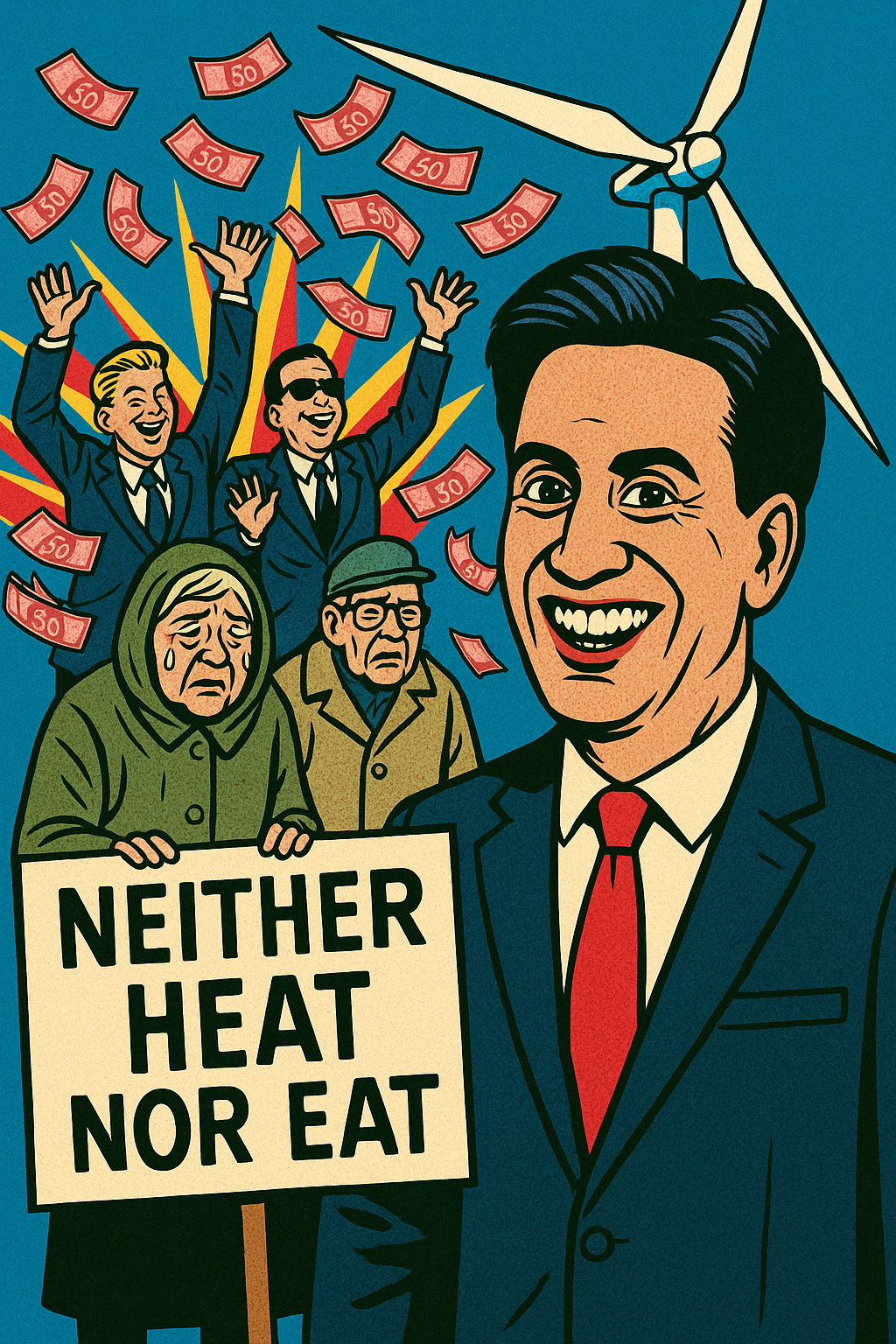
Yet the rot is older and deeper. For two decades Westminster has genuflected before the altar of Net Zero, a creed at once irrational and profitable. On 28 January 2025, The Daily Telegraph published a letter from the Energy Intensive Users Group warning that climate levies were on course to triple by 2030—from £60 to £172 per tonne of CO₂. They told ministers they “will not be able to bear these costs.” Sir Jim Ratcliffe of Ineos called it “industrial extinction” after shutting the last synthetic-ethanol plant in Scotland. Under the emissions-trading scheme, every tonne of carbon produced above a shrinking quota attracts two taxes: the main price, now £41.84, and a supplemental floor of £18 rising to £25. Together they already cost about £60 a tonne and are heading for £172 by 2030. The British steel sector emits roughly 11 million tonnes annually; its carbon-tax bill will approach £1.9 billion a year before the decade is out. Manufacturers pay these charges twice: directly, and again when power companies pass their own carbon costs through electricity bills. The International Energy Agency confirms that Britain’s industrial electricity prices are the highest on earth. The Minister responsible, Ed Miliband, calls this “good for business”. He does not specify whose business.
Behind the ideological fog lies an even uglier trade. The global carbon-credit market, worth $949 billion in 2023, has become a casino for the pious rich. In London the ICE Endex and the LSE’s “Voluntary Carbon Market” turn permission to emit into financial derivatives. A steelworker pays £60 for a tonne of CO₂; a bank repackages that same tonne into a portfolio yielding ten times the profit. The moral arithmetic is perfect: the poor freeze so that hedge funds may breathe easier. Miliband’s father dreamed of expropriating the rich; the son taxes the middle class to feed them.
Meanwhile, the country that once was called “the workshop of the world” is ceasing to make anything at all. Car production has fallen to a seventy-three-year low. Cement output has slumped to the 1950s. Pirelli has “temporarily” closed its tyre plants in Staffordshire and Cumbria; Wedgwood has suspended its pottery for three months; glassworks, foundries, and paper mills go dark every week. Industry’s share of an almost stagnant GDP has dropped in a decade from 12 per cent to below 9. Industrial energy costs are twice those in France and four times those in the United States. Factories that survived the Luftwaffe and the 1970s cannot survive a Cabinet meeting. We are witnessing deliberate de-industrialisation disguised as environmental virtue—the liquidation of a civilisation for tax credits.
The human toll is quieter but just as deliberate. The ONS records more than 60,000 excess winter deaths in 2022–23, the worst in thirty years. Around 6,000 of these were caused by cold homes. Six thousand. They froze to death so that carbon traders could meet their sustainability targets. During that same winter, the average dual-fuel bill reached £2,500, and ministers congratulated themselves on “helping” by capping it there. To call this policy failure is too kind. It is murder by accounting entry. Britain’s entire annual CO₂ output amounts to less than one per cent of the world total; China cancels it out every two weeks. Our sacrifices register only in the balance sheets of energy conglomerates.
And still the politicians congratulate themselves. Miliband dreams of making Britain a “clean-energy superpower” by taxing its remaining industries into oblivion. His department plans to expand carbon pricing to waste incineration and cargo shipping, thereby ensuring that even the disposal of rubbish requires permission from the Treasury. Yet the guilt is bipartisan. It was Cameron and May who imposed the carbon-price support, Johnson who buried fracking, Truss who installed libertarian mascots like Steve Baker and Syed Kamal to preach free markets while presiding over a planned economy. Fourteen years of Conservative rule gave Britain the highest energy prices in Europe. Labour merely tightened the screws. The parties differ in slogan, not in purpose. Their function is to rotate the beneficiaries of the same corruption.
What we inhabit is not capitalism or socialism but an extractive cartel of state, monopoly, and finance. Smart meters spy and disconnect. “Price caps” guarantee margins. “Green subsidies” take from the poor to reward the donor class. Ofgem is not inept; it is obedient. It was designed not to restrain profiteers but to ensure them stability. Transmission companies enjoy regulated returns of eight per cent, immune to risk. Renewable developers collect £11 billion a year in subsidies. Since 2020 the household burden has risen by £24 billion a year while real wholesale costs have barely changed. Every line of the bill is another line of tribute.
The Government pretends that reform is possible. It is not. The framework itself is the theft. The Climate Change Act must be repealed. Carbon levies and price floors must be abolished. Net Zero must be scrapped. The North Sea must reopen; fracking must resume; coal and nuclear must be freed from bureaucratic strangulation. Only competition and abundance can restore sanity. Do these things, and prices will halve within a decade. Fail, and Britain will achieve the unique distinction of being the first nation in history to industrialise, de-industrialise, and congratulate itself on the achievement.
Elsewhere the world moves on. The United States, behind tariff walls and shale gas, is re-industrialising. China builds two coal plants a week. India burns what it must to lift its poor from poverty. Only Britain mistakes starvation for sanctity. Our rulers would rather preside over ruins than relinquish control of the narrative.
When the blackouts come, the press will praise our stoicism. They will speak of Dunkirk Spirit, of shared sacrifice, of “doing our bit for the planet”. But the comparison is obscene. The British of 1940 endured hunger and cold to preserve their civilisation—or so we were told: that was a lie, but is another story. The British of 2025 endure them so that financiers can trade derivatives on the right to breathe. There is no moral grandeur in dying of hypothermia while Ed Miliband tweets beside a wind turbine. The old who perish each winter are not casualties of weather but of policy. Their killers wear suits, not masks, and their weapon is the standing charge.
Between 2000 and 2024 the real wholesale gas price rose 116 per cent; household bills rose 150 to 160. The difference—tens of billions—has been siphoned into the coffers of transmission firms, green-levy contractors, and brokers. Every extra pound on the meter is another brick in the golden wall separating the ruling class from the people who pay for it. The lights of London shine brighter each year while the rest of the country sits in the dark.
This regime cannot be reformed because it is not broken. It works exactly as intended. Elections exchange one set of hirelings for another. The State exists to protect creditors from citizens, not citizens from creditors. A new dispensation is required: one in which ministers cannot join the boards they once subsidised, where energy policy is written for the consumer, not for the financier, and where production is considered a virtue rather than a sin. Britain needs, not another committee or consultation, but a moral revolution—a cleansing of the Augean stables. Until it comes, the lights may flicker on, but the country will remain in darkness.
Sources
- The Daily Telegraph, 30 Oct 2025, “Middle class households to pay off £500m worth of energy debts.”
- The Daily Telegraph, 28 Jan 2025, “Industry will not be able to bear net-zero tax, Miliband warned.”
- The Daily Telegraph, 26 Oct 2025, British industry is now in terminal decline, killed by expensive energy.”
- Office for National Statistics, CPI components D7DT (Electricity) and D7DU (Gas), 2000–2024.
- ONS Excess Winter Mortality Statistics (2022–23).
Discover more from The Libertarian Alliance
Subscribe to get the latest posts sent to your email.
Related posts:

Powered by YARPP.