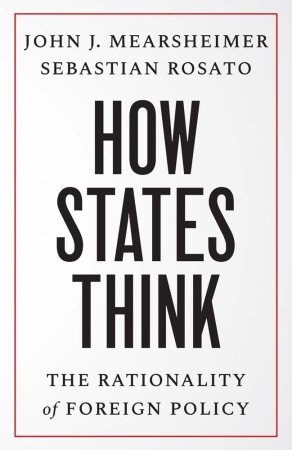
John J. Mearsheimer and Sebastian Rosato, How States Think: The Rationality of Foreign Policy (New Haven: Yale University Press, 2023), ISBN: 9780300259962, 226pp.
John Mearsheimer, long a heretic within the priesthood of American foreign policy scholarship, has once again delivered an uncomfortable truth that the mainstream would prefer buried. With How States Think: The Rationality of Foreign Policy, co-authored with Sebastian Rosato, Mearsheimer confronts the tired refrain that world leaders—from Putin to Kaiser Wilhelm—are irrational lunatics driven by delusion, megalomania, or cultural psychosis. Instead, he demonstrates that foreign policy decisions, even when catastrophic in outcome, are often the products of rational deliberation, guided by coherent theoretical frameworks grounded in geopolitical logic.
This volume, like much of Mearsheimer’s earlier work, commits the cardinal sin of intellectual honesty. It refuses to follow the ideological breadcrumbs laid down by the Atlanticist think tanks and media lackeys. It does not pander to the current obsessions with psychological profiling of “bad men” in history or the lazy habit of moralising every diplomatic decision that defies American hegemonic interests. It lays out, in stark terms, that rationality is not about success or ethical virtue, but about the internal logic and deliberative process behind decision-making: “Rational policies can violate widely accepted standards of conduct and may even be murderously unjust” (p. x). In an era where geopolitical analysis has been reduced to personality cults and partisan outrage, this assertion is practically revolutionary.
The book opens with a challenge to the Western consensus surrounding Russia’s 2022 invasion of Ukraine. The authors present Putin not as a madman lashing out from imperial nostalgia, but as a rational actor responding to a deteriorating security environment and what he described as an existential threat: “For our country, it is a matter of life and death, a matter of our historical future as a nation” (p. xi). This framing is not apologism; it is realism in its purest form. Mearsheimer and Rosato reject the moralistic condemnation of strategic actors whose decisions run afoul of NATO interests. Instead, they contextualise policy decisions within the anarchy of the international system—where “security is the highest end” (p. 213, quoting Waltz).
The authors meticulously dismantle popular definitions of rationality, particularly those employed by rational choice theorists and political psychologists. The former’s model of expected utility is dismissed as a “non-definition” (p. 76)—an empty abstraction untethered from the complexities of real-world statecraft. Political psychology, meanwhile, is critiqued for its presumption that any deviation from Western liberal norms must be a product of cognitive bias or mental defect. By contrast, Mearsheimer and Rosato advocate a clear and grounded definition: rationality involves the application of credible theories and robust deliberation, even in the face of enormous uncertainty (p. 35).
The book is particularly powerful in its use of historical case studies. From Imperial Germany’s pre-WWI calculations (p. 102–108) to the Bush administration’s disastrous invasion of Iraq (p. 199–206), the authors explore the inner workings of foreign policy decision-making. In many so-called “irrational” cases, they uncover coherent, theory-based reasoning. Even Japan’s decision to attack Pearl Harbor is portrayed as an effort to “secure strategic areas… and [establish] an impregnable position” (p. 151, quoting Nagano). The logic is clear—even if the gamble failed.
The most striking contribution of this work is its refutation of the myth that irrationality is a frequent or defining characteristic of state behaviour. The authors demonstrate that even flawed decisions often stem from deliberation based on established schools of thought—realism, liberalism, or some combination thereof. Where irrationality does arise, it is typically due to a collapse in process, often caused by powerful individuals—“dominators”—who override collective deliberation. Cases such as Germany’s “risk fleet” strategy before World War I or the U.S. invasion of Iraq under Cheney’s dominance reflect such breakdowns (p. 180–206).
This insight is essential. It reveals that irrationality is not the norm but the exception. And crucially, it undermines the propaganda value of accusing geopolitical adversaries of madness. Such accusations are often deployed to mask the failures of Western policy or to justify escalation and war. The narrative that Putin is a deranged neo-tsar, or that Iran is governed by apocalyptic mullahs, conveniently absolves NATO strategists of responsibility for provoking predictable, rational responses.
How States Think does more than diagnose the errors of conventional foreign policy analysis—it exposes its ideological function. By insisting that we judge state behaviour not by outcomes or moralistic yardsticks, but by theoretical consistency and deliberative integrity, Mearsheimer and Rosato offer a method of analysis that is both intellectually defensible and politically dangerous. It threatens to strip the American empire of its most powerful illusion: that it is always reasonable, and that its enemies are always mad.
In sum, this book is a decisive intervention in a discipline increasingly dominated by psychobabble and moral posturing. It is a return to theory—not the empty formalism of game theory, but the hard-nosed, historically grounded realism that once guided serious geopolitical analysis. In an era of engineered crises and manufactured consent, such clarity is rare—and for that reason alone, How States Think should be required reading.
Indeed, Mearsheimer’s latest work confirms what many dissidents have long suspected: that when foreign policy fails, it is rarely because the other side acted irrationally. More often, it is because Washington mistook its own ideology for truth, its own delusions for reason, and its own power for omnipotence.
Discover more from The Libertarian Alliance
Subscribe to get the latest posts sent to your email.