
Here is a jolly story—just what I needed to raise my blood pressure in a house that, for financial reasons, I choose not to heat! A boy of fifteen, already wounded in knife fights, already found with drugs and cash and weapons, already known to social services since 2017, has been sent to an “outdoor activity placement” at a cost of £17,000 a week. The Family Court judge who approved it, Steven Parker, called the price “astronomical” and complained that local authorities are “at the mercy” of private care providers. The Department for Education, ever pious in defeat, has announced that it will “crack down on profiteering.”
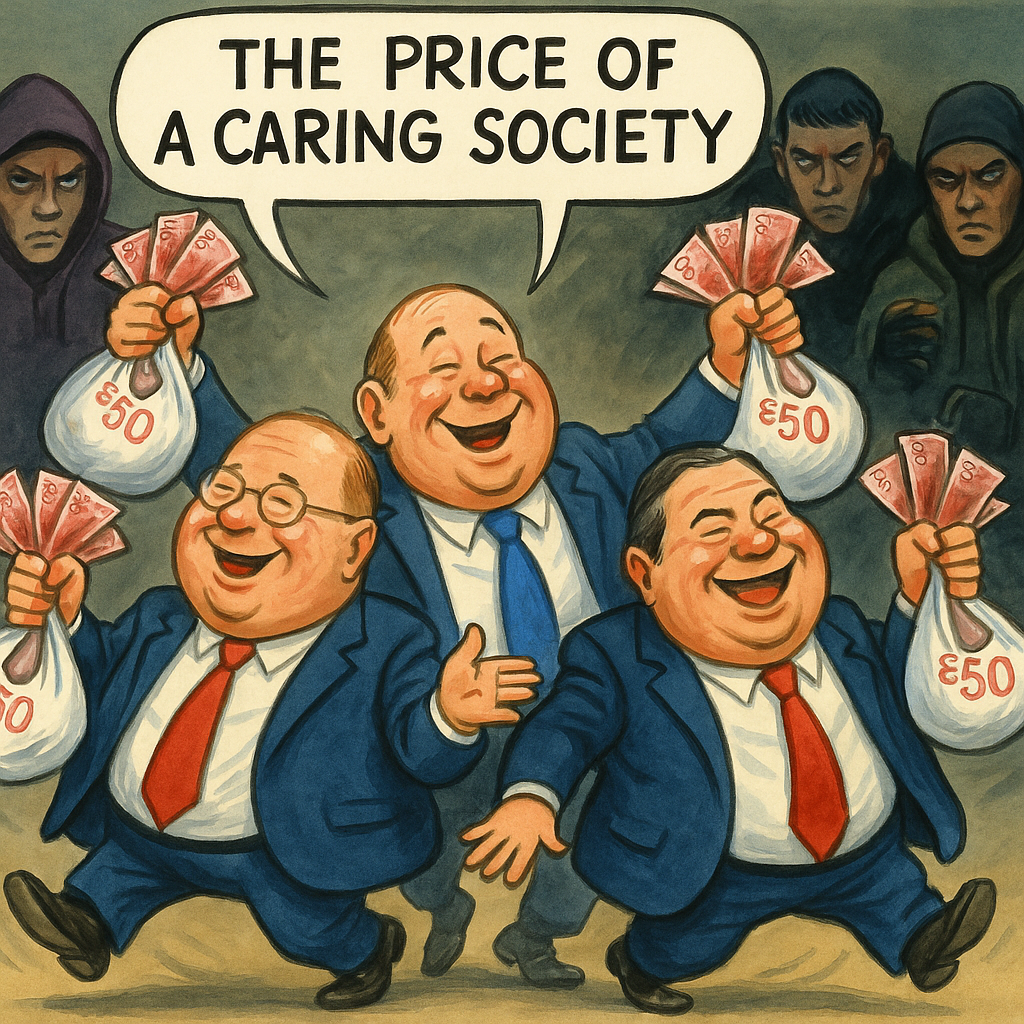
Every part of that story is true. Every part of it is also false. The truth is that this is not profiteering but policy. It is not mismanagement but design. The modern British State wants such children to exist, wants them to cost this much, and wants the public to pay for their endless management. What the judge calls “astronomical costs” are not aberrations—they are the revenue streams of a protected industry.
A price of £17,000 a week—£884,000 a year—for a single boy is not unusual. The National Audit Office has shown that residential placements for “looked-after children” now average over £318,000 per year, and that 10 per cent of placements absorb half of the total spend. England and Wales together spend £15.56 billion a year on these services. This is the care economy—the single most bloated, least productive, and most morally corrupt segment of the British public sector. You can read my earlier moan about this here.
These are not innocent children being shielded from misfortune. They are, for the most part, the children of chaos—the genetic and moral offspring of the underclass bred by fifty years of welfare. They stab each other in daylight. They terrorise schools and streets. Their mothers drink. Their fathers, if known, are already in prison or on the dole. The care system does not reform them. It coddles them until they are old enough to reproduce. And every time one of them goes berserk, the system congratulates itself for “intervening.”
This is the arithmetic of our decline. For every pound the State spends on a bright student learning music or Latin, it spends two hundred on subsidising failure. For every grammar-school graduate denied a scholarship, there is a “vulnerable youth” costing more per week than a house in Kensington.
Judge Parker’s dismay is genuine but irrelevant. He says local authorities are “at the mercy” of private care providers. They are not at the mercy of anyone; they are the architects of the system. They destroyed the network of voluntary and religious institutions that once cared for such children cheaply and effectively. They outlawed discipline. They replaced vocation with process, charity with bureaucracy. The “shortage of accommodation” he mentions is an artefact of regulation.
The private sector did not conquer this market—it was invited in. Councils sold their homes to “not-for-profit” charities which soon became profit-making contractors. Every bureaucrat who failed in the public sector reappeared as a director of a care consultancy, charging triple the rate. The same hands that caused the problem now invoice for its solution.
Whenever the word “vulnerable” appears in an official statement, money is being stolen. The Department for Education says it is “unacceptable for providers to profit excessively from vulnerable children.” But it does not say who these children are, or why they exist in such numbers, or why their guardians require a billion pounds a month to “support” them.
It speaks of “rebalancing the market.” The market cannot be rebalanced because it was never a market. It is a moral cartel. It survives not because it produces results, but because it produces virtue. Each act of failure confirms the righteousness of those who feed on it.
Judge Parker approved the placement because there was nothing else to approve. There are no cheap options, only expensive ones. The boy will spend seventeen weeks being “re-engaged through outdoor activities.” He will kayak and climb and “build resilience.” When the money runs out, he will go home to his mother’s bottles and his father’s absence. By spring, he will be back before another judge, older and better-armed. Another £300,000 will be found. Another judge will sigh.
The scandal is not the profiteering. It is the subsidy of decay. The British State now rewards moral failure as a career path. Have a child you cannot control, and the State will house him, feed him, and employ an army of professionals to interpret his moods. Assault a teacher, and you are “excluded from education”; the remedy is an alternative school at five times the cost. Join a gang, and you qualify for “specialist interventions” with wilderness holidays.
Meanwhile, a musician in training must fund her own instrument. A Latin student must pay for his own textbooks. A school offering the International Baccalaureate cannot afford to teach it. The State starves ability and fattens incompetence.
This “private sector” that the Department promises to discipline is a parody of capitalism. It is a cartel of cronies. Its profits are guaranteed by statute. Councils are obliged to provide placements, whatever the cost. Providers know they will be paid. They charge what they like. The same names appear on the boards of local authorities and their contractors.
When a council pays £17,000 a week for a boy to go climbing, it is not being robbed; it is paying itself. The money circulates among consultancies, charities, training companies, and advocacy groups. Everyone takes a cut. The only person not earning from it is the taxpayer who funds it.
The care industry is not a failure of government but its foundation. It provides employment for tens of thousands of functionaries who vote correctly. It generates statistics that justify the next round of spending. It offers endless opportunities for moral posturing. It has replaced the working class as the moral capital of the Left.
The system needs these children. Without them, there would be no “vulnerability,” no “trauma,” no “safeguarding.” The care industry would collapse. Each new birth to an unfit parent is a future revenue stream. Each act of delinquency is a job creation scheme.
The Department says it will “invest” £560 million “to reform children’s social care and expand and refurbish children’s homes.” This is a confession, not a remedy. More homes mean more children to fill them. Reform in this sector always means expansion. “Cracking down on profiteering” will mean new regulators, new inspectors, new consultants, all funded from the same pot.
Judge Parker says, “It is not for me to say what the solution should be.” Indeed it is not for him. But the solution is obvious. England does not need to “rebalance the market.” It needs to rediscover the distinction between right and wrong. Instead of outdoor activity centres, offer a choice between the armed forces, agriculture, the trades, or hunger. If hunger leads to prison, make prison a place of unending labour on the roads. Or, in place of prison, bring back public flogging of petty criminals. Redraw the old distinction between the deserving and undeserving poor. Stop paying. End the subsidies. Withdraw the licence from every pseudo-charity charging five-figure weekly fees. Make the parents pay or otherwise bear the consequences of their feckless procreation of genetic dross. Let the underclass feel what it costs to reproduce itself. Above all, stop treating the children of degeneracy as sacred objects. Their salvation is not worth the ruin of the nation.
Until then, there will be no shortage of boys like “A,” no shortage of judges to pity them, and no shortage of parasites to grow rich upon them.
Discover more from The Libertarian Alliance
Subscribe to get the latest posts sent to your email.



Bravo! First, your headline engages with science. If I say at a party that I believe in gravity, it is uncontroversial. If I say I believe in Darwinism, people will sidle away, yet both are science. Second, you avoid a frequent libertarian error of leaving the justice system less examined by considering it one of the functions of a limited government. Every person earning a living in society should earn that living from willing voluntary customers. If someone says to me “you don’t mean that about the police” I will say, “I especially mean it about the police and about all those with guns engaged to ‘protect’ us.”