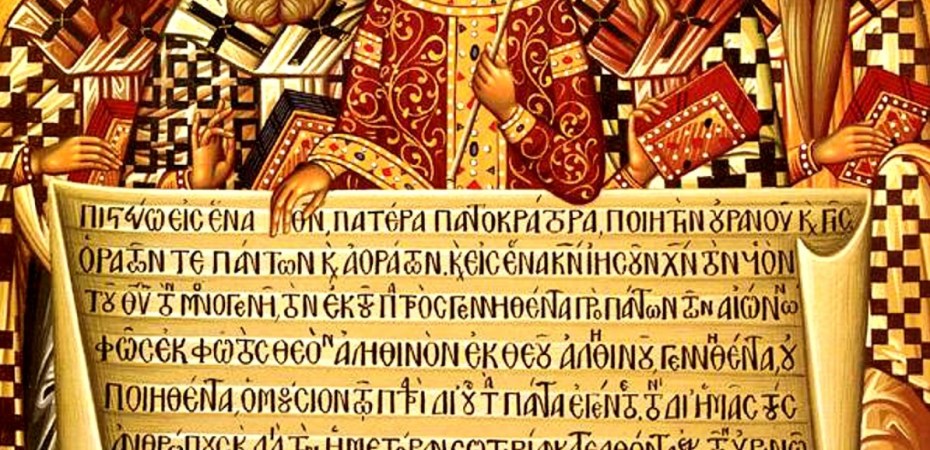
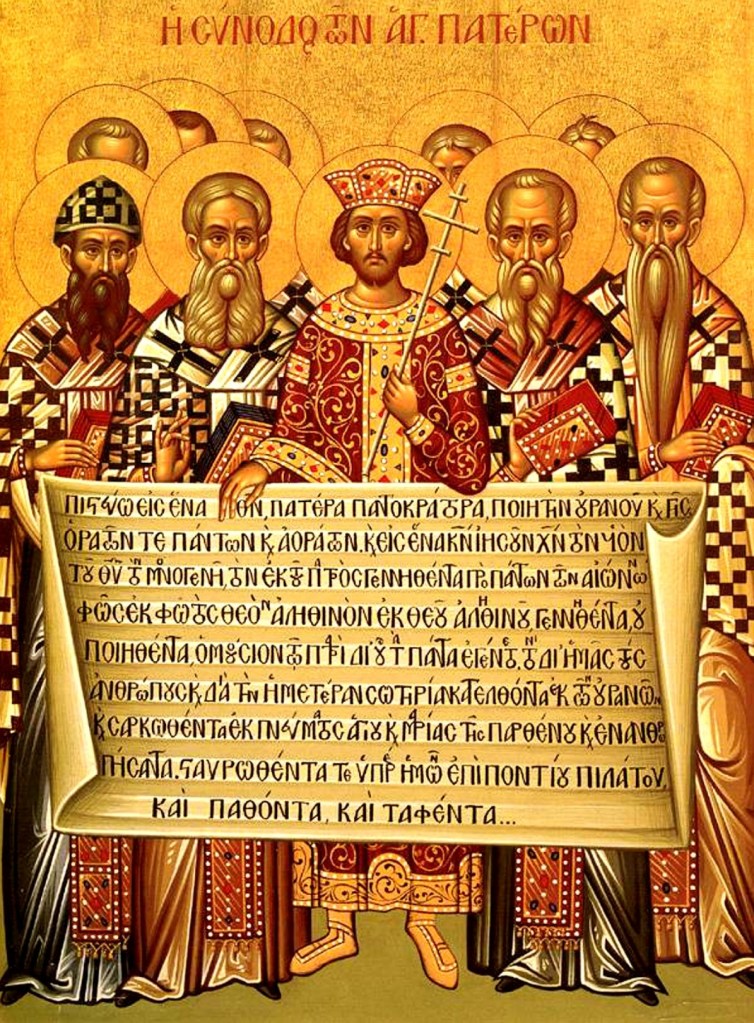
On Saturday the 29th November 2025, at a meeting in Constantinople, Pope Leo XIV and Patriarch Bartholomew signed a Joint Declaration committing their churches to work towards a restoration of full communion. It reads, at first glance, like a neat closing of a circle. Nicaea is praised. The Creed is reaffirmed. There is talk of peace, dialogue, even of one Easter date. If you only skim it, you could imagine that the “Great Schism” is an unfortunate misunderstanding that responsible adults are now managing away with a mixture of goodwill and politely phrased theology.
It is not that simple. The split between East and West is not a quarrel over manners. It came out of centuries of drifting apart after Nicaea, hardened around the filioque controversy and conflicting claims about papal authority, and was then sealed by political catastrophe and mutual bitterness. To understand what is really going on when a Pope and an Ecumenical Patriarch invoke Nicaea together, you have to revisit that longer story.
What follows is my attempt to set out that background as clearly as I can, then to read the declaration through it. Though a Catholic, I will try to be fair to both sides. I will not pretend that repeated references to “dialogue” have already solved what a thousand years of history created.
From Nicaea to Estrangement: How East and West Drifted
The Council of Nicaea in 325 is the obvious starting point. It defined that the Son is homoousios – of one essence – with the Father, and gave us the core of the Creed still used today. Bishops from the whole empire attended. Rome sent legates. Alexandria, Antioch and other centres were represented. There was no sense yet of two rival communions. Everyone was part of one imperial Church, even if there were local rivalries.
After Nicaea, though, the world that had produced that unity did not stay still. By the late fourth century, the Roman Empire was effectively running as two courts. The East had Constantinople, a new capital full of officials, theologians, and money. It spoke Greek. It saw itself as the Christian empire, the guardian of orthodoxy and of the councils.
The West had Rome and then Ravenna, but the imperial system there was weakening. Germanic peoples moved into imperial territory. By 476, the Western Emperor was gone. What remained were Latin-speaking kingdoms – Ostrogoths, then Lombards, then Franks – that paid lip-service to the Roman legacy but ran their own affairs.
This split mattered for the Church.
- In the East, emperors convoked councils, enforced their decisions, and expected bishops to sort out doctrine within an imperial framework. The Patriarch of Constantinople emerged as “New Rome”, alongside Alexandria, Antioch and Jerusalem.
- In the West, the Bishop of Rome found himself dealing with Arian Gothic rulers and later with Frankish kings. The papacy became a symbol of continuity in a world where civil structures were fragile. Rome did not have an emperor above it in the same way as Constantinople. That made a difference to how it thought about its own authority.
At first, these were different emphases inside a shared world. Over time, they became different instincts.
Another factor was language. The Eastern Church lived in Greek, with its own philosophical vocabulary and patristic tradition. The West moved from a bilingual elite to a largely Latin world. When East and West did talk to each other, they sometimes misunderstood because crucial terms were not exactly equivalent.
For example:
- The Greek term ousia and the Latin substantia overlap but carry different resonances.
- Greek liturgy developed elaborate hymnography, icons, and a strong sense of mystery. Latin liturgy became more concise and legalistic in tone.
Liturgy itself diverged. The Romans used unleavened bread in the Eucharist. The Greeks used leavened. Fasting customs, clerical discipline, and minor rites also developed on separate tracks. None of this was heretical in itself. However, when relations were already strained, every divergence could be spun as proof the other side had “gone wrong”.
The fourth to seventh centuries were packed with doctrinal battles: Arianism, Nestorianism, Monophysitism, Monothelitism. East and West were involved in them all, but not always in the same way.
The Eastern empire bore the brunt of these fights, often with direct imperial involvement. Councils at Constantinople, Ephesus and Chalcedon tried to clarify how Christ could be both divine and human without confusion, separation, or mixture. Large sections of the Eastern population, especially in Egypt and Syria, rejected Chalcedon and formed their own Miaphysite Churches.
Rome generally backed Chalcedon and insisted on clear dogmatic formulas. It also had its own undeclared trauma with the so-called “Three Chapters” controversy in the sixth century, when emperors tried to appease anti-Chalcedonian opinion by condemning certain Western theologians whom Rome regarded as sound. The Pope who finally signed was dragged off to Constantinople and treated badly. The memory stayed.
By the time of the iconoclast crisis in the eighth and ninth centuries, the pattern was familiar:
- Emperors and Eastern bishops argued over whether icons should be honoured.
- Popes in Rome condemned iconoclasm and defended the traditional practice.
When the Second Council of Nicaea (787) restored icons, Rome and Constantinople agreed on the outcome. Yet the West also had the Frankish kingdom under Charlemagne, which criticised the council’s language, partly because of a bad Latin translation. Again, East and West technically shared the same faith but did not move in step.
The Council of Constantinople I (381) had already given the Bishop of Constantinople “second place after Rome, because it is New Rome”. Later, at Chalcedon (451), canon 28 expanded that logic: the city that was the seat of the emperor and senate should have equal privileges in ecclesiastical matters.
Rome never accepted that canon. It defended the older ranking based on apostolic foundation – Rome, Alexandria, Antioch, then later Jerusalem. Constantinople, however, had imperial backing and would not go away. Over the next centuries, the Patriarch of Constantinople became the key figure in the East, often clashing with other patriarchates and sometimes with Rome as well.
So by the ninth century you had:
- An Eastern Church centred on a Greek-speaking imperial capital that believed it had a natural primacy in its half of the world.
- A Western Church centred on Rome, which claimed an older, Petrine primacy that did not depend on any emperor.
They still communicated. They still recognised each other’s sacraments. However, mutual irritation was growing.
The Filioque: More Than One Latin Word
Into this already tense environment came the filioque – the phrase “and the Son” added to the description of the Holy Spirit’s procession in the Creed.
The original Creed from Nicaea–Constantinople said that the Holy Spirit “proceeds from the Father”. This was based on John 15:26 and on the Eastern conviction that the Father is the single “arche” or source within the Trinity.
In parts of the Latin West, especially in Spain, a phrase was added: qui ex Patre Filioque procedit – “who proceeds from the Father and the Son”. Councils in Toledo used it in the sixth and seventh centuries, mainly against Arianism. The argument was that if the Spirit comes from the Father and the Son, the Son must share the Father’s full divinity.
Charlemagne’s court theologians later promoted the filioque as a mark of Latin orthodoxy against the Greeks, whom they suspected (sometimes unfairly) of subordinationism. By about the eleventh century, the filioque had become standard in Western liturgical recitation of the Creed. It was even carved on Latin altars in places like Aachen. Eventually, under pressure from the Franks and others, Rome itself adopted the filioque liturgically, though for a long time it had resisted changing the text.
The Eastern objections were twofold.
On the formal side, they argued that no local or regional synod had the right to change the Creed of an Ecumenical Council. If the Church as a whole had agreed a formula at Nicaea and Constantinople, only another truly ecumenical gathering could alter it. From this angle, the filioque looked like an abuse of power: the West unilaterally rewriting the shared symbol of faith.
On the theological side, Eastern theologians worried that the Western wording undermined the “monarchy of the Father”. For them, the Father is the single personal source from whom the Son is begotten and from whom the Spirit proceeds. To say that the Spirit proceeds “from the Father and the Son” sounded as though there were two sources in the Godhead, or as though the Spirit was somehow dependent on both Father and Son in the same way.
Some Eastern writers accepted the formula “through the Son” as an expression of the Spirit’s manifestation in the world. They did not want the filioque turned into a definition of the inner, eternal life of the Trinity.
To be fair, Western theologians did not mean to set up two independent sources. Augustine and those who followed him insisted that the Father and the Son share one divine nature and will, and therefore one principle of the Spirit’s procession. The dispute was about emphasis and conceptual framing.
Yet in practice, the filioque came to symbolise a deeper question. Was the West free to define doctrine and alter common formulas on its own, or should it act only in concert with the East? For the Greeks, the very fact that the West had inserted this phrase without an Ecumenical Council was as worrying as the phrase itself.
These tensions erupted in the ninth-century Photian schism. Photius, a brilliant layman raised quickly to the Patriarchate of Constantinople, clashed with Rome over his appointment and over jurisdiction in Bulgaria. Among other charges, he accused the Latins of heresy for using the filioque.
Local synods in Constantinople condemned the filioque and declared that adding it to the Creed was unlawful. Rome in turn defended its doctrine. The dispute was eventually patched up, but lines had been drawn. The filioque was now a declared point of division, not just a local liturgical difference.
When you fast-forward to 1054, this history sits underneath the formal exchange of excommunications. To the Greeks, the papal legates were representatives of a Church that had, without proper authority, altered the Creed and claimed universal jurisdiction. To the Latins, the Patriarch was rejecting doctrinal developments and papal primacy that they believed were already part of the Church’s life.
The filioque therefore matters not only as a Trinitarian formula but as a symbol of the wider question: is the West allowed to act alone?
From 1054 to 1204 and Beyond: How the Break Hardened
By 1054, when Cardinal Humbert placed a bull of excommunication on the altar of Hagia Sophia and Patriarch Michael Cerularius responded with his own excommunication, relations were already bad. The triggers – disputes over unleavened bread and jurisdiction in southern Italy – were secondary. The deeper issues were the filioque, papal claims, and long-standing suspicion.
Even then, it is important not to read history backwards. Many people did not treat 1054 as a final rupture. Communion still existed in some border regions. There were later contacts and even theoretical unions.
What made the Schism feel permanent were the disasters that followed, especially the Fourth Crusade. In 1204, crusaders diverted from their stated aim of recovering the Holy Land and instead attacked Constantinople itself. They looted the city. Churches and monasteries were plundered. Relics were carted off to the West. A Latin emperor was installed on the throne, and a Latin patriarch was placed in the city.
From the Orthodox point of view, this was not a theological seminar. It was invasion and desecration. However many apologies are issued centuries later, the memory of 1204 still shapes Orthodox attitudes. It confirmed that Latin promises could not be trusted. Anyone talking about “sister Churches” has to reckon with the moment when one “sister” sacked the other’s capital.
There were serious reunion projects later on. The Council of Lyons (1274) and the Council of Florence (1438–39) produced agreements in which Eastern bishops, under severe political pressure, accepted papal primacy and even the filioque. In both cases, these unions collapsed once the bishops went home. The Byzantine laity and lower clergy refused to receive them. They smelled politics behind the theology and were not entirely wrong.
These failures added a further layer of cynicism. From the Orthodox side, “union” began to sound like code for Western domination in exchange for military aid, whether against Latin princes or the Ottoman Turks. From the Catholic side, the repeated pattern of agreed unions being repudiated later looked like instability or bad faith.
After the fall of Constantinople in 1453, the Ecumenical Patriarch became a subject of the Ottoman Sultan. The “millet” system made him, in effect, the civil leader of all Orthodox Christians in the empire. This created new habits of church–state relations, some of which survive in modern forms.
Meanwhile, in the West, the papacy went into battles with rising nation-states, weathered the Protestant Reformation, and reshaped itself at the Council of Trent. By the nineteenth century, Vatican I defined papal infallibility and universal jurisdiction, partly in response to the collapse of the Papal States and the challenge of liberalism.
All this happened without Orthodox participation. The East developed its own spiritual and theological currents, often with a strong monastic flavour and a deep suspicion of rationalism. The West developed scholastic dogmatics and canon law. They still shared the Bible, the first seven councils, and many saints. Yet their institutional memories had split so far that they could no longer hear each other clearly.
Why the Schism Has Lasted
Once the division had acquired history, it gained momentum of its own.
- Different theological styles made mutual understanding harder.
- National Churches in the East became symbols of ethnic survival. The Russian, Greek, Serbian or Romanian Orthodox Church was not just a doctrinal body but a guardian of language and identity.
- The Catholic Church doubled down on a centralised model with a strong papacy, especially after the Reformation.
Each side began to see its own shape as normal and the other’s as slightly deformed.
There were gestures in the twentieth century that broke some of the ice. In 1965, Pope Paul VI and Patriarch Athenagoras lifted the mutual excommunications of 1054. Since then, popes and patriarchs have met more often. There is a Joint International Commission for Theological Dialogue. There is less crude polemic than in the past.
However, the doctrinal and structural issues that created the Schism have not simply evaporated. They are still there under the surface.
The Barriers to Full Communion – A Catholic Reading
From a Catholic point of view, the Orthodox Churches are not heretical sects with invalid sacraments. Rome recognises them as true particular Churches with apostolic succession and a real Eucharist. The Catholic claim is that the fullness of the Church of Christ subsists in the Catholic Church in communion with the successor of Peter. Separation from Rome is therefore a wound, yet not a complete loss of Church life.
Within that framework, the main obstacles look something like this. Catholic doctrine, especially as defined at Vatican I and reaffirmed at Vatican II, holds that the Pope has a primacy given by Christ. It is not only a primacy of honour but a primacy of jurisdiction. He has “supreme, full, immediate, and universal” power over the whole Church. Under specific conditions, he can define doctrine infallibly.
The Orthodox accept a primacy of honour for Rome in the first millennium. Some are prepared to discuss a real, but limited, primacy in a reunited Church. They do not accept a universal jurisdiction that allows Rome to intervene directly in any local Church, nor do they accept the Vatican I definition of infallibility.
From the Catholic side, full communion would require recognising the papal office at least in the sense already defined by the Church’s own councils. You can discuss how that authority is exercised, and you can design structures that give Eastern synods real freedom in their own traditions, but the dogmatic statements cannot simply be rolled back.
From the Orthodox side, this looks like a demand to swallow a specifically Latin development that they have always resisted. Any Catholic–Orthodox “union” that fudged this question would be, in Rome’s eyes, dishonest. Any union that enforced Vatican I in a rigid way would, in many Orthodox eyes, be surrender.
The Catholic Church regards the filioque as a legitimate doctrinal development. It does not treat the Eastern formula “who proceeds from the Father” as wrong. Modern Catholic teaching accepts that saying the Spirit proceeds “from the Father through the Son” can be an orthodox expression of the same reality.
In practice, Rome has shown a willingness to omit the filioque when reciting the Creed jointly with Orthodox or Eastern Catholics, in order to respect the original conciliar text. However, it has not repudiated the doctrine that the Spirit proceeds from the Father and the Son as from one principle.
Many Orthodox theologians remain unconvinced. They fear that the Latin approach undermines the Father’s role as the single arche and ends up with a blurred picture of the Trinity. They also consider the unilateral alteration of the Creed to be illegitimate.
From a Catholic perspective, this is a real theological issue, yet not an insurmountable one. You could imagine a reunited Church using the original Creed in liturgy and allowing different theological explanations, provided they are judged compatible. The difficulty is not only the doctrine but the trust. The East asks whether the West will refrain from unilateral moves in future, or whether another dogmatic definition will arrive one day without their consent.
The Catholic Church defined certain doctrines after the Schism in terms that the Orthodox never accepted, simply because they were not there.
These include:
- The Immaculate Conception of Mary (1854).
- The Assumption of Mary (1950).
- Detailed teachings on purgatory, indulgences, and the temporal consequences of sin.
- Very precise Latin accounts of original sin and grace that rely heavily on Augustine and later scholastics.
Orthodox theology honours Mary as “All-Holy” and speaks of her unique role. It believes in a process of purification for some souls after death. It takes sin extremely seriously. However, it is not naturally eager to turn these themes into sharp legal definitions with penalties and remissions.
From the Catholic point of view, these dogmas express truths that were already present implicitly in the Church’s faith. A full reunion would require accepting them, at least materially, though they could be explained in Eastern language.
That is easy to say and hard to implement. You are asking living Orthodox Churches to assent to definitions that carry a Latin conceptual flavour and that arrived in their absence. Whether that is possible without re-opening the definitions themselves is one of the big open questions.
Finally, there are structural and historical obstacles. On structure, Orthodox Churches are used to a model where autocephalous Churches govern themselves through synods. A reunited Church would need to accommodate that, while still upholding some meaningful primacy for Rome. The Catholic side sometimes points to Eastern Catholic Churches as proof that this is possible. Many Orthodox see those same Churches – the so-called “Uniates” – as evidence of an old policy of absorbing Orthodoxy parish by parish.
On memory, the centuries since 1054 have left deep scars: 1204, Catholic missionary competition in traditionally Orthodox lands, political rivalry in Eastern Europe, and modern nationalist conflicts where Church and state blend in messy ways. Catholic teaching treats these as sins of members of the Church but not as reasons to doubt the Church’s divine constitution. Orthodox narratives sometimes read them as confirmation that Rome’s claims lead to political domination.
Even if theology were miraculously agreed in a committee one afternoon, those memories would still need to be worked through.
Reading the Joint Declaration with All This in Mind
With that history in the background, the joint declaration between Pope Leo XIV and Patriarch Bartholomew looks less like a harmless platitude and more like a very precise balancing act.
Several points are worth noticing.
a) Nicaea as shared foundation
The document leans heavily on the 1700th anniversary of the First Council of Nicaea. It calls the council a “providential event of unity”, recalls its Christology in detail, and insists that Catholics and Orthodox still confess the same faith in the Trinity and in the incarnation.
This is true. For all their differences, both sides recite essentially the same Creed. By starting here, the declaration is trying to remind everyone that the deepest Christian claims about God and Christ are not in dispute between East and West.
It also quietly sidesteps the filioque issue. The declaration quotes the Nicene faith in a way that does not foreground the contested phrase. It goes back to what both sides can say together without flinching. That has obvious symbolic value, even if it leaves the actual controversy untouched.
b) Easter as a test case for practical unity
The text makes much of the fact that, this year, Christians happened to celebrate Easter on the same day. It expresses a “shared desire” to find a common solution so that the “Feast of Feasts” can be kept together every year.
This is not empty. Easter is the central liturgical moment of the Christian year. When Catholics and Orthodox celebrate it on different dates, the disunity is visible in every parish calendar. A common date would not solve papal primacy or the filioque, but it would be a powerful sign that the Churches are at least willing to take concrete steps together.
At the same time, it is a relatively “safe” problem to choose. Agreeing on an Easter date does not require either side to adjust its dogmas. It is more like a test of whether they can act together at all. That is important, yet it is not the same as tackling the theological core.
c) Dialogue, peace, and interreligious relations
Another large section of the declaration deals with war, violence, and interreligious dialogue. It condemns the use of religion to justify violence, urges political leaders to seek peace, and calls for cooperation with people of other faiths, explicitly linking this to the anniversary of Nostra Aetate.
Viewed one way, this is simply responsible. Christians in the Middle East, in Ukraine, and elsewhere live under the shadow of war. The heads of Rome and Constantinople share a duty to speak against the misuse of God’s name for bloodshed. They are also trying to position Christianity as a force for coexistence in plural societies.
Viewed another way, there is a risk that “unity” gets redefined in humanitarian terms. If Catholics and Orthodox stand side by side on peace, ecology, and social justice, the temptation is to assume that doctrinal issues are secondary. The declaration does mention “the joint theological commission” and “issues that have historically been considered divisive”, yet it does not name them. The closest it comes is a reminder of the 1965 lifting of excommunications, and a gentle rebuke to those who “are still hesitant to any form of dialogue”.
I do not think the authors are secretly saying that dogma no longer matters. However, they are clearly prioritising a common public stance on war and cooperation over an open discussion of papal primacy and later dogmas. That tells you something about where official ecumenism is comfortable operating.
d) Unity as both gift and process
The declaration describes unity as a “gift that comes from on high” and also as a goal that requires “firm determination”, dialogue, and joint work. This is standard ecumenical phrasing: unity is something God gives, but we have to prepare ourselves to receive it.
From within Catholic theology, there is a further claim not made explicit here. The Church believes that the fullness of unity already exists, concretely, in the Catholic Church in communion with the Pope. Ecumenism is therefore not a negotiation between equal halves of a broken whole, but an attempt to heal wounds so that others can share that fullness. The declaration talks instead about “sister Churches” walking together towards “full communion” as a future state.
That is not heresy. The Catholic magisterium itself uses the language of sister Churches in certain contexts. Still, the document’s surface symmetry blurs the asymmetry in how Rome understands the situation. For good diplomatic reasons, it does not say what a Catholic dogmatics textbook would say.
Where This Leaves the Schism
If you ask whether the joint declaration has ended the Great Schism, the honest answer is clearly no. It was never intended to. It does three things instead.
First, it reaffirms a shared foundation in Nicaea. That matters. In a world full of Christologies that reduce Jesus to a moral teacher or an inspired prophet, having Rome and Constantinople together recite “true God from true God, homoousios with the Father” is not trivial.
Second, it pushes for practical symbols of unity – most obviously, a common Easter date. If the Churches cannot manage that, it is hard to imagine them solving papal primacy. If they can, it might build some trust.
Third, it sets the tone: less mutual suspicion, more cooperation on peace and human dignity, and ongoing theological dialogue. Tone is not everything, yet without it you cannot even begin.
What it does not do is tell you how the core issues might be resolved. It does not suggest any concrete path by which Orthodoxy could accept Vatican I, or by which Rome could maintain its own dogmas and yet make space for Eastern synodality and theological styles. It nods to the filioque controversy indirectly, by praising the Creed of Nicaea, but leaves the problem of later Western additions to another day.
You could say the Schism began when East and West stopped listening to each other and started assuming the worst. That is partly true. However, they also grew into different shapes. One side built a highly centralised structure with an infallible head and a tight canonical system. The other side developed a looser, synodal network of national Churches that trust councils and Fathers more than any single bishop. Those are not minor variations. They are two ways of being Christian that came out of the same first millennium but then followed separate roads.
The joint declaration is a sign that the leaders on both roads want, at least, to walk in parallel and to talk. It is not yet a map that shows where or whether the roads join.
Reading List
Here is a reasonably full reading list on the East–West Schism, the drift between the Churches after Nicaea, the filioque controversy, and modern Catholic–Orthodox dialogue. I have grouped it so that you can raid it according to mood rather than wade through it in order.
General Overviews of the Great Schism
Henry Chadwick, East and West: The Making of a Rift in the Church: From Apostolic Times until the Council of Florence (Oxford University Press, 2003).
The obvious starting point. Chadwick traces the whole story from the New Testament period through Nicaea, the rise of Constantinople, the filioque, 1054, the Crusades, and the failed unions of Lyons and Florence. It is compact but dense, with a cool Anglican tone that is sympathetic to both sides.
Timothy (Kallistos) Ware, The Orthodox Church (latest ed.).
Standard Orthodox introduction. The chapters on Byzantine history and the schism are clear and readable, and his treatment of Rome is firm but not hysterical. Good for seeing how a well-educated Orthodox bishop tells the story.
John Binns, An Introduction to the Christian Orthodox Churches (Cambridge University Press, 2002).
Covers Orthodox history and theology with less apologetic edge than some in-house texts. The sections on the Schism and later relations with Rome are concise and useful.
Encyclopaedia entries
- East–West Schism in The Oxford Dictionary of the Christian Church (Cross & Livingstone).
- East–West Schism in Encyclopaedia Britannica (online).
Both entries are short but give clean timelines and bibliographies.
Political and Cultural Drift after Nicaea
To get the “slow divergence” rather than just 1054 as a date:
J.B. Bury (ed.), The Cambridge Medieval History, vols. I–IV (old but still valuable).
Especially the chapters on the later Roman Empire, the rise of Constantinople, and the Byzantine Church. It shows how politics and ecclesiology intertwined long before the Schism.
Averil Cameron, The Byzantines (Blackwell, 2006).
Excellent on Byzantine political culture, theology, and self-consciousness as “the Christian empire”. Helps explain why Constantinople felt itself equal or superior to Old Rome.A. Markus, Gregory the Great and His World (Cambridge, 1997).
Rome under Gregory as a Western centre coping with a post-imperial landscape. Useful contrast with the Constantinopolitan situation.
Dimitri Obolensky, The Byzantine Commonwealth: Eastern Europe, 500–1453 (Praeger, 1971).
Shows how Orthodoxy spread through Slavic lands, creating a “commonwealth” of cultures that did not revolve around Rome.
The Filioque Controversy
Here you really want at least one serious monograph and then some ecumenical material.
Edward Siecienski, The Filioque: History of a Doctrinal Controversy (Oxford University Press, 2010).
The modern standard in English. Siecienski traces the biblical and patristic roots, the Spanish and Frankish developments, the Byzantine reactions, and modern dialogue. He is good on both the formal issue (who may alter the Creed) and the substantive issue (Father as single source vs. Latin account of “one principle”). Amazon+1
World Council of Churches, Spirit of God, Spirit of Christ: Ecumenical Reflections on the Filioque (Faith and Order Paper 103, 1981).
Historical and theological essays from Catholic, Orthodox, and Protestant contributors. It shows where serious dialogue had already reached forty years ago and is still widely cited. Internet Archive
Yves Congar, I Believe in the Holy Spirit, vol. 3 (Chapman/Seabury).
Classic Roman Catholic pneumatology with a long section on the filioque and the Eastern objections, written by a major Vatican II peritus.
John Meyendorff, Byzantine Theology: Historical Trends and Doctrinal Themes (Fordham University Press).
Has a strong Orthodox presentation of the monarchy of the Father and patristic Trinitarian thought, against which the filioque looks like a foreign body.
Papal Primacy and Ecclesiology
On the Catholic side:
Klaus Schatz, Papal Primacy: From Its Origins to the Present (Liturgical Press, 1996).
Historical survey of how Roman primacy has been understood and argued for, including the Eastern reception and rejection of various claims.
Joseph Ratzinger (Benedict XVI), Called to Communion (Ignatius Press).
Short but important book on Catholic ecclesiology and primacy. He has some quite irenic ideas on how a reunited East could exercise synodality under Rome.
On the Orthodox side:
John Zizioulas, Being as Communion (St Vladimir’s Seminary Press).
Not a history book, but hugely influential on Orthodox ecclesiology, emphasising bishop, Eucharist, and synodality. Essential for understanding why a strong universal jurisdiction feels alien in this framework.
Nikos Nissiotis et al., The Orthodox Church in the Ecumenical Movement: Documents and Statements, 1902–1975 (WCC).
Contains official Orthodox texts on Rome, primacy, and ecumenism. Very useful for seeing the official tone rather than online polemics.
Primary Sources: Councils, Canons, and Declarations
If you want to quote the things everyone appeals to:
First Council of Nicaea (325)
- Canons in Greek/Latin with English translation, online at Fourth Century Christianity.
Later Councils and Documents
- Decrees of the Ecumenical Councils, ed. Norman Tanner (2 vols., Georgetown University Press). Includes Nicaea, Constantinople, Chalcedon, Lyons, Florence, Trent, etc., with parallel Latin/Greek and English.
- The Acts of the Council of Florence (in Tanner and in older Mansi volumes) for the failed reunion and its doctrinal formulas.
Photian material
- The Mystagogy of the Holy Spirit by Photius (in English translation, in various editions) for an early, sharp Orthodox critique of the filioque.
Modern joint declarations
- Joint Declaration of Pope Paul VI and Ecumenical Patriarch Athenagoras I (7 December 1965) lifting the 1054 excommunications.
- Documents of the Joint International Commission for Theological Dialogue between the Catholic Church and the Orthodox Church (all online on the Vatican “Christian Unity” site), especially:
- The Mystery of the Church and of the Eucharist in the Light of the Mystery of the Holy Trinity (Munich, 1982).
- Uniatism, Method of Union of the Past, and the Present Search for Full Communion (Balamand, 1993).
- Synodality and Primacy during the First Millennium: Towards a Common Understanding in Service to the Unity of the Church (Chieti, 2016).
- The Schism in Broader Church Histories
To keep the Schism in its wider context:
Jaroslav Pelikan, The Christian Tradition, vols. 1–3 (University of Chicago Press).
Especially vol. 2 (The Spirit of Eastern Christendom) and vol. 3 (The Growth of Medieval Theology). Pelikan is superb at showing how Western and Eastern doctrinal developments respond to different pressures.
Karl Bihlmeyer & Hermann Tüchle, Church History: The Middle Ages (Newman Press).
A traditional Catholic narrative that still holds up surprisingly well on factual detail and gives you the Western “feel” for the Schism.
Steven Runciman, The Eastern Schism (Oxford, 1955).
Old now, and coloured by Runciman’s tastes, but still readable and elegant, with a good sense of the personalities involved.
M. Papandreou et al., History of the Ecumenical Patriarchate (Various publishers).
Gives a Constantinopolitan narrative in which Rome is one factor among many.
The Fourth Crusade and 1204
Because nothing poisoned East–West relations like the sack of Constantinople:
Jonathan Phillips, The Fourth Crusade and the Sack of Constantinople (Jonathan Cape, 2004).
Narrative history with decent scholarly apparatus. Shows how the Crusade went off the rails and why the Byzantines never forgave the Latins.
Michael Angold, Byzantium: The Bridge from Antiquity to the Middle Ages and The Fourth Crusade (Routledge).
Angold is good on the longer Byzantine context that made 1204 such a trauma.
Donald M. Nicol, Byzantium and Venice: A Study in Diplomatic and Cultural Relations (Cambridge University Press, 1988).
Explores Venetian–Byzantine relations and shows that 1204 was not simply “evil Catholics attack innocent Orthodox” but a mess of economic and political calculation that still left a spiritual scar.
Modern Catholic–Orthodox Dialogue and Ecclesiological Proposals
To get beyond the “who was right in 1054” question:
Edward Siecienski, The Papacy and the Orthodox: Sources and History of a Debate (Oxford University Press, 2017).
Companion to his filioque book. Traces the arguments over primacy from the Fathers through Florence to John Paul II’s Ut Unum Sint and current dialogue. Very helpful for mapping the terrain.
John Paul II, Ut Unum Sint (1995).
Encyclical on ecumenism with a famous invitation to other Christians to discuss forms of exercising the papal ministry that would be acceptable to them. Essential for understanding the current Catholic “line”.
Metropolitan John (Zizioulas) and Cardinal Walter Kasper, various essays in ecumenical volumes (e.g. the collection The Petrine Ministry: Catholics and Orthodox in Dialogue).
These show high-level Catholic and Orthodox theologians trying to imagine what a reconciled primacy and synodality might look like.
Thomas Bremer, “The ‘West’ as the Archetypal Enemy in the Theological and Philosophical Discourse of Orthodox Christianity”, in EGO – European History Online (2017).
A short but sharp article on how Orthodoxy has often defined itself over against “the West”.
More Technical Studies and Specialist Articles
If you want to go further down the rabbit hole:
- Robert M. Haddad, “The Stations of the Filioque”, St Vladimir’s Theological Quarterly 46 (2002).
- Articles in St Vladimir’s Theological Quarterly, Theological Studies, and Pro Ecclesia on papal primacy, synodality, and first-millennium practice.
- Joseph P. Farrell, God, History and Dialectic (own imprint, 1997; electronic ed. 2008) – a very idiosyncratic Orthodox take on “two Europes”, but fascinating as a window into one radical Orthodox critique of the West.
Discover more from The Libertarian Alliance
Subscribe to get the latest posts sent to your email.