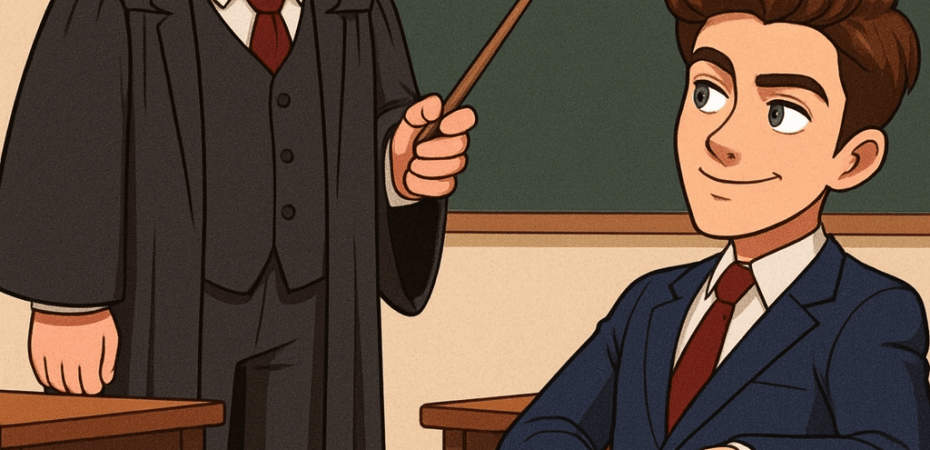
Neil,
Since you have set this rather imaginative examination in the philosophy of liberty, I have done my best to answer the questions in a way consistent with what I actually believe, rather than with what libertarians my grandparents’ age often insist I ought to believe. Unlike Sebastian, whose answers I have seen, I have avoided rhetorical fog and the usual recitations about “self-evident truths.” Rights, justice, and authority only matter if they can be explained without appealing to magic.
I hope the following earns at least a pass mark from you. If not, I will accept the result with my usual good grace, though only after pointing out in tiresome detail where I think the marking scheme has gone wrong.
Q1. How should you judge what actions are right and what actions are wrong?
Answer: Other (specify).
Right and wrong do not come from scripture or Westminster. They are not natural objects waiting to be discovered. They are human rules designed to keep conflict within bearable limits between individuals who have separate bodies and incompatible desires. The only meaningful test of a moral rule is whether it protects those boundaries in ways that prevent life becoming continuous low-level warfare.
So an action is wrong when it invades someone else’s domain; it is right when it does not. This requires no metaphysics and no divine permission. It is the minimal logic required for civilised coexistence.
Q2. What is the status of human rights?
Answer: Other (specify).
A right exists only when there is a recognised rule protecting it and some institutional or customary mechanism that can enforce that rule. Rights are conventions—not in the sense of being optional, but in the sense of being human constructions rather than natural phenomena.
They are not innate; nature contains force, not entitlement. They are not earned; the point of rights is to prevent people evaluating one another as livestock. They are not granted by government; governments excel mainly at destroying rights. Rights are the negotiated boundaries that prevent human beings from devouring each other.
Q3. What are the important human rights and freedoms?
Answer: Life, security of person, liberty and property.
These four rules are the minimal structure that prevents society from disintegrating. They keep people from being killed, beaten, immobilised, or robbed. Everything else withers without them. Once lists of rights start expanding into “dignity” or “self-esteem,” they lose all shape. The core rights matter because they work, not because they are poetic.
Q4. What is your nation?
Answer: Other (specify).
My nation is England in the cultural sense: the historical community of language, memory, and custom. It is not the administrative abstraction called the United Kingdom. Nations are inherited. States are improvised. If Whitehall collapsed tomorrow, England would still exist.
Q5. What is the binding force which holds a nation together?
Answer: Shared culture.
Geography forces proximity but not unity. Shared ancestry can help but is not sufficient. Political goals last only as long as the next general election. Culture—habits, manners, stories, and expectations—is what creates the sense of belonging that allows millions of strangers to behave as if they are members of the same moral community.
Q6. What is politics?
Answer: A system that enables an in-group to exploit and oppress everyone else.
Politics is not a search for the common good. It is the technique by which a minority acquires power over the majority. When the rulers are competent, this can be tolerable. When they are stupid or ideological, it becomes intolerable. The rhetoric of public service disguises a structure that exists mainly to extract obedience, money, and deference.
Q7. Who has a right to tell you how you should behave?
Answer: Your own conscience as a human being.
Nobody acquires moral authority over me simply by claiming it. Governments possess power, not inherent right. Priests possess texts, not enforceable justification. Activists possess slogans, not moral standing. The only legitimate constraints on behaviour are the reciprocal rules that make coexistence possible. Beyond those, a person is answerable only to his conscience.
Anything else is force masquerading as duty.
Q8. Where does the authority of a political government come from?
Answer: From its willingness and ability to govern within the moral consensus of the intelligent.
Authority is not the same as power. Power is the ability to compel. Authority is moral permission. A government becomes legitimate only when it does not go out of its way to destroy its subjects. No modern government meets this standard perfectly, but the standard remains the only one that distinguishes justified rule from organised domination. That being said, I will accept organised domination when it will lead to better outcomes.
If consent evaporates, the State retains its police, but not its authority.
Q9. In what sense are we all equal?
Answer: We are all ethically equal, so each of us should obey the same moral rules.
We are not equal in intelligence, discipline, capacity, or luck. Pretending otherwise insults reality. But we are equal in the only sense relevant to political philosophy: no one is born with a natural licence to invade the body or property of another. Ethical equality means that the same protective rules apply to all.
Equality of outcome is impossible. Equality of opportunity is incoherent. Ethical equality suffices.
Q10. What is justice?
Answer: The condition in which each individual is treated, as far as practicable, as he or she treats others.
Justice is reciprocity under stable rules. It is not emotional satisfaction, redistributive zeal, or ideological theatre. It is the predictable application of principles that protect individuals from aggression and fraud. When someone violates those principles, he forfeits the protection he denied to others.
Justice is not mystical. It is functional. It is what remains when sentimentality is stripped away and only workable rules survive.

Discover more from The Libertarian Alliance
Subscribe to get the latest posts sent to your email.
Related posts:
 Sebastian Answers Headmaster Lock’s Examination in the Philosophy of Liberty
 An Examination in the Philosophy of Liberty
 Examination in the Philosophy of Liberty: The Headmaster’s Report
 Natural Rights: Kinsella v Mercadente
 The Great Alzheimer’s Trap: Why Science Stopped Looking for Real Answers
 The Monopoly of Ideas: Against Intellectual Property
Powered by YARPP.