Emily A. Hemelrijk
Women and Society in the Roman World: A Sourcebook of Inscriptions from the Roman West
(Cambridge University Press, 2020)
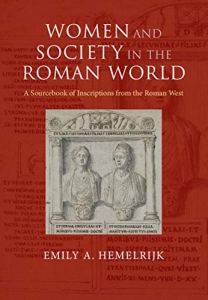 Emily Hemelrijk’s Women and Society in the Roman World offers the clearest and most persuasive case I have yet encountered for taking seriously the claim that Roman women—at least in the Latin-speaking West—enjoyed a degree of visibility and autonomy rarely matched in other ancient civilisations. The book consists of more than 600 inscriptions translated from Latin (and a few from Greek), each one accompanied by a contextual introduction. The range is encyclopaedic: family life, legal status, employment, religion, travel, civic honour. But the cumulative effect is more than empirical. Hemelrijk offers a sustained rebuttal to the assumption, still common in classroom teaching, that Roman women had a purely private, subordinate role. Her evidence is not anecdotal or literary, but epigraphic—drawn directly from the stones set up by and for Roman women themselves.
It’s worth starting with what makes this book unusual. Most writing on women in the ancient world recycle the same set of elite literary references, mostly written by and for men: Pliny’s admiration for Arria, Juvenal’s rants, the over-quoted Laudatio Turiae. Hemelrijk by contrast builds her argument not from rhetoric but from monuments. These include grave markers, dedications, graffiti, curse tablets, and statue bases. Such materials are typically ignored in school courses, not least because of their awkward Latin and formulaic appearance. Yet it is precisely this “unliterary” quality that makes them valuable. They show what mattered to real individuals, often of humble background. And once one starts reading the stone, the standard caricature of the passive Roman matron begins to crumble.
Let us consider the evidence. One of the most striking patterns is women’s participation in public religion. Hemelrijk presents numerous inscriptions honouring women as priestesses, sometimes of major cults like Magna Mater or Isis, but also as sacerdotes in local cities across the West—from Gaul to Numidia. These women did not just conduct rituals in private: they received public statues, funded banquets and games, and acted as patrons of their communities. The very fact that civic priesthoods were often linked to elite status and civic honours undercuts the idea that women were simply extensions of their husbands. Indeed, some of the inscriptions are precise in recording a woman’s own family background, wealth, and initiative in assuming public roles. These are not anomalies; they are a recognised and respected part of the epigraphic landscape.
Of equal interest is the chapter on occupations. The assumption that Roman women were confined to household spinning is challenged here with abundant counterexamples. We find women named as medicae (doctors), nutrices (nurses), tonsores (barbers), calcariae (shoemakers), and even as owners of workshops. There are inscriptions for wet nurses buried with honours, midwives with grateful dedications, freedwomen who ran inns, and even a slave hairdresser named Gnome commemorated with a marble plaque. Most worked in trades learned through slavery and continued in freedom, showing a continuity of skill and enterprise. It is particularly revealing that their professions are not hidden or excused but proudly displayed on funerary monuments. This pride, Hemelrijk argues, suggests that these women saw their work not as degrading but as socially valuable. In an ancient world that often held contempt for manual labour, this is no small thing.
Perhaps most compelling, however, is the evidence for women’s agency in legal and familial matters. The inscriptions are full of women who built their own tombs, named themselves as heirs, endowed civic foundations, and included elaborate instructions in their wills. These are not silent partners in a male-dominated world. Some of the most touching inscriptions are from mothers who buried children, but many are from children—sons and daughters—honouring their mothers not just for maternal devotion but for civic virtues, wealth, and wisdom. The constant appearance of female names on tombs, often prominently displayed, reflects a culture in which women’s identities mattered. Even women who died in childbirth, a sadly common fate, are commemorated with love and public grief.
And it is not just members of the freeborn elite who appear. One of Hemelrijk’s great achievements is to show the range of female voices in the Roman West, from emperors’ relatives to freedwomen and even a few named slaves. Many of the best inscriptions are from columbaria—those mass tombs of imperial freedmen and household staff—where slaves and former slaves set up inscriptions that record not just names but professions, affections, grievances, and hierarchies. These were often multi-ethnic environments, with Greek, Latin, and local names appearing side by side. Women appear here too, often with nicknames and markers of affection, in ways that feel unexpectedly intimate. A slave girl who died at fourteen receives a tender farewell from her young lover; a mother and daughter killed in a shipwreck are depicted together, their names immortalised in verse.
So, what does this mean for the broader question of female equality? No serious historian would claim that Roman women were equal to men in legal terms. The Roman patria potestas system gave enormous formal power to fathers and husbands. Women could not vote, hold office, or serve in the army. Yet what Hemelrijk’s book reveals is the discrepancy between legal incapacity and social power. In practice, many women exercised agency, owned property, ran businesses, took part in civic religion, and were honoured publicly. Their tombs and dedications show they were loved and respected in ways that suggest deep embeddedness in the life of their cities.
Compared to women in classical Athens—kept out of sight, confined to the oikos, with no public presence save in tragedy—Roman women, particularly in the West, emerge as far more visible and active. Compared to Han China, where women were rigorously subordinated to filial piety and clan authority, Roman women had wider space for individuality. Even in comparison with other parts of the Roman Empire, the Latin-speaking West seems to have offered women more frequent opportunities to act in public, to shape civic identity, and to be remembered in their own names.
The conclusion is not that Rome was a feminist utopia. Patriarchy persisted, and some of the same inscriptions that honour women also reflect restrictive ideals—pudicitia, castitas, obedience. But it is clear that within these boundaries, Roman women could and did lead lives of consequence. And they insisted that their contributions be recorded. In a world where many left no trace, their names endure on stone, testifying to a degree of public recognition unmatched by most of their ancient sisters.
Hemelrijk deserves praise not just for compiling this material but for presenting it so accessibly. Each inscription is introduced with a brief but illuminating commentary. Photographs and maps allow the reader to visualise the monuments in situ. The decision to eschew dense academic footnoting makes the book approachable for students and non-specialists. A supplementary PDF with original Latin texts is available online, providing a valuable resource for teachers and advanced readers.
There is a political point here as well. In an era where many university syllabi and popular histories depict the ancient world as a bleak landscape of oppression, Hemelrijk offers a more nuanced view. Yes, there was subordination and injustice. But there was also resilience, complexity, and a form of pragmatic recognition that allowed women to carve out space in the public world. For those of us (like myself) of Chinese background, this holds particular interest. The ancient Chinese world was one of intense male control and ritual confinement. It is difficult to imagine a Han woman having a public statue erected in her name, let alone funding a public building or being appointed as patron of a civic guild. Rome, in this regard, was a different sort of empire.
It would be easy to romanticise this. But it would be just as easy—and more common—to ignore it. Hemelrijk avoids both extremes. Her sourcebook stands as a careful, methodical, and quietly powerful contribution to our understanding of Roman society. In doing so, it opens a door onto a world where women were not equal by statute, but were often equal by esteem.
Discover more from The Libertarian Alliance
Subscribe to get the latest posts sent to your email.