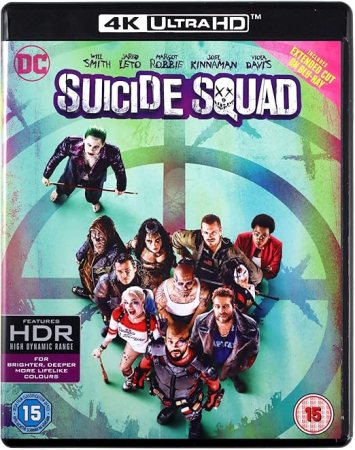
Suicide Squad (2016)
Directed by: David Ayer
Written by: David Ayer
Starring: Will Smith, Jared Leto, Margot Robbie, Joel Kinnaman, Viola Davis, Jai Courtney, Jay Hernandez, Adewale Akinnuoye-Agbaje, Cara Delevingne
Release Date: August 5, 2016
Available on: Prime Video
I have never had much patience for superhero films. Even as a child, I thought they were silly—overblown fantasies where costumed men and women run around engaging in theatrics that insult basic logic. Now that I am older, I can see that they serve a specific purpose in American culture: they are the secular version of the belief in American exceptionalism. They reassure their audience that no matter how corrupt or dysfunctional their country becomes, there will always be powerful beings—either literal superheroes or, failing that, an enlightened ruling class—to save the day. Suicide Squad doubles down on this delusion, but with a slight twist: here, the saviours are officially bad people, criminals coerced into serving the state for their own survival. It is a premise with some potential, but any expectation of real depth is dumped in favour of Hollywood’s usual mush of explosion and box-ticking diversity.
The basics of the plot are that Amanda Waller (Viola Davis), a shadowy government official, decides that the best way to combat threats to the United States is to assemble a team of imprisoned supervillains to do the dirty work of the American state. The so-called “Suicide Squad” includes Deadshot (Will Smith), a hitman with a conscience; Harley Quinn (Margot Robbie), a deranged, oversexualised lunatic; and, in what can only be described as the most embarrassing performance in an already embarrassing film, Jared Leto’s Joker—a preening, tattooed nightclub reject who looks like he was designed by a particularly uncreative marketing team after a brainstorming session about what “edgy” means to teenagers.
The mission that justifies this ridiculous premise is equally absurd. The Suicide Squad is sent off to deal with an ancient, godlike entity called the Enchantress (Cara Delevingne), who is unleashing mass destruction for reasons that barely qualify as motivations. The film is little more than a collection of incoherent fight scenes stitched together with exposition-heavy dialogue that insults the intelligence of even the most forgiving audience. The characters are given no real room to develop beyond the most basic clichés. The whole production oozes desperation—as if a boardroom full of executives had decided to cobble together a product that would tick every demographic box without ever needing to make sense.
The cast is a painful mismatch of styles and abilities. Will Smith does his usual routine of playing Will Smith with a gun. Margot Robbie throws herself into her role with energy, but Harley Quinn, as presented here, is little more than a collection of male-gaze-friendly affectations—she exists to provide fan service, not an actual character arc. Joel Kinnaman’s Rick Flag, the supposed straight man of the ensemble, is dull to the point of invisibility. And then there is Jared Leto again. Every second he is on screen is dreadful. He is neither menacing nor interesting—he is simply annoying, a try-hard parody of what a “cool” villain might look like in the minds of out-of-touch executives.
There is one moment of competence in the casting, and that is Viola Davis as Amanda Waller. Unlike the others, Davis appears to realise that she is in a terrible film and plays her role with a level of icy detachment that almost makes Waller seem genuinely sinister. But her presence only highlights how much better Suicide Squad could have been if it had chosen to lean into its premise rather than churn out a generic superhero film with slightly more tattoos and leather jackets than usual.
Beyond its failings as art, Suicide Squad is a symptom of something much worse: the unshakeable American belief that their government, despite its flaws, is ultimately a force for good. The premise of the film—that dangerous criminals can be turned into heroes if they serve the interests of the American state—plays into a common American narrative about redemption through military service. It is no accident that the film is saturated with imagery designed to glorify state power: heavily armed squads of soldiers, talk of “necessary evils,” the suggestion that a few questionable means are always justified to protect the “greater good.”
If anything, Suicide Squad is worse than the usual superhero fare. At least traditional superheroes function as an idealistic (if laughable) representation of American virtue. This film, however, presents America as a kind of violent protection racket—the bad guys are still working for the state, just in a more overtly coercive arrangement. If this is supposed to be an anti-hero narrative, it is one so sanitized and cowardly that it barely registers as a critique. The real American villains—the politicians, the corporate elites, the architects of foreign wars—are, of course, nowhere to be seen. Instead, the audience is given a fantasy where America is still the world’s last line of defence, its hands only occasionally bloodied by the expendable scoundrels it controls.
It is hard to explain just how mind-numbing Suicide Squad is. It is not merely a bad film; it is an exhausting film. Every scene is a blur of bad jokes and empty action set pieces that leave no lasting impression beyond the feeling that Hollywood has no visible sense of shame. The film is s failure at every level. It fails as a story. It fails as a character piece. It fails even in its cynical attempt to be a “gritty” alternative to traditional superhero films.
The best thing that can be said about Suicide Squad is that, eventually, it ends. I turned it off feeling not entertained, not even particularly angry—just mildly depressed at the waste of my own viewing time and of the wonderful skill and technology eaten up by making it. Beyond that, watching left me with the trite but just realisation of how much America’s film industry has in common with its political system: in obvious decline, but still self-important and convinced of its own virtue despite all evidence to the contrary.
Discover more from The Libertarian Alliance
Subscribe to get the latest posts sent to your email.
In general, I think the wisest policy is to avoid films and novels that are recently produced. They tend to be artificial constructs (astroturf); hopefully few will be influenced by them.