The sudden talk of banning X—still known to most people as Twitter—in the United Kingdom has been presented, with the usual solemn piety, as an emergency response to a moral outrage. We are told that artificial intelligence has been used to generate sexualised images, and that therefore children are at risk, and that the state has no choice but to act. This is the official story, and it is a familiar one. It is also, on any serious inspection, a pretext.
Perhaps I should avoid this digression, but I will make it anyway, if in my best mealy-mouthed lawyerly way. The British governing class has long displayed an extraordinary tolerance for men credibly accused of a taste for underage flesh that was restrained neither by personal decency nor by fear of the law. It has done this while at all times professing concern for the protection of children. In the 1960s, the Chairman of the Conservative Party, Robert Boothby, commissioned the gang boss Ronnie Kray to procure and try out rent boys for him—this at a time when homosexual acts of all kinds were illegal. Jeremy Thorpe, who led the Liberal Party in the 1960s and 1970s, was a determined pederast. He only went too far when he tried to murder one of his cast-off boys. He had to be brought to trial, but the case was wrecked by a bent judge and a parade of defence witnesses who later boasted how they had lied their heads off under oath to save their friend. In the 1980s, Leon Brittan was a Home Secretary surrounded by persistent allegations of sexual abuse involving minors—allegations widespread enough to have shaken public confidence, yet apparently insufficient to prevent him, as is clear from correspondence released in 1982, from discussing with Margaret Thatcher the desirability of banning dildoes. Again in the 1980s, Thatcher covered up for her Parliamentary Private Secretary, whose passion for schoolboys was common knowledge in the Conservative Party.
These are old cases. The only difference, however, between then and now is that the men concerned are no longer in a position to bluster their way through a libel suit. No action has ever been taken so far as I can tell to clean up the governing class. We can be sure that Jeffrey Epstein had and has his British equivalents. Here, I stand at the limit of what it is legally safe to say in England. I will only observe that any claims from the British governing class as a whole about concern for the protection of children defy belief.
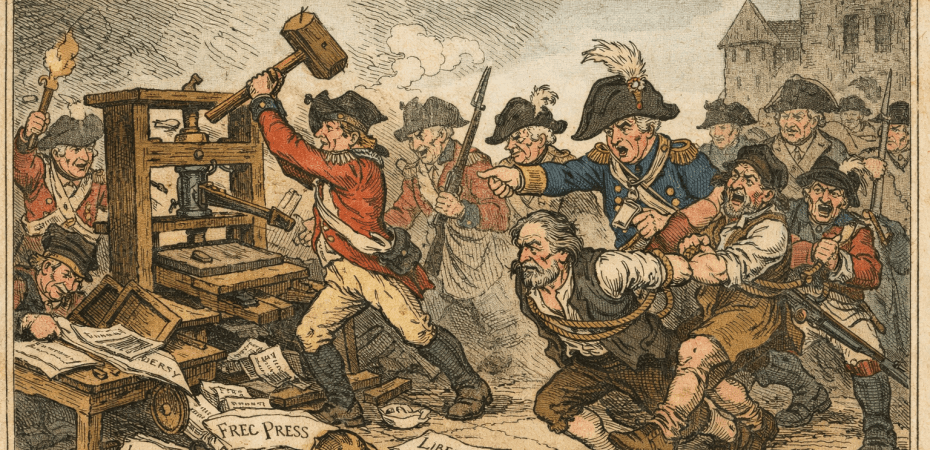
The real background, therefore, to the current threats against X has at least little to do with child pornography or the Grok chatbot. It has everything to do with the rapid criminalisation of dissent, and with the mounting panic of a governing class that no longer commands consent. The proposed ban is not an aberration. It is the logical endpoint of a long campaign to place political speech under close and permanent bureaucratic supervision.
The immediate trigger for the present hysteria was the misuse of Grok, the AI image-generation tool developed by xAI and integrated into X. In early January 2026, a wave of lurid reporting claimed that Grok had been used to generate non-consensual sexualised images, including images purporting to depict minors. The language used was deliberately maximalist. The Prime Minister, Keir Starmer, declared the material “disgusting and not to be tolerated” and publicly urged Ofcom to consider every available sanction, “including blocking the platform” if necessary. Within days, the Technology Secretary, Peter Kyle, confirmed that a ban was “on the table”, and that Ofcom had been instructed to carry out an expedited assessment of X’s compliance with British law.
This was accompanied by the now-ritual performance of urgency. Ministers spoke of a race against time, of unprecedented danger, and of the need to act before harm spread further. X responded by restricting Grok’s image-generation features to paid subscribers, a move widely dismissed as inadequate. The regime press treated this dismissal as proof of guilt rather than as evidence that the goalposts were being moved in real time.
The important point is that none of this is novel. Sexual abuse material has existed on the internet for decades. Britain already possesses extensive legal machinery to deal with it, including criminal offences and cooperation with international bodies. The Internet Watch Foundation has, for years, overseen the blocking of thousands of illegal domains. If the Government’s concern were genuinely confined to child exploitation, it would not need to threaten the closure of an entire political communications platform used by millions of adults to discuss politics.
The true enabling instrument here is not Grok but the Online Safety Act 2023. This sprawling piece of legislation, passed after years of consultation and revision, hands extraordinary discretionary power to the regulator Ofcom. Under the Act, platforms deemed to have failed in their “duty of care” can be fined up to ten per cent of global turnover, subjected to “business disruption measures”, or—in extremis—blocked entirely within the United Kingdom by court order.
The government does not itself pull the switch. Instead, it issues “guidance”, leans on Ofcom, and allows the regulator to present censorship as neutral technical enforcement. This indirection is deliberate. It allows ministers to posture as reluctant guardians of public safety while disclaiming responsibility for the consequences.
The Act also introduces criminal liability for senior managers who fail to comply with information requests or child-safety duties, with potential prison sentences attached. This is not regulation in any classical liberal sense. It is compulsion backed by exemplary punishment, designed to force private companies into becoming auxiliary organs of the state.
That this apparatus is now being openly discussed as a means of blocking access to X should surprise no one who has read the legislation carefully. The power was always there. What has changed is the political confidence to use it.
I will add that this machinery was not built by the current Labour Government. The Online Safety Act is a Conservative creation, conceived, drafted, and driven through Parliament by successive Conservative administrations between 2019 and 2023. Boris Johnson launched the initiative with characteristic bombast, promising to make Britain “the safest place to be online”. Oliver Dowden oversaw the early drafts. Priti Patel lent the weight of the Home Office to its punitive provisions. Rishi Sunak, despite backbench rebellions, ensured its final passage in 2023.
Above all, it was Nadine Dorries who served as the Act’s public evangelist. As Secretary of State for Digital, Culture, Media and Sport, she wrapped the bill in celebrity endorsements, plus emotive anecdotes and a rhetoric of moral emergency. She did more than any other individual politician to transform a vague desire for “online safety” into a comprehensive censorship regime. It is irony bordering on farce that the same Act is now being denounced by Conservatives in opposition as an instrument of Labour authoritarianism. The law is operating exactly as designed.
The scandal is compounded by the Reform Party. Reform has condemned the Online Safety Act and has promised its repeal. On paper, this places it on the side of free expression. At the same time, Reform has welcomed Nadine Dorries into its senior ranks—the Nadine Dorries, that is, who is most responsible for where we are. You cannot plausibly claim to oppose a law while embracing its chief architect. The contradiction is not rhetorical. It reveals how shallow and opportunistic much of Britain’s anti-establishment politics has become.
The ferocity with which X has been targeted is not accidental. Unlike most major platforms, X still permits a relatively wide range of political speech. It is chaotic and frequently vulgar. It is also one of the few remaining spaces in which journalists, academics, politicians, and ordinary citizens can collide without prior filtration by an approved set of moral assumptions.
This makes it intolerable to a governing class that increasingly relies on narrative management rather than persuasion. Britain is governed by ageing, deeply unpopular authoritarians who have lost the ability to command trust. Their policies on immigration, energy, war, and censorship itself would not survive sustained open scrutiny. The natural response is therefore to narrow the space in which scrutiny can occur.
The Grok controversy provided an opportunity. By framing the issue as an emergency involving children, ministers could mobilise the full emotional weight of the state against a platform that has long irritated them. That Grok is an AI tool, and that similar tools exist across the tech sector, is beside the point. The target was chosen in advance.
If X were ultimately blocked in the United Kingdom, the process would be bureaucratic rather than overtly political. Ofcom would issue enforcement notices. A court would authorise access restriction. Internet service providers would be instructed to block domains and IP addresses. Casual users would see error pages. More determined users would resort to VPNs, alternative DNS services, or Tor, just as they do in countries such as Turkey or Russia.
The ban would therefore be more symbolic than absolute. Its real function would be exemplary. It would demonstrate that no platform is beyond reach, that political defiance carries costs, that the British State is prepared to escalate from fines to outright exclusion.
This episode has been extensively reported, though often without serious scepticism, by outlets such as CBS News, The Guardian, The Telegraph, Politico, the BBC, and Yahoo News. Official government statements celebrating the Online Safety Act as a triumph for child protection remain available on the Government website. Critical analysis, including from the Electronic Frontier Foundation, has warned repeatedly that the Act would not make children safer but would instead normalise censorship and surveillance. The present threat to X confirms those warnings in full.
The proposed ban on X is not about protecting children. It is about protecting power. It is the latest move in a campaign to make political speech safe for those who govern by managerial fiat rather than democratic consent. That this campaign was built by a Conservative government with the acquiescence of former self-described libertarians, and is now being used by Labour, should remove any remaining illusions about the nature of Britain’s political class.
Sources
- https://www.cbsnews.com/news/uk-x-elon-musk-grok-ai-sexualized-images-fake-nudes-starmer/
- https://www.theguardian.com/technology/2026/jan/09/musks-x-ordered-by-uk-government-to-tackle-wave-of-indecent-imagery-or-face-ban
- https://variety.com/2026/digital/news/x-grok-ai-editing-paid-users-deepfake-controversy-uk-ban-threat-1236627061/
- https://www.telegraph.co.uk/business/2026/01/08/musks-x-could-be-banned-in-britain-over-ai-chatbot-row/
- https://uk.finance.yahoo.com/news/technology-secretary-threatens-block-uk-172730654.html
- https://www.theguardian.com/technology/2022/jul/13/online-safety-bill-tories-free-speech-david-davis
- https://www.politico.eu/article/online-safety-bill-uk-westminster-politics/
- https://www.gov.uk/government/news/stars-descend-on-downing-street-to-throw-support-behind-new-laws-to-make-uk-safest-place-to-be-online
- https://www.eff.org/deeplinks/2025/08/no-uks-online-safety-act-doesnt-make-children-safer-online
- https://www.legislation.gov.uk/ukpga/2023/50

Discover more from The Libertarian Alliance
Subscribe to get the latest posts sent to your email.