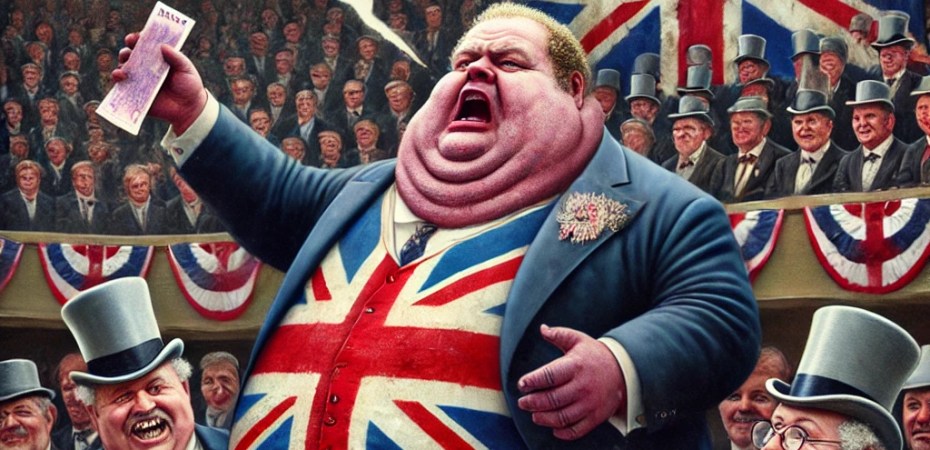
If, like me, you want to be a free citizen of a sovereign country, your first electoral duty is to destroy the Conservative Party. I do not mean to chastise it, to reform it, to remind it of its supposed principles, or to sigh over its past. I mean to destroy it as an electoral force capable of forming a government.
Every one of its leading figures, and this includes all its present and recent Members of Parliament, is a traitor in the only sense that now matters. They assisted in the construction of the dependent police state in which we now live. They expanded surveillance powers. They have entrenched political policing. They normalised the recording of “non-crime hate incidents.” They presided over the cancellation of bank accounts for dissidents. They supported lockdowns that confined the healthy to their homes by administrative decree. They oversaw the largest peacetime transfer of wealth from the productive classes to the financial and bureaucratic classes in our history. They did all this while speaking the language of liberty. It was not incompetence. It was treason.
The Conservative Party promised to control immigration and then opened the gates wider. It promised to cut taxes and delivered the highest tax burden since the 1940s. It promised to defend free speech and abolished it by law and by regulatory terror. It promised to leave the European Union, then retained the regulatory mindset that made departure meaningless. It promised to shrink the State and instead extended its reach into every corner of private life.
There is a limit to how often one can describe this as error. A pattern of betrayal ceases to be accidental. It becomes structural. The modern Conservative Party exists to absorb discontent and to neutralise it. It presents itself as the defender of order against chaos, of nation against utopia, of prudence against fanaticism. In practice, it has functioned as the administrative wing of the same oligarchic settlement that it pretends to resist. It has ensured that nothing essential changes while everything valuable is eroded.
To vote Conservative in present circumstances is not conservatism. It is a vote to continue the managerial revolution by other means.
This leaves the Labour Party. But that can be left to the genuine socialists who follow Jeremy Corbyn and George Galloway. These are as disgusted with Labour as we are with the Conservatives. They look at the parliamentary party and see a machine captured by Atlanticist lawyers and City rentiers. They mutter about purge and betrayal. They complain that Labour has abandoned even the pretence of socialism in favour of technocratic management. Let them pursue that quarrel. Good luck to them too.
There is, however, a further point. If you want to destroy the Labour Party as well, the best you can do is to set an example by helping to destroy the Conservative Party. The Conservative Party is the principal absorber of protest. It is the velvet glove that conceals the administrative fist. So long as it stands intact, every other insurgency remains marginal. Remove it, and the two-party alternation of tone without substance begins to fracture. The regime depends on controlled oscillation. Break one pivot, and the mechanism stutters.
Sadly, this appears at the moment to mean supporting Nigel Farage and his Reform Party. Electoral politics impose this inescapable logic: if you want one party to lose, you need another party to win. There is no metaphysical space between defeat and victory. The only likely replacement for the Conservatives in the short term is Reform.
I say “sadly” because Reform has begun to look exactly like the Conservatives. It looks like the Conservative Party because it is now stuffed at the top with Conservatives: Robert Jenrick, Nadine Dorries, Suella Braverman, Danny Kruger, Nadhim Zahawi. These are not figures of high distinction who have seen the error of their ways and wish to reform a ruined system. They were present at every betrayal. They voted for the lockdowns. They supported the censorship regime. They supported the tax rises and mass immigration. They presided over the decay they now denounce. They now present themselves as insurgents against the order they helped entrench.
A vote for Reform has increasingly become a vote for the second eleven of a party whose first eleven proved almost ludicrously unfitted for any position above pushing trolleys in a Tesco car park. The rhetoric has sharpened. The instincts remain familiar.
Even so, this may be the squalid choice we face at the next election. Most politicians sell out once they have lied their way into office. Nigel Farage appears to have put the usual steps in reverse order. He has diluted in advance. That may not change what needs to be done. If the Conservative Party is to be destroyed, it must be defeated. If Reform is the only vehicle capable of defeating it, then the arithmetic cannot be ignored. Political purity is a luxury in a managed decline.
I have had my attention drawn to various social media postings by Rupert Lowe. These are encouraging. They are not wholly to be trusted. Lowe appears to be driven at least as much by hatred of Nigel Farage as by love of his country. He probably has good reason to hate the man. Most people who have known him share the feeling More to the point, anyone who has never held high political office, and who probably never will, can fire off manifesto promises in all directions without confronting the constraints of power. Even so, what he says is encouraging.
Lowe speaks plainly about tax. He proposes driving corporation tax down to the lowest level in Europe. He speaks of cutting income and dividend rates, of raising thresholds, of reducing National Insurance, of scrapping IR35, of doubling the VAT threshold, of abolishing business rates for small firms, of ending the regulatory suffocation that has turned commerce into a compliance industry. He promises to abolish inheritance tax. He speaks of making the Budget a non-event rather than a ritual humiliation. He proposes to leave private businesses alone if employer and employee are content.
He also addresses the younger generation. He denounces the burden of student loan interest. He proposes scrapping that interest and tightening eligibility for foreign claimants. He speaks of tax relief for working parents, of front-loading child benefit, of abolishing stamp duty for British nationals, of removing welfare access from foreign nationals, of forcing the healthy idle back into visible labour. He rejects the moralising attack on private sector working from home. He speaks of childcare costs that make family formation a financial gamble. This language resonates because it acknowledges reality.
On the one hand, if enough people believe him, that may take votes away from Reform. A divided vote can mean a failed attempt to destroy the Conservative Party. The regime survives by fragmentation of opposition. There is no point in denying that risk.
On the other hand, the fact that Lowe is picking up support by saying what he does may force Reform to start saying the same, and saying the same with more chance of getting itself elected. Farage is not a man who welcomes open dissent within his party. He prefers control to debate, and mediocrity around him to intellectual brilliance. He does not cultivate internal pluralism. But he is attentive to resonance. If he sees that arguments about tax reduction, deregulation, national preference and family relief carry weight, he will adopt them. He will not credit Lowe. He will present them as his own. The origin will not matter.
The idea that a successful political movement must have the same uniformity of belief as the old Communist Party is a mistake. People are not drawn to the sound of an apparatchik droning out the party line. They are drawn to argument, to friction, to visible disagreement that suggests vitality. A party that fears internal discussion begins to resemble the bureaucratic state it claims to oppose.
Rupert Lowe, whatever his motivations and whatever his chance of personal success, is doing us a favour by opening up debates that Nigel Farage is doing his best to silence. He is widening the spectrum of permissible speech within the insurgent camp. He is moving the Overton Window broadly in the right direction.
Do not suppose that a Reform Government would save this country. As said, it is openly the Cameron-May-Johnson Conservative Party Version 2.0 with sharper marketing. It would inherit the same civil service, the same judiciary, the same regulatory superstructure, the same international constraints. It would make the same compromise. It would disappoint. It would retreat from its most incendiary promises under very light pressure.
The path to eventual success probably lies through the failure of a Reform Government. If Reform governs and fails, its failure may discredit not merely its own leadership but the entire managerial consensus from which so many of its new recruits have come. If the Conservatives are first destroyed, Labour’s contradictions sharpen. If Labour falters, the duopoly weakens further. Each disappointment strips illusion. We must think in stages.
The immediate objective is not national resurrection. It is the destruction of the Conservative Party as the principal instrument of managed betrayal. The secondary objective is to expose the structural constraints that bind all major parties. Beyond that lies the cultivation of a movement that understands the real distribution of power in this country and speaks accordingly.
Rupert Lowe’s interventions unsettle the surface. Nigel Farage’s electoral machine may yet serve as a battering ram. Neither man is a saviour. Neither offers a finished doctrine. Both operate within constraints. History seldom presents immaculate champions. It more often presents flawed men in compromised circumstances. The question is not whether they deserve admiration. The question is whether they can be used.

Discover more from The Libertarian Alliance
Subscribe to get the latest posts sent to your email.
Related posts:
 Danny Kruger and the Kiss of Death
 The Function of Farage: A Commentary on Marian Halcombe’s Analysis
Powered by YARPP.
Farage and Reform are finished. Good.
Restore, seemingly, is the only openly non-defeatist nativist party with the courage do what is required.
Firstly, let me say that as a long time Southampton supporter, I have a low (pun intended) level of respect for Rupert Lowe because of the way he treated Lawrie McMenemy.
Secondly, I agree that “Nigel Farage’s electoral machine may yet serve as a battering ram.” That is precisely why I have taken on the job of campaign manager at my local branch of Reform UK.
Thirdly, I have heard the narrative that Lowe’s ascent actually helps Reform, because it enables them to disown the extremist far right. My view is, let’s see what happens, but it’s possible that this narrative may have some validity.
As to strategy, I am pleased to see many similarities between Mr Bickley’s analysis and mine. My four first steps:
(1) Get rid of the Tories. Target date May 7th.
(2) Get rid of Labour (by encouraging them to destroy themselves). Target date looks to me like late 2027.
(3) Get rid of the green agenda, by making sure the evidence, facts and valid scientific conclusions are promulgated. That will get rid of the greens and the illiberal anti-democrats.
(4) Get rid of the s….
(oh dear, as a long time member of the Libertarian Alliance, I don’t think I can complete that word without bringing the organization into disrepute).
(5) Re-build. New set-up of governance. Individual justice for all. Full political and economic freedom for all who earn it by respecting the equal rights of others.
I’m not religious, but I feel I have to end this missive with the word: Amen.
Your self-restraint is greatly appreciated – not that most other writers here display any
Are “they” voting Green because it is pro-environment or anti-Western Civilisation?
Reform has blunted its knives, but so has Rupert Lowe. It is a matter of perspective, but I see no essential difference between Reform and Restore Britain. Remember that the real problem is not illegal immigration, rather it is legal immigration that does the damage.
Rupert Lowe calls for mass deportation of illegal immigrants, but they are not the problem. The problem is that millions have come here perfectly legally. The illegal ones are easy to deal with. It is the legal ones who must be deported or at minimum disenfranchised (as well as those here illegally of course), otherwise this is all pointless – especially pointless if Mr Lowe visibly reassures foreigners that they may still be welcome here as legal immigrants. Maybe he thinks they should still be allowed to vote too?
Perhaps my own metaphor is wrong. It’s as if these people are not so much the blunt knives in the drawer, they are not knives at all. More like spoons, each waiting for their heap of sugar.
So much for the racial paradigm that materialistic boomers don’t grasp. I’m also sorry to say that the economic paradigm is wrong. Any politician who proposes liberal/neo-thatcherite economic policies comes over to me as a salesman for further debasement. Even the leading light of The Libertarian Alliance, Dr. Gabb, acknowledges that Thatcherism contributed to the country’s decline rather than reversing it. Capitalism is a doomed system, but for now (maybe for the next hundred years or so) it remains the only game in town, I admit that, and I think that some things should be run privately or under private initiative or self-direction regardless of the prevailing political-economic system, but workers should have strong rights and there are even free market arguments for a strong plebeian position, and ideas such as Universal Basic Income have free market justifications.
Mr Lowe and The Libertarian Alliance want to do away with much regulation, reasoning that this equates to economic liberty and will stimulate economic activity, but I speak as someone who has had to work in menial employment. I do not agree with most of what has happened in this country since 1997, but I do agree with some of it, especially the protection of workers. Maybe the detailed reforms enacted should be looked at again, and consideration could be given to restricting access to Employment Tribunals, abolishing the minimum wages and restoring Wages Councils, and limiting the scope of the Equality Act, and other ideas – yes, perhaps the Blairite approach was wrong and mistaken – but the broader idea was right and I know what will happen if employers are allowed freer reign again.
All that aside, I wonder if we will see at Westminster something analogous to what happened in Northern Ireland. Everybody assumed that politics there would be dominated by the Ulster Unionists and the SDLP and that the Province would be governed from the centre, and for a time I think the Executive was run by UUP-SDLP ministers. But the undercurrents were pointing in a different direction. The apparent end of the Troubles and devolution had the effect of polarising the electorate and the beneficiaries were the DUP and Sinn Fein ultimately.
Might we see Reform in government, maybe in coalition with or with support from a few Restore Britain MPs, and the Greens as the official opposition?