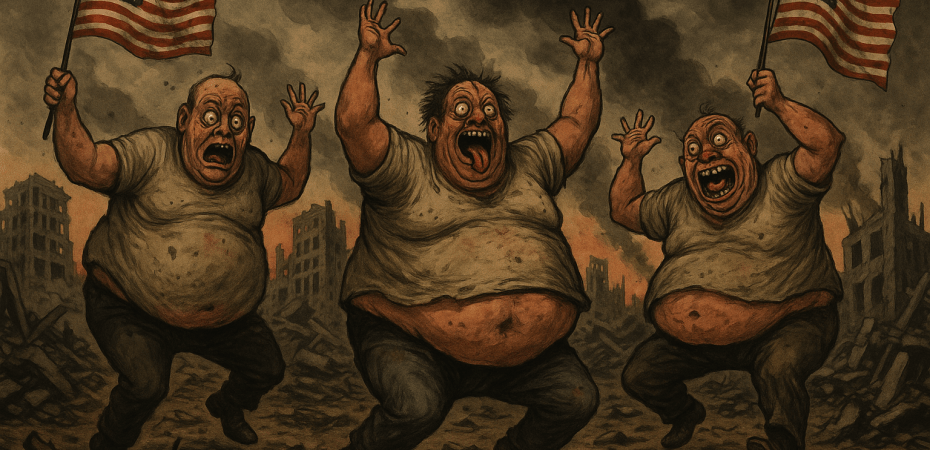
The steady drumbeat toward war with Iran now echoes with a familiarity that should chill any historically literate American. Once again, Washington has assembled an armada in the Middle East—this time the largest concentration of U.S. air and naval power since the invasion of Iraq in 2003. Nearly 100 aerial refuelers. Two carrier strike groups—the USS Abraham Lincoln and now the $17.5 billion USS Gerald R. Ford—shuttled back and forth across the Atlantic like pieces on a risk board. Fighter aircraft. Missile batteries. The full, glistening machinery of what passes in Washington for “strategy.”
To experienced eyes, the composition of this force has only one plausible purpose: a sustained air and missile campaign designed to induce the disintegration of the Iranian state and society. If so, this is strategic imbecility masquerading as strength.
For decades, American presidents and their civilian courtiers have fallen in love with the same fantasy: that massive standoff firepower—precision-guided, data-driven—can compel submission without the messy business of ground war. In a political culture allergic to American casualties, airpower becomes a narcotic. It promises victory without coffins.
But except for Israel’s narrow 1967 preemptive strike, no air and missile campaign in modern history has achieved decisive results. When Bill Clinton was told the Kosovo bombing would last “3 or 4 days,” it dragged on for 78. Serbia’s antiquated 1970s air defenses shot down a stealth F-117 and were never degraded below 83%. In the end, it was diplomacy in Moscow—not bombs over Belgrade—that concluded the affair.
Yet here we are again, intoxicated by targeting matrices and PowerPoint briefings. The planners become true believers. The president, insulated from operational detail, becomes convinced that “shock and awe” will compel Tehran to crawl. Congress abdicates. The political class swoons before the promise of technological omnipotence. Meanwhile, reality intrudes—quietly and often fatally.
Iran is not Iraq. It is not Libya. It is not Yemen. It is a nation of nearly 90 million people, the seventeenth largest country in the world, with a landmass comparable to Western Europe. It has had years to prepare for precisely this scenario. Its missile clusters are widely dispersed and often underground. It possesses modern air defenses and an arsenal of ballistic missiles and drones capable of striking U.S. bases across Qatar, Saudi Arabia, Kuwait, Bahrain, and the UAE—as well as the American flotilla loitering cautiously more than a thousand miles from Iran’s shores.
Even Washington seems dimly aware of this. The Lincoln has been kept at distance. Nine of America’s twelve carriers are in dock or unready, worn down by years of overextension. The USS Dwight D. Eisenhower has spent more than a year in repairs after a failed campaign against Yemen’s Ansar Allah—an irregular force the United States and its allies could not defeat, even after successive bombing campaigns failed to reopen the Red Sea to shipping.
If the U.S. Navy cannot subdue Yemen, what delusion suggests it can bomb Iran into political collapse?
And let us not forget June 2025. In a twelve-day war, Iran first exhausted Israeli air defenses with older missiles and drones, then struck significant military and intelligence targets with more advanced systems. Israeli censorship has prevented a full accounting of the damage. The United States intervened directly, bombing three Iranian nuclear sites before accepting a ceasefire proposal. That was a limited exchange. A new campaign, aimed at “disintegration,” would be something else entirely.
Iranian leaders have already signaled that deterrence requires inflicting at least 500 U.S. casualties. They may be correct that President Trump’s tolerance for body bags is low. The Strait of Hormuz—through which 20% of the world’s oil passes—could be shut down. Oil prices could double or triple. U.S. bases could be hit. Warships targeted. The global economy convulsed. And then what?
Dr. Fred Ickle once warned that states must apply as much discipline to planning exits as to planning attacks. But Washington never plans exits. It assumes submission. If airpower fails to smother Iran’s missile arsenal—and if Israel’s defenses are overwhelmed—the White House will require an “off-ramp.” None is visible.
The more one examines this looming catastrophe, the less it resembles strategic necessity and the more it resembles a grotesque combination of special-interest pressure and political desperation. The American military-industrial complex—Eisenhower’s “unwarranted influence”—has grown fat on endless war. Privatized armaments firms produce ever more expensive systems in ever smaller quantities, generating staggering profits while delivering humiliating results in Afghanistan, Iraq, and Ukraine. Since 1992, the United States has outspent Russia fifteen to one on its military. Yet Russia has outproduced the West in basic war materiel, exposing the structural rot beneath America’s trillion-dollar façade.
The answer from Washington? Increase spending to $1.5 trillion per year. Build larger, more expensive warships. Pretend that a $26 billion carrier will compensate for strategic incoherence. This is not defense. It is imperial inertia, lubricated by campaign contributions and ideological capture.
And now, at a moment when the American political class is reeling from the stench of the Epstein revelations—revelations that have implicated powerful figures and shaken public trust—the drums of war begin to thunder. How convenient that national attention might be redirected toward an external enemy. How convenient that a crisis abroad can eclipse scandal at home. War has always been the health of the state. It rallies flags. It silences dissent. It reframes questions of corruption and elite depravity into questions of “national security.” The timing is too neat to ignore.
Trump’s negotiating team—described accurately as a Laurel and Hardy duo—demands that Iran dismantle its nuclear and missile programs in exchange for no new sanctions. This is not diplomacy; it is performance art. Iran, already crippled by sanctions, is asked to render itself defenseless while Israel retains an arsenal reputed to include hundreds of nuclear warheads. No sovereign state would accept such terms. Diplomacy requires mutual respect and compromise. Washington offers neither. Instead, it offers standoff missiles and ultimatums.
Eisenhower warned in 1949 that those who measure security solely in terms of offensive capacity distort its meaning. Nazi Germany possessed crushing offensive power in 1939. Six years later, it lay smashed. The United States now stands at a similar crossroads—not in moral equivalence, but in strategic folly. Relying on offensive force to solve political problems has placed America on a collision course with the world. The UN Charter prohibits the threat or use of force. Yet Washington treats it as parchment fiction.
There is no good reason to sacrifice American soldiers and sailors in a war on Iran. No justice in killing Iranian civilians. No strategic logic in igniting a regional conflagration that could devastate the global economy and further exhaust a hollowed-out war machine.
The only certainty is destruction—of Iranian infrastructure, of regional stability, and perhaps of America’s own precarious position in the world. The question is whether the American people will recognize this gathering storm for what it is: not a defensive necessity, but a reckless gamble born of arrogance, corruption, and political desperation.
If they do not, another “Made in the USA” catastrophe awaits.

Discover more from The Libertarian Alliance
Subscribe to get the latest posts sent to your email.
[…] insane or a controlled member of the Epstein Syndicate warned against it. The Libertarian Alliance warned repeatedly against it. A war, if it came, was always more likely to be the moment the world discovered that the […]