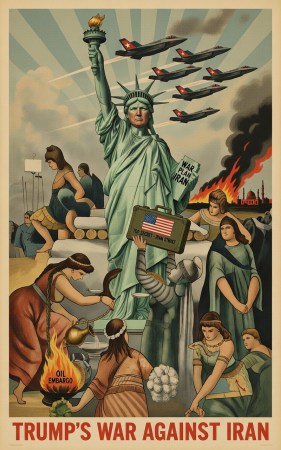
by Kevin Scott Bjornson
Liberty is grounded in the principle that initiating force is wrong, not in the idea that all interventions are wrong. An intervention is simply taking a side in a conflict. Whether it is just or unjust depends entirely on who initiated force. An intervention in defense of victims can be morally justified; an intervention on behalf of aggressors cannot. Both are interventions. The moral distinction lies in the direction of force, not in the fact that a political boundary is crossed.
The belief that “all intervention is aggression” is not part of the classical liberal or individualist anarchist tradition. It is a later development that entered the libertarian movement through a very specific intellectual lineage—one that diverged sharply from the universalist, natural justice framework of thinkers like Mises, Friedman, and Rand.
The Barnes–Martin Lineage
Harry Elmer Barnes, later praised by Murray Rothbard as “the great revisionist historian,” opposed U.S. action against Hitler not by analyzing German aggression, but by claiming that American involvement was engineered by “special interests,” including Jewish groups. His framework inverted the moral reality of the period: the victims of Nazi persecution became the supposed cause of the conflict, while the regime initiating mass violence was recast as a misunderstood actor. This was not principled anti war reasoning; it was a conspiratorial narrative that explained world events through hidden cabals rather than through ideology, institutions, or open aggression.
James J. Martin, Barnes’s protégé, extended this revisionist tradition. He wrote for the late period American Mercury after it had been taken over by extremist owners, and in his later writings he openly praised Axis figures such as Otto Skorzeny. Martin followed the same trajectory as Barnes: beginning with anti interventionist “revisionism” and ending in apologetics for regimes and actors who initiated force on a massive scale.
Rothbard revived this revisionist framework in the post WWII libertarian movement. His foreign policy stance did not come from classical liberalism or 19th century individualism; it came from Barnes and Martin, whose work consistently redirected suspicion toward those defending victims and away from those initiating aggression.
Divergence From the Classical Liberal Revival
The post WWII classical liberal revival led by Mises, Friedman, and Rand (all Jewish-Americans) rebuilt the liberty movement on universal principles: individual rights, economic reasoning, and institutional analysis. They did not treat foreign policy as a stage for hidden puppeteers, nor did they reduce war to the machinations of “special interests.” Their framework was consistent: aggression is wrong, and defending victims is not aggression.
The revisionist anti interventionist lineage diverged from this. It treated the act of intervention itself as the moral wrong, regardless of who initiated force. In doing so, it replaced the core libertarian principle with a reflexive suspicion of the defender and an indulgence toward the aggressor.
The Pattern in Application
Writers in the Barnes–Martin–Rothbard tradition consistently opposed interventions that responded to aggression, and they often opposed interventions that defended groups under attack. During the Cold War, the same pattern extended to communism: they opposed interventions resisting communist expansion even when those interventions were clearly responses to force initiated by communist regimes.
This pattern is not an expression of liberty. It is the product of a revisionist anti interventionism that treats all uses of force as morally equivalent, regardless of who initiated violence.
Modern attempts to view Epstein (a Jew) and Israel as puppeteers controlling US foreign policy repeat the same narrative structure Barnes used in the 1930s and 1940s. Epstein may have hade connections to multiple intelligence services, but the files disclose no evidence of a Epstein-Mossad link. They do show that Epstein cultivated relationships with Russian officials, and eagerly sought to help arrange finances for Putin. Iran is an important ally of Russia. Available files show Epstein opposed Trump and favored Bill Clinton.
Epstein’s activities do not map onto a simple “pro Israel” or “anti Iran” axis. Using him as a unifying explanation for U.S. or Israeli decisions ignores institutional, strategic, and ideological factors and replaces them with a single hidden operator—precisely the template that misdiagnosed events in the past.
Summary
The liberty tradition requires clarity about aggression, not categorical opposition to intervention. When analysis reduces complex state decisions to the actions of a single shadowy figure, it abandons the principles of individual rights and institutional reasoning that define classical liberalism.

Discover more from The Libertarian Alliance
Subscribe to get the latest posts sent to your email.



As a postscript, allow me to add that James J. Martin wrote an article in the late-stage American Mercury magazine in the same issue as a full page eulogy to the-then recently deceased Otto Skorzeny (Hitler’s favorite who held the rank of Standartenführer in the Waffen SS, later charged with war crimes). I wrote a letter to the editor complaining about Martin’s choice in publishing venues, and Martin replied by calling me “reptilian”. I’m not sure if he had in mind the shape-shifting reptilian huminoids who secretly control world governments…
In the case of Trump’s attack on Iran, it’s not merely interventionist, as the U.S. has deep interests in the Middle East. The fundamentalist Islamic regime controlling Iran is a threat, not only to Israel but all the other countries in that region, which the U.S. is trying to have good relations with through the Abraham Accords. It’s important to remember that U.S. withdrawal from the Middle East would create a power vacuum that would be filled by Islamic terrorists, as well as their suppliers/masters Russia and China.
A lot of people seem to forget just how anti-American are the narratives that always look for Jews and Israel to scapegoat for anything that happens in the Middle East involving the U.S.
Excellent analysis. It puts the finger on this disgusting trend in MAGA-related commentary of using “conspiracy theory” to rationalize hatred of Jews and Israel, and kiss up to the memory of Adolf Hitler and the Nazi Party, blaming the victim all the way.
It is heartwarming to see that the liberventionists are back and with no better arguments than they had in 1991 or 2002.