
Mr Bickley says that I should write about the Iran War. I have nothing to say directly about it other than that the British Government should keep out. This is not our war. Indeed, we lose nothing from a stronger Iran, but gain much from a weakened America and a humbled Israel. So I will write instead about the Greek text that I am presently reading with Dr Gabb. This is Plutarch’s biography of Crassus. What I say may have some relevance: I leave that to you to decide.
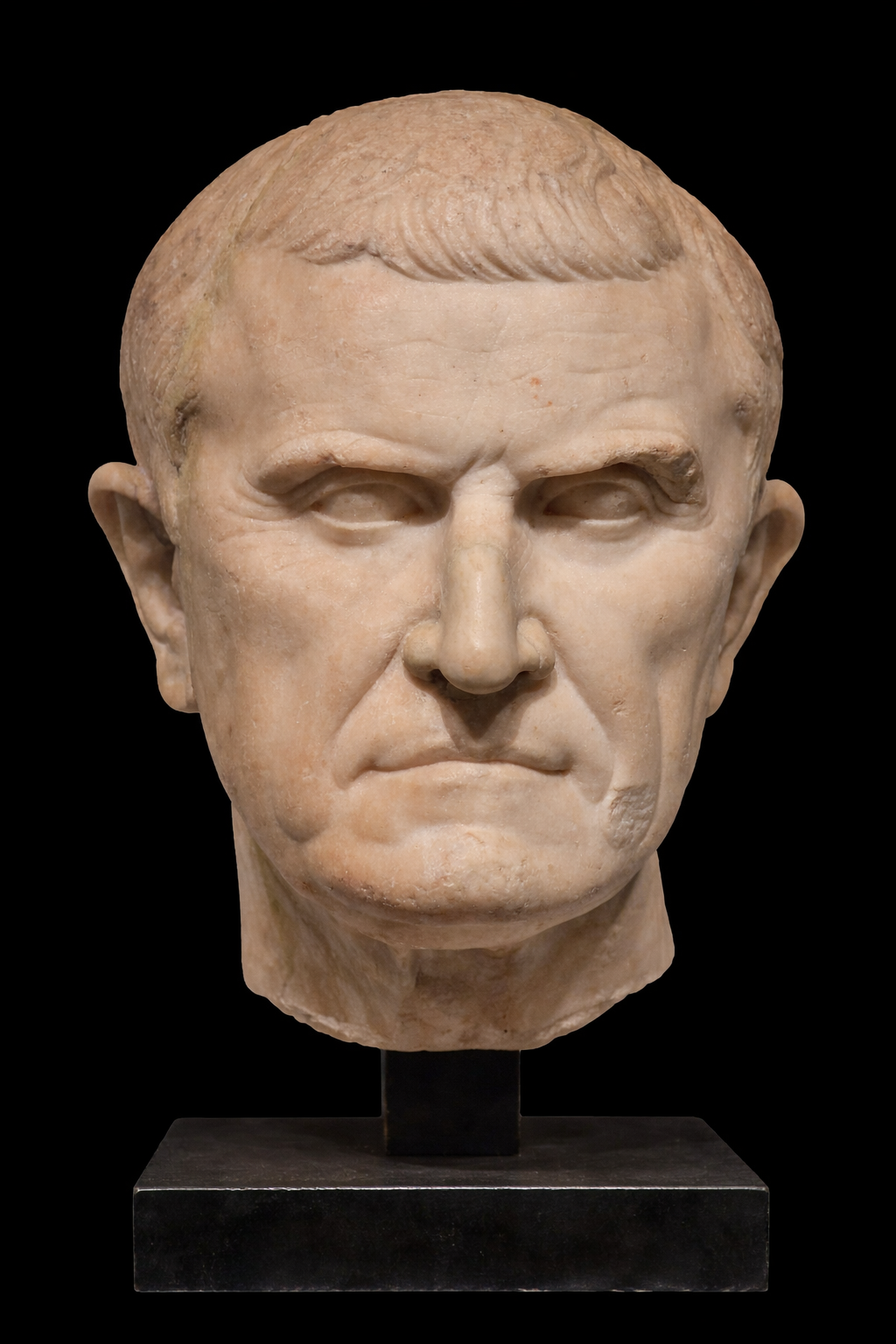
Among the many unlovely figures produced by the Roman Republic in its decline, Marcus Licinius Crassus (115-53 BC) stands out for the peculiar ugliness of his ambition. Rome had known cruel men before him. It had known corrupt men, greedy men, reckless men. Crassus managed to combine all these qualities with a kind of dull mediocrity that made his eventual destruction almost inevitable. Plutarch records his life with a certain restrained contempt. One senses that the biographer recognised in Crassus a very Roman type: the man who mistakes money for merit and confuses personal vanity with the interests of the state.
Wealth Built on Ashes
Crassus began as one of the richest men Rome had ever seen. This wealth did not arise from brilliance in commerce or skill in administration. It came largely from opportunism during times of terror. During the dictatorship of Sulla, Rome endured the notorious proscriptions. Political enemies were declared outlaws. Their property was seized and sold for trivial sums. Crassus made himself useful to the regime by buying up confiscated estates. Plutarch notes that he was particularly fond of purchasing houses that had been burned or abandoned during the chaos of civil conflict.
His most profitable enterprise was almost grotesque. Crassus maintained a private fire brigade composed of hundreds of slaves trained to extinguish flames. When a building caught fire, he did not rush to help. Instead he would arrive and calmly offer to purchase the burning property at a ruinous discount. If the owner refused, the building was allowed to burn. If the owner agreed, the fire brigade suddenly became very efficient.
Thus did Crassus accumulate a fortune. And this was the man who later claimed to act in defence of Rome.
Hunger for Glory
Money, however, was not enough. Crassus envied the glory of other men. Pompey had conquered great kingdoms in the East. Caesar was beginning the campaigns in Gaul that would make him immortal. Crassus possessed wealth greater than both of them combined, yet he lacked the one thing Roman aristocrats valued above everything else: military prestige.
Unfortunately for him, he was not a natural soldier. Plutarch presents him as a man of moderate political ability and very limited strategic insight. He could organise finances. He could manoeuvre within the Senate. Yet war requires imagination, discipline, and patience. Crassus possessed none of these qualities in any convincing degree. Nevertheless he wanted a triumph. He wanted legions, conquered territories, and the intoxicating prestige that comes from defeating foreign powers.
Rome and the Eastern Rival
At the time Crassus turned his eyes eastward, Rome faced a formidable rival in the Parthian Empire. Parthia had grown strong across the Iranian plateau and Mesopotamia. Its rulers commanded immense cavalry forces and controlled the trade routes linking the Mediterranean world with Central Asia. While Rome dominated the western seas, Parthia increasingly looked toward the Levant and the eastern Mediterranean.
In Roman political imagination this rivalry took on a familiar shape. The Republic had long believed that the Mediterranean should be its private lake. Carthage had once stood in the way of that and had been erased from history. Later Hellenistic kingdoms had resisted Roman expansion and had been absorbed or broken. Now Parthia appeared to be moving cautiously toward the same waters.
A prudent Roman statesman might have recognised the situation as delicate. Diplomacy could have stabilised the frontier along the Euphrates. Careful military planning might have prepared Rome for future conflict without provoking immediate disaster.
Crassus saw something entirely different. He saw opportunity.
A War Without Permission
Plutarch records that the invasion of Parthian territory began without the proper authority of the Roman state. Crassus had been appointed governor of Syria in 55 BC. That post carried defensive responsibilities. It did not grant the right to launch an aggressive war against one of the most powerful empires in the known world.
The Senate and People of Rome did not formally declare hostilities. Many prominent Romans warned against the expedition. Even the tribunes of the people attempted to block his departure. Crassus ignored them. He framed the invasion as a necessary action to secure Roman interests in the East. In reality it served a simpler purpose. He wanted a campaign dramatic enough to rival the achievements of Pompey and Caesar.
Personal glory dressed itself in patriotic language, as it often does.
The March into Disaster
From the beginning the expedition was marked by astonishing incompetence. Crassus assembled seven legions and, in 53 BC, crossed the Euphrates into Mesopotamia. Roman armies had fought successfully in many climates and terrains. They had defeated kings and confederations from Spain to Syria. Yet success depends on understanding the enemy.
The Parthians fought differently from the foes Rome had previously encountered. Their strength lay in heavily armoured cavalry and swarms of mounted archers capable of striking from a distance while avoiding close combat. They moved rapidly across open terrain where Roman infantry struggled to maintain formation. Crassus ignored warnings about these tactics. Even worse, he allowed himself to be misled by unreliable local guides who encouraged him to advance deeper into the desert rather than following the safer routes along the rivers.
His logistics began to fail. Water grew scarce. Supply lines stretched thin. The legions marched through unfamiliar territory while the enemy observed from a distance. Parthian commanders understood exactly what they were doing. They allowed Crassus to proceed.
The Trap at Carrhae
Eventually the Roman army approached the region near Carrhae. There the Parthian general Surena decided the moment had arrived. Mounted archers surrounded the legions and began a relentless bombardment. Roman shields and armour offered little protection against the endless rain of arrows. Whenever the Romans attempted to charge, the Parthians simply withdrew on horseback and resumed their attack from a distance. It was a masterpiece of tactical control.
Crassus had marched confidently into territory where his army’s traditional strengths became weaknesses. The tight infantry formations that had crushed so many opponents now turned into targets. The Parthian cavalry could move faster than the Romans could respond.
The battle continued for hours. Roman soldiers died where they stood. Attempts to break through the encirclement collapsed. Units became isolated. Panic began to spread. Crassus’s son Publius, one of the few competent officers in the army, led a desperate cavalry charge that ended in annihilation. The Roman army had been drawn precisely where the Parthians wanted it.
The Collapse
By nightfall the legions were shattered. Some attempted to retreat under cover of darkness. Others surrendered. Many simply died in the desert. Crassus himself entered negotiations with the Parthians that ended in confusion and violence. In the struggle that followed he was killed. Plutarch recounts the famous story that molten gold was poured into his mouth as a final insult to the man whose greed had helped destroy him. Whether or not the story is true, the symbolism pleased Roman moralists. A man who worshipped wealth died mocked by it.
This might have led to a full-scale war between the Roman Republic and the Parthian Empire. The Parthians, however, thought it best to quit while they were ahead. The sent word to Rome that they regarded the invasion as a bandit incursion and would take no further action. The first really big war between the empires had to wait until the reign of Trajan in the early second century.
The Lesson
The catastrophe at Carrhae became one of the greatest military disasters in Roman history. It was not caused by lack of courage among the soldiers. Roman legionaries fought stubbornly even in impossible circumstances. Nor was it inevitable that Rome and Parthia should collide in such a disastrous fashion. The real cause was simpler. One wealthy politician believed that the affairs of great empires could be treated as instruments for personal advancement. He ignored constitutional restraints. He dismissed warnings from experienced men. He marched into a war that had not been carefully planned and did not need to be fought. The Parthians, by contrast, behaved with patience and clarity. They studied their opponent. They allowed him to move deeper into their territory. When the moment was right, they struck with precision and destroyed him.
Ambition and Ruin
Plutarch did not write allegories in the modern sense. Yet his portraits of Roman statesmen often carry warnings that extend beyond their immediate historical setting. Crassus represents a type that appears repeatedly in political life. A rich man begins to believe that wealth grants wisdom. He imagines that power can be seized through spectacle rather than competence. Foreign conflict becomes a stage upon which personal vanity hopes to perform heroic acts. Reality tends to intervene.
Empires do not collapse merely because they possess enemies. They collapse when their leaders treat strategy as theatre and mistake self-promotion for statecraft. The desert of Mesopotamia has seen many armies march across it with confidence. Some returned in triumph. Others left only bones behind. Crassus belonged to the latter category.
Plutarch, with quiet irony, leaves the reader to draw the conclusion. I have drawn mine. Have you?
Discover more from The Libertarian Alliance
Subscribe to get the latest posts sent to your email.
What conclusion do you draw? That Trump is a Caesar, or a Crassus? In reality, he is neither. Unlike the foolish Bush, Trump did not
–announce the time of his attack thus allowing the enemy to prepare
–pass up an opportunity to wipe out the enemy leadership when they gathered together
–launch a full-scale land invasion, which in the case of Iran is vast, mountainous, hot and dry.
–continue to occupy with useless parades and attempts to install democracy
Ukrainian experts have arrived to help with drone defense. So far, the drones have hit mostly Arab civilians, desalination plants and oil tankers. The US is the world’s largest producer of oil and natural gas.
The ratio of Iranian vs. American casualties is thousands to one. US soldiers have plenty of water and food. If we run out of ammo, we can always sail the ships away but not before laying waste to Iran’s economy, thus preventing any attempt at recreating its nuke program for one or two generations. Our plan B is Carthaginian-light. Our plan A is Venezuela-heavy. My life will continue to progress under either option.
At this point, whether Starmer wishes ill or good for the US and Israel is irrelevant to Americans and Israelis. Neither of us are a British colony or protectorate. Decades of dependence on NATO (read: US) protection and an increasing nanny-bully state have hollowed out its once respected military. British culture is also declining fast, due to a failure to replace with a better culture the one they have largely abandoned.
A wise person always thinks to prepare for the worst and not rely on hope for the best. Whether or not British realize the situation, reality has the final say. Time will tell what we will see.
So Ford’s in his flivver and all’s right with the world?