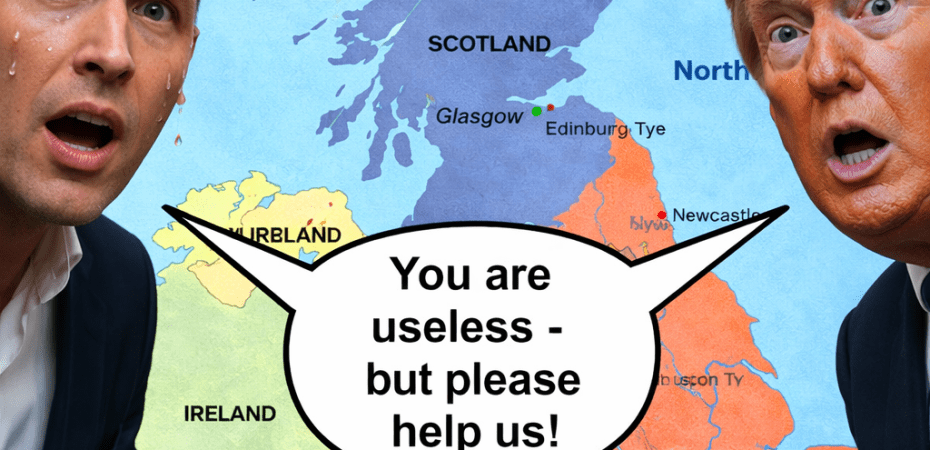
The Evening Standard informs us that Pete Hegseth, the American Secretary of War, has discovered that London lies within missile range of Iran. This revelation appears to have followed a failed Iranian attempt to strike Diego Garcia, after which Mr Hegseth announced—presumably with a straight face—that because Iran had fired at something a long way off, other things a long way off might also be at risk. This is the level at which the Western alliance now conducts its strategic thinking.
There was a time when imperial decline produced men of a certain calibre—dishonest, certainly, but at least articulate in their dishonesty, capable of cloaking aggression in principle, and of conducting folly with a degree of intellectual seriousness. We have now entered a different phase. The United States places its wars in the hands of a former television personality whose understanding of distance appears to have been acquired from a road atlas, and whose reasoning would shame a moderately attentive schoolboy.
Two missiles were fired. Neither struck its target. One was intercepted; the other failed of its own accord. From this, Mr Hegseth concludes that London must now live under the shadow of annihilation. It is difficult to decide whether this is stupidity or theatre. In practice, the distinction scarcely matters.
The British Government, to its credit—or perhaps merely its embarrassment—has declined to endorse this performance. There is, we are told, no assessment that Iran intends to strike London. This is the polite language of dissent. It means that even those whose careers depend on Atlantic obedience are not yet willing to repeat the latest American fantasy.
You might ask why such fantasies are produced at all. The answer is neither subtle nor new. A governing class that has spent two decades blundering from one disaster to another requires a constant supply of fear. Iraq collapsed. Afghanistan collapsed. Libya collapsed. Syria remains a charnel house. The credibility of those responsible has not survived these events. Therefore, something else must be provided in its place. That something is anxiety.
Iran today. Russia tomorrow. North Africa the day after. A missile here, a drone there, a “shadow fleet,” a “hidden hand,” a map with arrows, a general with a grave expression. The details change. The structure remains. The public must be kept in a condition of manageable alarm, so that it will continue to fund and to obey, and to refrain from asking the only relevant question: why are we involved at all?
For that question admits of an answer both simple and intolerable. Britain is at risk not because it is weak, but because it insists on being present. Diego Garcia is not a British necessity. RAF Fairford is not a parish defence measure. These are nodes in an American system of global projection. They exist to make Britain useful to Washington. They do not exist to make Britain safe. If Iran notices them, it does so for reasons that are neither mysterious nor unjustifiable. A state that assists in the bombing of others should not be astonished to discover that it has been added to the list of those who may, in due course, be bombed. This is not a moral judgement. It is a statement of causation.
The British establishment has spent a generation pretending that foreign policy operates without consequences. We intervene for “values,” for “credibility,” for “the rules-based order,” for whatever phrase is currently in fashion among the literate functionaries of Whitehall. When the consequences arrive, they are treated as acts of God. Missiles fall like rain. Enemies arise from nowhere. History becomes a series of unfortunate accidents. The truth is less comforting. We are noticed because we choose to be noticed.
Donald Trump, in his own vulgar manner, described Britain’s aircraft carriers as “toys.” He intended insult. He achieved description. These vessels are not instruments of national defence in any serious sense. They are tokens of status, purchased at vast expense to maintain the illusion that Britain remains a power of the first rank. In reality, they serve only one purpose: to demonstrate that Britain is willing to accompany the United States on its expeditions, and to do so at its own cost. They are toys, in the sense that they exist to gratify the vanity of their owners.
The same may be said of the broader military posture that has been adopted since the end of the Cold War. Britain has abandoned the logic of insular defence in favour of permanent expedition. We are everywhere and nowhere—present in sufficient quantity to attract hostility, but never in sufficient strength to determine events. We possess commitments without control, obligations without authority, risks without benefit. This is not strategy. It is dependency disguised as relevance.
The proper starting point for British defence is geography. We are an island. This used to be considered a fact of some importance. No Iranian army is preparing to land in Kent. No flotilla approaches the Thames. The only plausible threats arise at long range, and even these are mediated by political choice. A country that minds its own business is a less inviting target than one that advertises its participation in distant wars.
It follows that Britain’s safest course is not to extend its commitments, but to reduce them. Withdraw from the habit of automatic alignment. Close the gap between British interests and British actions. Cease to offer facilities and prestige to conflicts that do not concern the British people. Allow others to conduct their quarrels without our assistance. In short, behave like a normal country. This would have two effects. First, it would reduce the number of enemies who have reason to consider Britain at all. Second, it would restore a degree of internal coherence to British policy. A state that does not pretend to be everywhere can concentrate on being somewhere—namely, at home.
The objection is immediate and predictable. Disarmament invites aggression. Weakness tempts attack. The world is dangerous. These phrases have been repeated so often that they have acquired the status of reflexes. They are also largely false. Britain is not endangered because it lacks the means to intervene abroad. It is endangered because it has too many reasons to do so. Remove the reasons, and the danger diminishes accordingly. This is not pacifism. It is prudence.
A modest professional force, sufficient for the protection of maritime approaches and essential infrastructure, combined with a widely distributed capacity for local defence, would serve Britain better than the present arrangement of expensive symbols and foreign entanglements. A people capable of defending its own territory is less dependent on distant alliances, and less easily drawn into conflicts that have nothing to do with its survival. It would also have the incidental advantage of rearming the people and thereby reducing the power of the managerial state. For that is the unspoken companion of every external threat. A missile in the distance becomes an argument for surveillance at home. A hostile power abroad becomes a justification for control within. The same voices that warn of danger are always ready with the remedies: more spending, more regulation, more authority, more obedience. The defence of the realm becomes indistinguishable from the expansion of bureaucracy. The British people are thus invited to pay for their own supervision.
Pete Hegseth is not the cause of this condition. He is its symptom. He speaks in slogans because that is how he thinks, but also because slogans are what the system now requires. He exaggerates threats because exaggerated threats sustain the system. He mistakes noise for thought because thought is no longer necessary to his function. He is, in short, perfectly fitted to his office.
The proper response is not to engage with him on his own terms, still less to echo his alarm. It is to reject the premises that make his performance possible. Britain does not need to be everywhere. Britain does not need to fight every war. Britain does not need to be told, by men of his quality, that distance on a map is the same thing as danger in reality. What Britain needs is a ruling class capable of distinguishing between the two. Until that appears, we shall continue to be governed by men who discover geography with amazement, who mistake failure for warning, and who call for more of the policies that have already brought us to this pass.
London is not threatened because Iran has suddenly learned to measure kilometres. London is threatened because it is governed by fools who think that such measurements are a reason to go on as before.
Discover more from The Libertarian Alliance
Subscribe to get the latest posts sent to your email.
Related posts:


Powered by YARPP.
Iran has demonstrated the ability to reach most of Europe, and unless stopped they will be able to reach the US mainland also.
We should take seriously when cultish regimes announce their threats and intentions. Instead of brushing aside Mein Kampf as hyperbole and capitulating to Hitler’s demands (“peace in our time”), on the theory that intervening against Nazism would provoke Nazis to more aggression.
If the US hadn’t intervened to protect Europe in WW2, Stalin would have conquered western Europe, isolating Britain from the mainland. Sure, there were failures in that fight, such as Monty’s ill-fated “Market Garden” and Churchill’s “Gallipoli” operation. No nation fights perfectly, not even Britain, nor the US in Afghanistan and Iraq.
Article 154 of the Iran constitution “supports the just struggles of the oppressed against the arrogant in every corner of the globe”. Their preamble openly proclaims their duty to continue their struggle (Kampf) and their global mission to expand their belief community to a position of political control over the world. This includes a variety of methods (not just conventional missiles). For fundamentalists (which the Iran regime is), the world is divided into two realms: Dar al Harb (literally “the abode of war”, referring to lands not under Muslim rule); and Dar al Islam (“the abode of Islam”, wherein Sharia law prevails and the ruler is Muslim).
Fortunately, Iran’s constitution does not speak for all who identify as Muslim.
Similarly, not all Nazi party members knowingly signed onto the holocaust or large invasions.
The UK needs a credible military for its own sake and the preservation of the British way of life. The US wants the UK to have a credible military in order to reduce the burden on the US through NATO.