
by Thorten Polleit
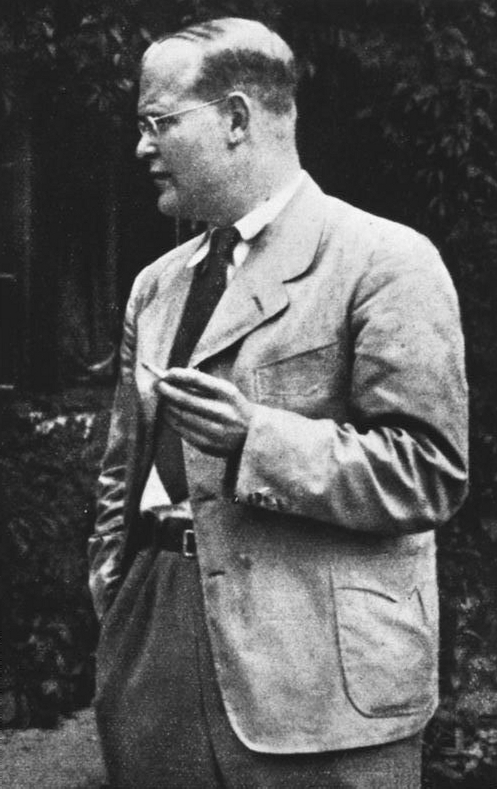
DIETRICH BONHOEFFER—THE CHRISTIAN FIGHTER FOR FREEDOM. ON THE 81ST ANNIVERSARY OF HIS DEATH (1906–1945)
Today, 81 years ago, on 9 April 1945, Dietrich Bonhoeffer was murdered in Flossenbürg concentration camp by the National Socialists.
Bonhoeffer was born on 4 February 1906 in Breslau (today Wrocław, Poland) as the sixth of eight children of an educated middle-class family; his father was a well-known psychiatrist and neurologist. Bonhoeffer studied Protestant theology in Tübingen, Berlin and New York and received his doctorate in 1927. He worked as a theologian, lecturer, student pastor and author (for example “Nachfolge”/“The Cost of Discipleship” (1937) and “Widerstand und Ergebung”/“Letters and Papers from Prison,” written 1943–1945, published 1951).
Bonhoeffer recognised the danger of National Socialism early on. After Adolf Hitler’s (1889–1945) seizure of power in 1933, Bonhoeffer became actively involved in church resistance. He rejected the national socialists influencing the church, publicly criticised the persecution of Jews, and established illegal preachers’ seminaries. In 1935 he became head of the preachers’ seminary of the Confessing Church in Finkenwalde. In 1936 the National Socialist regime withdrew his teaching licence at the university. This was followed by a writing ban and eventually expulsion. After a stay in America, Bonhoeffer returned to Germany. From 1940 he worked with the military resistance: through his brothers-in-law and friends (e.g. Hans von Dohnanyi, 1902–1945; Wilhelm Canaris, 1887–1945) he was involved in plans to overthrow Hitler, including attempts to establish contacts abroad and to rescue Jewish fellow citizens. He led a risky double life as a pastor and opposition figure.
On 5 April 1943, he was arrested together with Dohnanyi and initially imprisoned in the Wehrmacht investigation prison in Tegel. After the failed assassination attempt of Hitler on 20 July 1944, the Gestapo found incriminating material and Bonhoeffer was transferred in October 1944 to Prinz-Albrecht-Straße (Reich Security Main Office). In February 1945 he was moved via Buchenwald to Flossenbürg concentration camp. On 9 April 1945—only a few weeks before the end of the war—he was hanged in the courtyard of the detention building together with other resistance fighters. He was 39 years old.
Bonhoeffer is regarded as one of the most important Protestant theologians of the 20th century, especially as a role model for courageous Christian resistance against injustice and dictatorship. He paid for his struggle for freedom with his life. As a Christian he followed the biblically commanded freedom: freedom not in the sense of “being allowed to do whatever I want,” but as liberation from inner and outer bondage.
The Bible emphasises that man without God lives in bondage—in sin, egoism, guilt and fear of death. Jesus, as Paul writes, has not only freed us from something, but has freed us for something—for the true freedom as children of God:
“For freedom Christ has set us free; stand firm therefore, and do not submit again to a yoke of slavery.” (Galatians 5:1)
“Now the Lord is the Spirit, and where the Spirit of the Lord is, there is freedom.” (2 Corinthians 3:17)
Freedom as understood in the Bible is not licentious. The Bible warns against using freedom as an excuse for egoism or sin. Christian freedom is freedom for the good and for love:
“For you were called to freedom, brothers. Only do not use your freedom as an opportunity for the flesh, but through love serve one another.” (Galatians 5:13)
“Live as people who are free, not using your freedom as a cover-up for evil, but living as servants of God.” (1 Peter 2:16)
In the Old Testament, the focus is often on external liberation, such as the Israelites from slavery in Egypt (Exodus). God presents himself as the one who has liberated his people (Exodus 20:2). The freedom granted by God is here also linked to responsibility and obedience to God’s will. In the New Testament, Jesus refers to Isaiah 61 in Luke 4:18–19 and proclaims:
“He has sent me to proclaim liberty to the captives and recovering of sight to the blind, to set at liberty those who are oppressed.”
The Bible assumes that man has freedom of will and decision. Already in the creation story and the fall into sin (Genesis 3) it becomes clear that man can choose and is responsible for his decisions. God repeatedly calls for choice:
“I have set before you life and death, blessing and curse. Therefore choose life …” (Deuteronomy 30:19)
Bonhoeffer developed a deep, biblical and Christologically grounded understanding of freedom. For him, freedom was not merely “freedom from,” but above all “freedom for”—for service to God and neighbour, for obedience to God’s commandments. In his writings (think of “Ethics,” 1940–1943, “Letters and Papers from Prison”) he criticised an egocentric freedom that leads to massification or tyranny. For him, freedom stands in a tension with responsibility, vicarious representation (standing up for others) and the “mandates” of God (church, family, work, community). He therefore saw the National Socialist total state control of society and the individuals constituting it as incompatible with the Christian life.
In the resistance against the National Socialist regime (from the Confessing Church) Bonhoeffer worked with economists of the Freiburg Circle—with Walter Eucken (1891–1950), Constantin von Dietze (1891–1973) and Adolf Lampe (1897–1948). In 1942/43 Bonhoeffer commissioned them to draw up a memorandum on the post-war order for Germany (“Memorandum of the Freiburg Bonhoeffer Circle”). In it, a competitive order (free market economy with a state regulatory framework) is explicitly preferred to a centrally administered, or planned, economy. The reasoning: Any centrally planned economy leads to massification, corruption, legal uncertainty and makes a Christian life more difficult (no room for personal responsibility). A competitive order, on the other hand, protects legal certainty, prevents concentration of power and offers the best framework for moral action and freedom. This memorandum had a significant influence after 1945 on the so-called “Social Market Economy” (Ludwig Erhard (1897–1977), Alfred Müller-Armack (1901–1978) and others). It attempted to combine Christian-ethical motives (such as responsibility and human dignity) with ordoliberal ideas.
Ordoliberalism, also known as the “Freiburg School,” rejects planned economy and socialism, emphasises competition and freedom as prerequisites for a humane economy and society. However, the central idea of the Ordoliberals that one can use “the good of the state” and at the same time eliminate “the bad of the state” is a momentous error. First the empirical finding: Wherever you look, over time the state has become ever larger and more powerful at the expense of individual freedoms. Whether in education (school and university), transport, health, old-age provision, law and security, money and credit, environment—everywhere the state has become the dominant, now almost overwhelming actor and has increasingly destroyed the freedoms of the individual. And this is no coincidence.
For the state is—and this is what the Ordoliberals fail to recognise—the territorial compulsory monopolist with the final decision-making power over all conflicts on its territory, and it claims the right to levy taxes (it thus allows itself something that is forbidden to all others: to force people against their will to pay money). Such a state did not come into being through voluntary agreements, but through coercion and violence, and coercion and violence are ultimately the means with which it enforces its commands against individuals.
Above all, the state cannot be tamed, cannot be contained, not by invocations, not by constitutional rules. It becomes ever larger and more powerful—at the expense of the freedoms of those subject to it.
The ordoliberal basic idea of a merely “ordering state,” a state that can be limited and kept small, is an illusion, a false thought. Hans-Hermann Hoppe has aptly put it: that even from a minimal state a maximal state will sooner or later emerge. For the maximal state is already inherent in the raison d’état. Raison d’état means that the interest in the preservation, security and well-being of the state stands above all individual interests. According to this ideology, the state is “allowed” to take actions that violate the law, morality or religious rules applicable to individuals (such as taxes or military conscription) if this is deemed necessary for securing its existence or its interests.
The intellectual roots of modern raison d’état are located by the Swiss historian Jacob Burckhardt (1818–1897) in the Italian Renaissance of the 14th to 16th centuries, where Niccolò Machiavelli (1469–1527) prominently laid down the foundations of a ruthless, purpose-rational power politics that subordinates morality and the welfare of the subjects to state interests in his work “The Prince” (Il Principe, written 1513, published posthumously 1532). Well-known theoreticians and especially practitioners of this doctrine north of the Alps were, for example, Cardinal Richelieu (1585–1642) or Otto von Bismarck (1815–1898), who implemented the idea of raison d’état, underlying the modern state, in France and Germany. An ideology which, according to its inherent logic, led to the suppression of the freedom and prosperity of individuals and to a centralisation of power in all present-day nation states.
Ludwig von Mises (1881–1973) called this ideology arising from raison d’état “etatism,” which he defined as follows:
“Etatism is, as a theory, the doctrine of the omnipotence of the state, and as a practice, the policy that strives to order all earthly things through commands and prohibitions of the authorities. The community ideal of etatism is a particular form of state socialism.”
The path to the “all-powerful state” that is once again being taken in Germany would have been more than a great disappointment for Bonhoeffer, perhaps even horrified him, precisely from a Christian-freedom perspective.
The biblical emphasis on personal freedom, and the commanded necessity to provide order, law and security for the community of people is usually presented as an area of conflict; and the use of coercion and violence by the state is, as long as it remains “limited,” accepted (grudgingly) as a viable solution. But such consent ignores and fails to recognise that the provision of the goods of order, law and security in the community does not require any coercive and violent monopoly at all (indeed, that a coercive and violent monopoly is in contradiction to law and order), but that they can only be provided in a free market. The logical solution is: “private law society.”
In a private law society, the same law applies to everyone. There is no “public law” that stands above private law. Uninvited coercion and aggression (“Thou shalt not steal,” “Thou shalt not kill”) are forbidden, property (biblically part of the order of creation) is protected. Christian neighbourly love takes place on the basis of voluntariness, not through coercion (2 Corinthians 9:7: “Each one must give as he has decided in his heart, not reluctantly or under compulsion”). The goods of security, law and order (police, justice and defence) are demanded and supplied in the free market like any other good: by competing, voluntarily financed providers (voluntary associations of all kinds such as insurance companies, protection agencies, arbitration courts, community assemblies and the like).
It is probably due to the distorted images, the confusion, the reinterpreted truths (as they are generated in particular in modern mainstream economics) that so many people today find it so difficult to recognise the state (as we know it today) for what it actually is: a man-made “coercive and oppressive apparatus”, as Ludwig von Mises put it. The modern state in this form cannot be a God-ordained authority (Romans 13:1-7). On the contrary: the state (as we know it today) is literally a deception that calls us to dis-illusionment.
And it was precisely to this that Bonhoeffer, incidentally, urgently called us in his letters from prison; he warned us against the “masquerade” that veils truth, the good and the right. He wrote: “The great masquerade of evil has thrown all ethical concepts into confusion. That evil appears in the form of light, of benefit, of historical necessity, of social justice is for the one coming from our traditional ethical world of concepts simply confusing; for the Christian who lives from the Bible, it is precisely the confirmation of the abysmal wickedness of evil.”
Bonhoeffer was murdered by the National Socialists 81 years ago today. His death still admonishes Christians today to resist an unjust state; and Bonhoeffer’s struggle for freedom should above all encourage freedom theorists, especially representatives of libertarianism, to expand their (action-)logical foundation of freedom by expressly including Christianity and Holy Scripture. For the ultimate, unshakable freedom in a fallen world does not lie in human hands; it is rather the freedom of the children of God through faith in Jesus Christ.
Discover more from The Libertarian Alliance
Subscribe to get the latest posts sent to your email.
Related posts:

Powered by YARPP.