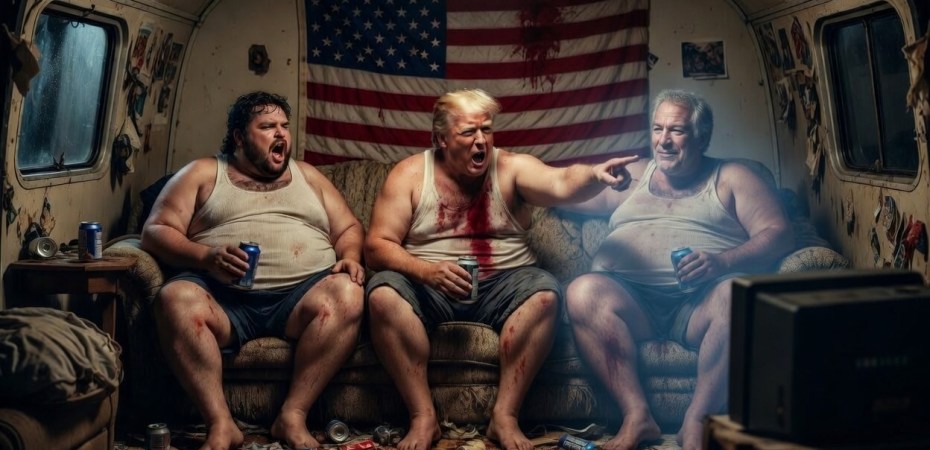
Probably, I should stop writing about this godawful war. Giving up, however, is as hard as looking away from some gory public execution: you know you should, but the latest spurt of blood and shuddering scream is just too much. A further point is that I voted for this dumpster fire of an Administration. Unless I am denouncing it in public, I feel morally dirty. So here goes….
In the latest chapter of an already disastrous foreign policy misadventure, President Donald Trump has announced a naval blockade of Iranian ports in the Strait of Hormuz following the collapse of high-level talks in Islamabad. Vice President JD Vance, after more than 21 hours of negotiations, declared that Iran had “chosen not to accept our terms,” packed up, and headed home. Iran’s Foreign Minister Seyed Abbas Araghchi offered a sharply different view: the Americans behaved poorly, Netanyahu’s intervention shifted the focus to Israeli interests, and Washington tried to extract at the table what it could not win on the battlefield. “We came here with good faith,” Araghchi said, calling Vance’s parting press conference unnecessary.
This is not serious statecraft. It is the flailing of a political class that behaves like grifting trailer trash — loud, incompetent, ignorant of basic norms of civilized diplomacy, and utterly detached from reality. Negotiations are not supposed to be a surrender treaty where one side dictates terms and then throws a tantrum when the other refuses. Yet that is precisely how the Trump administration has conducted itself.
Trump described the blockade with characteristic flair: “We’re putting on a complete blockade… It’ll take a little while.” He added that he considered naming the Persian Gulf the “Gulf of Trump” but decided against it, and boasted, “I could take out Iran in one day. One hour.” These are not the words of a competent leader; they are the boasts of a man who has painted himself into a corner and is now spraying paint everywhere in hopes something sticks.
The dynamics are clear to everyone except, apparently, the American decision-makers. China-linked shipping dominates much of the remaining traffic through the strait. Any attempt to interdict vessels risks immediate retaliation, including Chinese provision of targeting data on US Navy assets. Global energy prices are already spiking, with oil heading toward or past triple digits, and the pain will hit American consumers and markets long before it meaningfully pressures Iran. Iran’s self-sufficiency and prepositioned supplies allow it to weather the storm far better than Gulf Arab states or the broader world economy.
Meanwhile, a reported US Navy attempt to send two destroyers (USS Michael Murphy and USS Frank E. Peterson) through the strait ended in embarrassment. Iranian sources claimed the ships used deception tactics — electronic warfare and false identification as Omani commercial vessels — only to be detected, locked onto by cruise missiles, and given 30 minutes to withdraw or face attack. They reversed course. American accounts differ, but the episode underscores how Iran retains effective control and the US is reduced to risky stunts during a supposed ceasefire.
The US finds itself in a classic trap of its own making. Conceding to Iranian demands would invite Democratic attacks portraying Trump as weaker than Obama on Iran, while Israeli actions could torpedo any deal anyway. Escalating further accelerates the very economic damage — soaring gas prices, stock market pain, and global disruption — that is already eroding Trump’s domestic support. This may be the most egregious unforced foreign policy error in American history. There is no clear path to victory, and any later deal is likely to be even less favorable.
Tucker Carlson captured the deeper problem: “I feel sorry for him, as I do for all slaves. He is not free in this moment.” Carlson’s blunt assessment points to external influences — particularly Israeli pressure — constraining Trump’s room for maneuver, turning what should be American interests into a sideshow.
Iranian commentator Patricia Marins outlined ten reasons why Tehran is not in a position to fold:
- Control of the Strait of Hormuz, where any forcible seizure would be extremely bloody.
- Ability to disrupt other shipping lanes via the Houthis.
- A sustained arsenal demonstrated by consistent missile and drone launches.
- Intact ground forces with high morale.
- Unknown location of enriched uranium, with no easy way to seize it.
- Iran effectively sanctioning America through fuel prices and inflation.
- Generating pressure on Trump from Gulf states as well as Asian and European allies.
- Awareness and exploitation of US interceptor shortages.
- Improving air defenses with a long-term strategy.
While daily bombings erode Iranian infrastructure, the same pressure — economic, political, and military — is mounting far more dangerously against Trump and his partners. Iran’s resilience is proving sustainable in ways the US approach is not.
Reports also confirm that Chinese AI-enhanced satellite imagery has assisted Iranian targeting during the conflict, further highlighting how isolated and outmaneuvered Washington has become.
This episode reveals the American governing class at its worst: a rabble of grifters playing high-stakes poker with other people’s lives and the global economy, yet lacking the basic competence to read the table. They ignore diplomatic norms, treat negotiations as diktats, and respond to setbacks with ever-more grandiose threats and renaming fantasies while the real world — rising oil prices, failed naval transits, and shifting global alignments involving Russia, China, and Iran — moves against them. Putin’s recent call with Iranian President Pezeshkian, thanking Russia for support, only highlights the shifting alliances. The US can announce blockades and boast of one-hour victories all it wants. The world sees the truth: a leadership class that is loud, incompetent, ignorant of civilized statecraft, and increasingly irrelevant to the actual balance of power.
The blockade is not Plan A, B, or even C. It is the desperate improvisation of a political elite that has run out of competent options — and, more dangerously, never possessed the wisdom to avoid the corner it now occupies. The American people, and the world, will pay the price in higher prices, instability, and eroded credibility while the grifters continue their performance.

Discover more from The Libertarian Alliance
Subscribe to get the latest posts sent to your email.
Related posts:


Powered by YARPP.