
There are moments when a political quarrel reveals something deeper than disagreement. What begins as a dispute over policy turns, almost imperceptibly, into a test of authority: who has the right to judge, and on what grounds. The present conflict between the American administration and the Holy Father is one such moment. It is not, at root, about Iran. It is about whether political power will accept any moral authority beyond itself.
At first glance, the dispute looks familiar. A pope calls for peace. A government defends its actions. Supporters line up on either side. Yet the tone has shifted. The disagreement is no longer merely substantive. It has become theatrical and increasingly incoherent.
President Donald Trump’s recent outburst against Pope Leo XIV is the clearest example. It was not a brief remark made under pressure. It was a long, deliberate statement, delivered in the peculiar register of Truth Social, combining grievance with self-congratulation, and both with theological confusion. The Pope was described as “WEAK on Crime” and “terrible for Foreign Policy,” as if the Vicar of Christ were a failed cabinet minister. His election was attributed, improbably, to American political calculation. His moral criticisms were dismissed as partisan interference.
One might call this a temper tantrum. That would not be entirely inaccurate. But it is more revealing to treat it as evidence. Trump does not recognise a category of authority that is not political. Every criticism is interpreted as opposition. Every moral judgement becomes an attack. The Pope, in this framework, is not a teacher but a rival.
The difficulty is that the Catholic Church does not occupy that position. It does not compete with states for power. It judges them. It claims the right to do so because it speaks, however imperfectly, in the name of a moral law that precedes political arrangements. This claim is unwelcome in any age, but it is particularly unwelcome in one accustomed to treating power as self-justifying. Trump’s rhetoric only makes sense if one assumes that all authority is of the same kind. If that assumption is false, his criticism collapses into category error.
JD Vance, unfortunately, has chosen to reinforce rather than correct this confusion. His recent remarks, delivered at a Turning Point USA event in Georgia, would be comic if they were not so revealing. While being heckled by his own audience—forced at one point to pause and demand quiet—he informed the Pope that he should “be careful when he talks about matters of theology.” The spectacle is difficult to ignore. A politician struggles to maintain order in a room while offering guidance to the head of the Catholic Church on doctrinal precision.
Vance’s argument rests on a familiar move. He invokes Just War theory, citing the liberation of France and the defeat of Nazism as examples of cases in which God might be said to support those who “wield the sword.” This is not, in itself, a foolish point. There are wars that can be judged retrospectively as just. But the move is superficial.
The Just War tradition does not consist of assembling historical anecdotes and drawing broad conclusions. It consists of a demanding moral framework, articulated by Augustine of Hippo and given systematic form by Thomas Aquinas, which places severe restrictions on when force may be used. It is designed to restrain governments, not to furnish them with rhetorical support.
The Pope’s statement that God is not on the side of those who wield the sword is not a denial of this tradition. It is a refusal to allow God to be casually enlisted in it.
The Catechism of the Catholic Church (§2309) makes the point with greater precision than any political speech. War may be justified only if all conditions are met: the damage inflicted must be lasting, grave, and certain; peaceful means must have been exhausted; there must be a serious prospect of success; and the evils produced must not exceed those eliminated. These are not slogans. They are constraints. The present war fails to sit comfortably within them.
Yet the deeper issue is not misinterpretation but framework. Vance has suggested that the Vatican should concern itself with morality, leaving public policy to political leaders. The phrasing sounds reasonable until one considers it for more than a moment. War is not a technical matter separate from morality. It is one of its most extreme expressions. To exclude the Church from judging it is not to clarify roles. It is to silence moral criticism. This is not Catholic teaching. It is a modern political instinct.
The Church claims no authority to command armies, but it claims universal authority to judge the use of those armies. That claim is not optional. It is constitutive. To deny it is to reduce Catholicism to a private spirituality, which it has never been. What we see, then, is not merely disagreement with the Pope, but an attempt—perhaps unconscious—to domesticate the Church.
The tone adopted by the administration reinforces this impression. Trump’s earlier Easter Sunday outburst, complete with profanity and theatrical threats that “a whole civilization will die tonight,” was not merely undignified. It revealed a conception of power untroubled by restraint. His subsequent irritation at papal criticism follows naturally. A man who sees himself as the primary agent of order will not welcome a reminder that his actions are subject to judgement.
The more troubling development is the response among some Catholic supporters. Faced with a choice between political loyalty and ecclesial authority, they hesitate. Some even reverse the hierarchy, treating the Pope as an optional commentator while defending the state as the primary moral actor. This inversion is historically familiar. It is also what the Just War tradition was designed to resist.
Augustine wrote in a world where empires justified themselves effortlessly. His warning remains relevant:
Remota iustitia, quid sunt regna nisi magna latrocinia?
Remove justice, and what are kingdoms but great robberies?
The point is not that all wars are unjust. It is that without moral limits, power becomes indistinguishable from organised violence.
Aquinas, more precise, insists that even when war is permitted, intention must be right. It must aim at peace, not domination. Once that intention shifts, the act is corrupted, however persuasive its justification.
This is where the present conflict becomes troubling. The language surrounding it—of regime change, of decisive blows—suggests something broader than immediate defence. It suggests a willingness to use force as an instrument of ordering the world. That is what the tradition forbids.
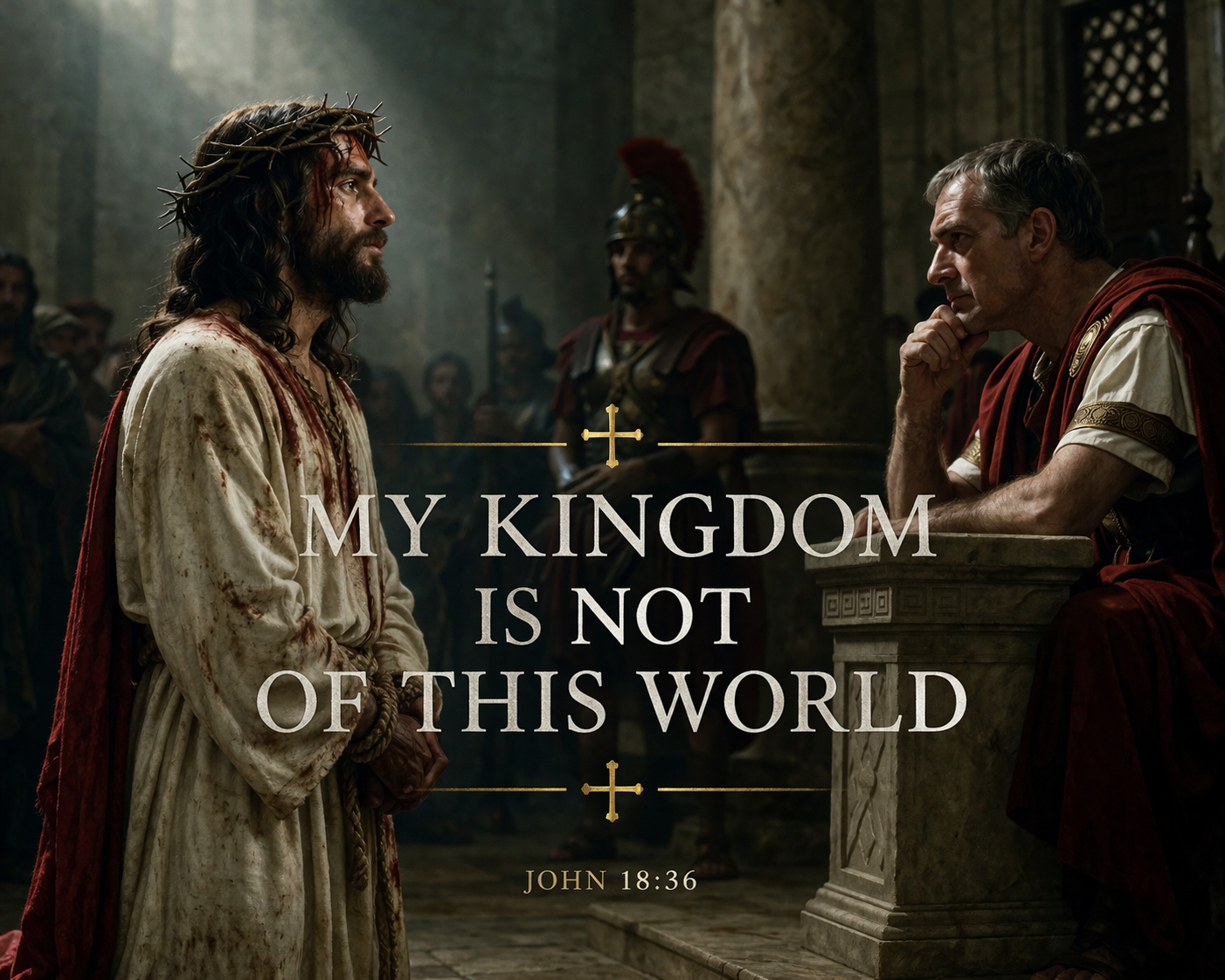
The Pope’s response, by contrast, has been notably restrained. He has refused to engage in personal quarrel. He has continued to call for peace, to insist that the Gospel cannot be bent to political purposes, and to remind his audience that “blessed are the peacemakers” is not a decorative phrase but a binding principle. One may disagree with his prudential judgement. One may argue that particular circumstances justify force. But to dismiss his intervention as naïve or incompetent is to misunderstand the nature of his office. He is not offering policy advice. He is articulating a moral limit. That limit is inconvenient. It always has been. It was inconvenient to Roman emperors. It was inconvenient to medieval kings. It is inconvenient to modern presidents. That is why it matters.
The present quarrel, then, is not simply between Trump and Leo, or between Vance and the papacy. It is between two conceptions of authority. One treats power as self-justifying and morality as subordinate. The other insists that power must answer to a law it does not create. The temptation to side with the former is strong, especially in moments of crisis. It offers clarity and the comfort of alignment with strength. It also abandons the framework that makes moral judgement possible.
There is a difference between defending one’s country and defending everything it does. It is not disloyal to recognise that difference. It is necessary.
Discover more from The Libertarian Alliance
Subscribe to get the latest posts sent to your email.


Great, and I fully agree. Vance is not much of a Catholic. His local bishop should deny him Holy Communion while he supports this war. How did his Catholicism come to mean support for genocide, ethnic cleansing, unprovoked war and the killing of schoolgirls?