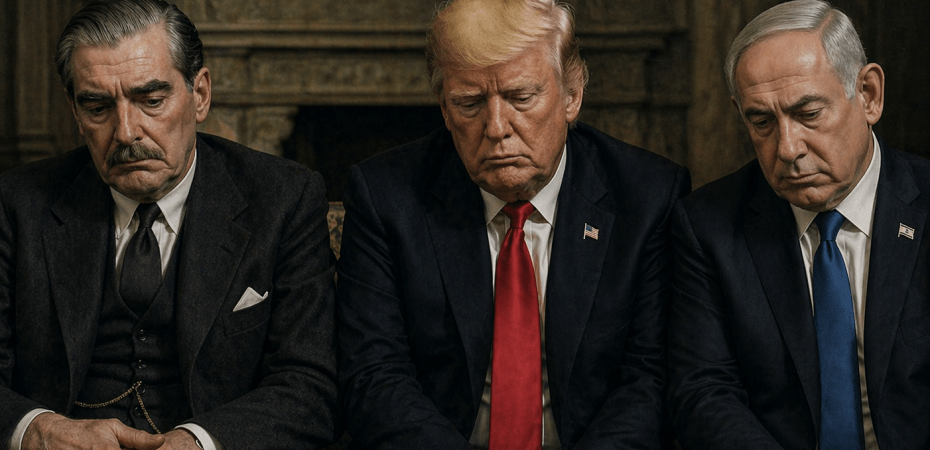
There are wars that rearrange the furniture of power, and there are wars that expose the furniture as matchwood. The conflict that Donald Trump has now suspended sine die belongs firmly in the second category. One must, of course, treat such statements with the scepticism they deserve. American policy in the Middle East has long resembled a relay station for external pressures rather than an independent centre of decision; and if firm instructions arrive from Tel Aviv tomorrow, the suspension may prove as durable as a snowflake in July. Even so, the essential verdict is already in. Mr Trump has destroyed himself. More importantly, he has administered a public and irreversible humiliation to the prestige and authority of the United States as a world power.
An Englishman may be permitted a moment of cold, historical satisfaction. Nations, like men, nurse their grudges. In 1956, at Suez, we learned that our principal ally was also our master. American financial pressure, delivered without sentiment, forced a retreat that marked the effective end of British independence in foreign affairs. The humiliation was complete, and it has echoed down the decades. There is, therefore, a certain classical symmetry—nemesis tarda venit, sed venit, as Bryan and Sebastian might pipe in unison—in watching the same power, bloated with self-importance and moralising cant, brought low by a smaller, more disciplined adversary it expected to crush in a fortnight. Karma, as the vulgar now say, is a bitch. America has long been the most consistent and effective enemy of peace and ordered liberty across the globe. From the overthrow of governments in Latin America to the devastation of Iraq and Libya, from the endless drone campaigns in Yemen and Somalia to the proxy wars that have turned entire regions into charnel houses, Washington has presented itself as the guarantor of a rules-based international order while acting as its most flagrant and systematic violator. Its humiliation is richly deserved and deeply satisfying to any observer who values the sovereignty of smaller nations and the restraint of great powers.
One may, without sentimentality, distinguish between regimes. The internal character of the Iranian government is not to my taste: authoritarian and often repressive. Its treatment of dissidents, its enforcement of strict moral codes, and its suppression of internal opposition have drawn justified criticism from human-rights organisations for years. Yet in the war forced upon it, Iran has fought with intelligence, restraint, and strategic coherence that stand in stark contrast to the barbarism of its adversaries. It has absorbed decapitation strikes that killed the Supreme Leader and senior officials. It has replaced its leadership without collapse—indeed, the succession to Mojtaba Khamenei, with his close ties to the Revolutionary Guard, has hardened rather than fractured the regime. It has maintained internal cohesion despite the targeting of civilian infrastructure. It has imposed costs on its enemies that they neither anticipated nor could effectively mitigate. Most importantly, it has demonstrated that American force is no longer decisive. It can smash installations, kill officials, and proclaim “total obliteration.” It cannot compel submission. It cannot define victory in terms that survive contact with reality. That distinction, once grasped, alters the strategic landscape more than any single battlefield success. Iran has earned the signal victory it has won and the quiet respect of the world for proving that a determined middle power, fighting on its own soil and with asymmetric tools, can humble the self-styled hyperpower.
Yet even this is not the most interesting outcome. The collapse of American prestige is obvious and important. The far greater loser is Israel.
On the eve of the present cycle of conflict—let us say, in the autumn of 2022—Israel stood as the unchallenged dominant power in the Middle East. Its economy was modern and lavishly subsidised by ethnic networking within the Jewish diaspora, drawing on the extraordinary concentration of influence in finance, media, technology, and academia that has long characterised Jewish communities in the West. It possessed nuclear weapons, a first-rate air force, and a modern army equipped with the latest American hardware. It sheltered behind the much-vaunted Iron Dome, presented to the world as an impregnable technological shield against attack or retaliation from its neighbours. The Abraham Accords were steadily normalising relations with Arab states that had once regarded it as an existential enemy, promising economic integration and diplomatic acceptance. Above all, it enjoyed a degree of control over American politics so complete and so undiscussable that its security concerns were treated as American priorities. Lobbying organisations and their campaign donations, plus institutional capture, ensured that no serious challenge to Israeli interests could emerge in Washington. It was, in short, a settler colony that had achieved the rare feat of combining hard power with political impunity. Secure in its dominance, it appeared invulnerable to the demographic and strategic pressures that had once threatened its existence.
Then Hamas launched its attack on 7 October. What followed has been a catastrophic avalanche that has swept away the carefully constructed edifice of Israeli power.
The Israeli political class responded with a policy that can only be described as genocidal in intent and execution. In Gaza it proclaimed—and then conducted—a war of deliberate civilian massacre, torture, rape, starvation, and dispossession. The siege announced by Defence Minister Yoav Gallant—“I have ordered a complete siege on the Gaza Strip. There will be no electricity, no food, no fuel, everything is closed. We are fighting human animals and we are acting accordingly”—was not a slip of the tongue. It was official policy, and it constituted the war crime of starvation of civilians as a method of warfare under Article 8(2)(b)(xxv) of the Rome Statute. International legal scholars were unanimous: this was not self-defence but the intentional deprivation of objects indispensable to civilian survival. The bombardments that followed turned densely populated neighbourhoods into rubble. Hospitals, schools, and residential blocks were reduced to dust. The survivors were starved, displaced, and robbed of their homes in what United Nations experts have rightly termed a pattern of “domicide”—the deliberate destruction of homes as a weapon of war and a form of collective punishment. Over 1.9 million Palestinians were displaced, many multiple times, in what amounted to the largest forced movement of a population in the region since 1948. The images—of emaciated children, flattened apartment blocks, and aid convoys blocked at the border—circulated globally and could not be spun away by even the most sophisticated hasbara machine.
The war was then extended into Lebanon with methods that were even more openly terrorist. Israel deployed concealed explosives in consumer electronics—pagers and walkie-talkies—distributed among Hezbollah operatives but detonating indiscriminately among civilians, including children, health workers, and journalists. In a single ten-minute onslaught on 8 April 2026, Israeli forces struck more than 150 locations simultaneously across Lebanon, killing at least 303 persons and wounding 1,150 others, many in densely populated residential neighbourhoods and commercial areas in central Beirut. Hundreds remained under the rubble. The strikes caused severe environmental damage: toxic air pollutants, contaminated water systems, and fires that destroyed ecosystems. Since 2 March 2026, the Israeli army had already killed more than 2,000 people in Lebanon, including health workers and journalists, and injured 6,588 others. Over one million people—approximately one in five of Lebanon’s population—were displaced, with 140,682 crammed into overcrowded shelters. United Nations experts condemned the attacks as demonstrating “utmost contempt for the international legal order, for diplomacy, and above all for the lives of civilians and the environment.” They described the pattern as consistent with ethnic cleansing and crimes against humanity. Amnesty International warned that the escalation was “ravaging the principles of humanity and distinction at the heart of international humanitarian law,” urging all parties to protect civilians but reserving particular condemnation for the indiscriminate nature of Israeli strikes. These were not isolated incidents; they were the continuation of a pattern that had begun with the 2024 ceasefire violations and escalated into open warfare.
The result was inevitable. Israel was indicted before the International Criminal Court for war crimes and crimes against humanity. It lost the public-relations war comprehensively. The Abraham Accords, once hailed as a diplomatic triumph, began to look fragile. Arab publics remembered why they had once shunned the Jewish state. Even moderate Gulf regimes began to distance themselves, quietly reassessing their security alignments.
As a distraction from this gathering disaster, Israel leaned on its American proxy to launch a wider war against Iran. The assault was conducted with the utmost barbarism: the murder of civilian leaders, including the Supreme Leader Ali Khamenei and top members of the government; the deliberate targeting of a school in the southern city of Minab, Hormozgan province, that killed around 150 schoolchildren among 165 total deaths; the destruction of civilian infrastructure, including ten medical centres. Amnesty International verified videos showing black smoke rising from the collapsed school building, with rescuers searching through rubble near a Revolutionary Guards compound. The UN described the bombing as a “grave violation of humanitarian law.” The Iranian Red Crescent reported 787 killed since the attacks began. Internet shutdowns prevented millions from accessing information, while fears grew for prisoners and dissidents amid explosions near detention facilities. Iranian retaliatory strikes hit Israel and Gulf states, damaging Tel Aviv and causing civilian casualties from debris in the UAE and elsewhere. This was not precision warfare. It was collective punishment on a regional scale, involving more than ten countries and threatening the foundations of international peace.
The Israeli puppet forced into this adventure was Donald Trump. He showed himself at once incompetent and visibly declining. His public statements veered between wild, murderous threats—“the hardest hits are yet to come”—and shifting, incompatible war aims. One day Iran’s nuclear programme had been “obliterated”; the next it was “right at the doorstep” of a bomb. He boasted of sinking the Iranian navy, destroying its air force and missile facilities, and dismantling its defence industrial base. Yet the regime survived, adapted, and counter-attacked with missiles and drones. Iranian forces blocked the Strait of Hormuz, seizing control of roughly twenty per cent of the world’s oil supply. Oil prices skyrocketed, destabilising global markets. The Gulf dependencies—long sheltered behind American power—were seriously damaged and are now quietly reconsidering their military and economic alignments with Washington. Trump’s rhetoric grew increasingly erratic, the claims more extravagant, the tone detached from observable reality. One need not play amateur psychiatrist to note that the faculties required for coherent strategy—clarity, consistency, proportion—were no longer reliably present. Mr Trump has not merely been defeated; he has been exposed as a man of limited and declining intelligence, propped up by a system that no longer knows how to replace him. His boasts of regime change rang hollow: the theocracy not only endured but hardened into a more militarised, anti-Western form. Score after score, as one may dryly note, went to Iran.
Israel itself did no better. Its Iron Dome, once marketed as the ultimate defence, proved of limited value against sustained missile barrages. Tel Aviv was reduced in places to a sea of ruins almost comparable to Gaza. The psychological shock of vulnerability has been profound. Because the country is no longer perceived as a safe place for business, its economy is in terminal decline. Investment is fleeing. Insurance premiums have soared. Reconstruction costs are mounting into the billions. Commercial activity has been disrupted for months. Skilled labour—engineers, doctors, entrepreneurs—is quietly examining exit strategies. The ethnic networking that once subsidised the state through diaspora capital and bent procurement contracts with Western governments, cannot indefinitely compensate for the loss of confidence. A settler colony that looks permanently at war, exposed to retaliation, and embroiled in endless legal and moral condemnation is not an attractive proposition for global capital. The carefully cultivated image of the high-tech, democratic outpost has been replaced by that of a garrison state whose methods repel even its former friends. Tourism has collapsed. Foreign direct investment, once a lifeline, has dried up. The shekel has weakened. Domestic unrest simmers as the costs of mobilisation bite into everyday life. What was a thriving, subsidised economy now faces the slow, grinding reality of contraction.
Worse still, the tight Israeli control over American politics has become a matter of open and increasingly frank discussion. What was once confined to the margins—whispers or claims confined to alternative media—is now debated in the mainstream press and on social platforms. The alignment between American policy and Israeli interests, long treated as natural and inevitable, is now scrutinised as a mechanism that has distorted US strategy for decades. This shift coincides with the re-emergence of older scandals—above all the unresolved questions surrounding the Epstein affair, with its documented paedophilia, its whispers of blackmail operations targeting influential figures, and its persistent allegations of links to Israeli intelligence networks. One must be careful here. Much remains unproven in a court of law. But the direction of travel is unmistakable. The old taboo is crumbling. The possibility of a purge of the more obvious agents of influence from public life can no longer be dismissed as fantasy. What was implicit has become explicit; what was denied is now examined in the cold light of failure.
In the middle of 2026, Israel emerges from this war seriously damaged physically, with all its careful moral camouflage stripped aside, its control over American and Western policy heading towards ruin, and even the prospect of a reckoning in the court of Western opinion. The 7 October attack—whatever its origins and whatever the undeniable atrocities committed by Hamas—appears to have been procured or exploited by the Netanyahu government to enable ethnic cleansing of the Palestinians and the conquest of its neighbours. Its result has been the opposite: a strategic defeat that may signal the beginning of the end of Israel as a viable settler colony. The carefully constructed narrative of victimhood and self-defence has collapsed under the weight of its own excesses. The world has seen the images and read the expert condemnations. It has drawn its conclusions.
Who said history has no sense of humour? It does not always reward virtue, but it punishes folly with merciless precision. The Jewish state began this sequence in a position of unassailable strength—military, economic, diplomatic, and political. It ends it diminished, exposed, and—most dangerously of all—revealed. The United States, its indispensable patron, has been humbled alongside it. American world dominance, once assumed to be eternal, now looks fragile and contingent. The Gulf states are rethinking their alliances. Europe faces higher energy costs and political blowback. The global economy bears the scars of disrupted oil flows. And England, watching from the sidelines with the long memory of a nation once hegemonic, may permit itself a quiet, sardonic smile. The wheel turns. Suez is answered at last.
The deeper lesson is one that the architects of this catastrophe will never acknowledge. Power without restraint breeds arrogance; arrogance without wisdom invites nemesis. Israel’s leaders chose genocide as policy, terrorism as tactic, and American vassalage as strategy. They have all been shone to be hollow fruit. America, blinded by its own exceptionalist mythology, chose to serve as the enforcer. It too has paid the price. Iran, for all its flaws, chose strategic focus. It stands taller today than it did yesterday.
History does not possess a sense of humour. But it has a sense of proportion. On this occasion, the proportion is exact—and the winner is … not Israel.

Discover more from The Libertarian Alliance
Subscribe to get the latest posts sent to your email.
Related posts:


Powered by YARPP.
[…] humiliation. Now that it has lost and is humiliated, I am pleased. It might be hard to be as pleased as Reginald Godwyn is. When I joined him yesterday afternoon in an office that reeked of tobacco and flatulence, he got […]