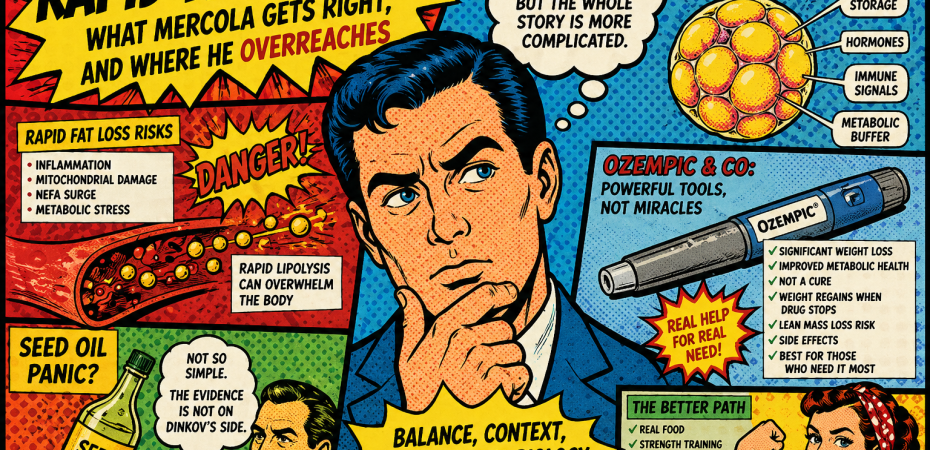
Dr Mercola’s article on rapid fat loss begins with an arresting idea: body fat is not merely dead weight. It is not just an ugly biological surplus waiting to be burned away by dieting, fasting, or a new generation of pharmaceutical injections. It is, in his words, a “metabolic safety system” that can become dangerous if attacked too quickly.
That insight is worth taking seriously. The modern conversation about fat loss is often stupidly mechanical. It talks as if the human body were a bank account with legs: calories go in, calories go out, and the whole moral drama of health can be reduced to arithmetic. This is not entirely false, but it is incomplete in the way a weather forecast is incomplete if it only says water falls from the sky. Biology has a memory. Fat cells are not just storage sacks. They are endocrine organs, immune actors, metabolic buffers, and signals to the rest of the body.
Mercola is therefore right to insist that fat loss is not automatically health. But he is less convincing when he turns this good biological insight into a wider theory of metabolic danger, seed-oil toxicity, and carbohydrate necessity. The article contains useful caution. It also contains too much interpretive spin.
The article builds much of its argument from a recent Journal of Clinical Investigation paper on familial partial lipodystrophy type 2, or FPLD2. This is a rare genetic disease, caused by pathogenic variants in the LMNA gene, in which fat tissue is lost or redistributed and severe metabolic disease follows. The JCI paper describes FPLD2 as “a rare disease characterized by adipose tissue loss and redistribution and metabolic dysfunction,” and explains that LMNA encodes nuclear lamins A/C, structural proteins that influence nuclear function and gene expression. (jci.org)
The study is genuinely interesting. Researchers examined patients from eight families, studied adipose tissue, and used mouse models to understand how fat-cell loss occurs. The findings were not a crude story of fat simply vanishing. They showed damaged adipocyte function, suppressed lipid-metabolism pathways, inflammatory programmes, mitochondrial disruption, and systemic metabolic consequences. A Michigan Medicine summary gives the bluntest version of the finding: “all of the fat cells (adipocytes) have really catastrophic things happening in them.” (michiganmedicine.org)
That matters. It proves that too little functioning fat can be dangerous, just as too much dysfunctional fat can be dangerous. People with lipodystrophy may look leaner in some areas while developing diabetes, fatty liver, high triglycerides, and other features we usually associate with obesity. In other words, the body needs healthy adipose tissue. The fat cell, properly understood, is not an enemy. It is a servant that becomes dangerous when overburdened, poisoned, inflamed, or destroyed.
This is the strongest part of Mercola’s article. He pushes against the childish assumption that thinner always means healthier. He reminds readers that body fat has protective roles. He also gives sensible advice when he discourages crash dieting, obsessive fasting, and exhaustive exercise performed as punishment. The best weight loss is not a spectacular assault on the scale but a gradual improvement in the body’s ability to handle fuel, maintain muscle, preserve energy, and reduce inflammation.
So far, so good. The problem begins when Mercola overextends the lesson. FPLD2 is a rare monogenic disorder. It is not the same thing as an overweight man losing three stone, or an obese woman gradually reducing visceral fat, or even a diabetic patient losing weight under medical supervision. In FPLD2, the fat cells are collapsing because of a structural genetic defect in the nuclear envelope. In common obesity, adipose tissue is usually excessive, inflamed, insulin-resistant, and already failing as a metabolic buffer. The contexts are almost opposite.
This distinction matters. Lipodystrophy teaches us that healthy fat tissue is necessary. It does not prove that intentional fat loss in obesity is dangerous in itself. Indeed, many trials show that weight loss in obesity usually improves blood pressure, glycaemic control, liver fat, inflammatory markers, mobility, and cardiovascular risk. The body that has too little functioning fat and the body that has too much dysfunctional fat may both be ill, but they are not ill in the same way.
Mercola’s article moves too easily from “fat tissue is protective” to “rapid emptying of fat stores may unleash metabolic chaos.” There is a partial truth here. Very aggressive weight loss can increase the risk of gallstones, lean-mass loss, fatigue, and rebound. It can also increase circulating fatty acids temporarily. But temporary mobilisation of stored fuel is not the same thing as systemic poisoning. The dose, context, and starting condition matter enormously.
The article’s weakest section is its reliance on Georgi Dinkov’s interpretation of fat as a kind of prison for unstable polyunsaturated fats. In this view, seed oils rich in linoleic acid are stored in adipose tissue because the body is trying to protect itself from them; rapid fat loss then releases these unstable fats into circulation, where they allegedly oxidise, inflame, and damage organs. This is presented with great confidence, as if modern nutrition science had missed the obvious.
But this is a minority interpretation. It may contain fragments worth examining, especially regarding ultra-processed foods and oxidative stress, but it is not the balanced state of evidence. Large cohort studies and many mainstream reviews have repeatedly associated higher linoleic acid intake or biomarkers with lower cardiovascular risk, not higher. Replacing saturated fat with polyunsaturated fat generally improves LDL cholesterol and reduces coronary risk in controlled dietary trials. The stronger case against the modern diet is not simply “seed oils are poison”; it is that industrially processed foods combine refined starch, sugar, cheap fats, salt, flavour engineering, and constant availability into a diet that overwhelms appetite regulation.
This difference is important because it changes the remedy. If seed oils are uniquely poisonous, the answer becomes almost ritual purification: eliminate soybean oil, canola oil, restaurant food, packaged food, and most modern cooking fats. If ultra-processed food is the main problem, the answer is more practical: cook real food, reduce industrial snacks, eat enough protein, avoid liquid calories, preserve muscle, and stop letting corporations design your appetite.
Mercola’s practical advice is therefore a mixture of sense and dogma. Avoiding crash diets is sensible. Building muscle is sensible. Moderate exercise is sensible. Eating whole foods is sensible. But recommending roughly 250 grams of carbohydrate a day as if the mitochondria demanded that amount from everyone is not sensible. Some people thrive on that intake. Others with insulin resistance, fatty liver, or metabolic syndrome may do better with fewer carbohydrates, at least for a time. White rice and fruit may be excellent for one person and unhelpful for another. There is no universal carbohydrate sacrament.
The same applies to fasting. Prolonged fasting can be abused, and some people use it as a respectable disguise for disordered eating. But time-restricted eating and moderate fasting windows can benefit some patients when done sanely. Again, context matters. The body is not a machine, but neither is it a fragile Victorian invalid that collapses whenever it misses breakfast.
The article becomes more relevant when we apply its caution to the new obesity drugs: semaglutide, tirzepatide, and the wider GLP-1 class. These drugs are now sold with the emotional force of salvation. They promise what decades of public-health lectures failed to achieve: large weight loss, reduced appetite, improved diabetes control, and possibly fewer heart attacks and strokes. In fairness, they are not fake. They work.
Semaglutide and tirzepatide produce impressive on-treatment weight loss in trials, and semaglutide has demonstrated cardiovascular benefit in high-risk patients with overweight or obesity. The SELECT trial found semaglutide reduced major adverse cardiovascular events in patients with overweight or obesity and established cardiovascular disease. (The Lancet) A 2024 real-world comparison also found that tirzepatide produced greater weight loss than semaglutide in adults with overweight or obesity. (JAMA Network)
That cannot be waved away by calling the drugs a scam. Some people are so fat, so diabetic, so breathless, so arthritic, so near to vascular disaster, that refusing these drugs on principle would be worse than accepting their risks. A man with severe obesity, uncontrolled type 2 diabetes, sleep apnoea, fatty liver, failing knees, and early heart disease does not need a lecture on ancestral eating before he receives help. He may need the drug, and quickly. The relevant comparison is not between semaglutide and perfect health through discipline. It is between semaglutide and continued metabolic collapse.
This is the concession that many alternative-health writers do not want to make. A dangerous tool may still be a necessary tool. A drug can be overmarketed to the vain and still lifesaving for the desperate. It can be a commercial racket at the population level and a mercy in an individual case.
Still, scepticism is justified. These drugs are not cures. The BMJ’s 2026 analysis found that after stopping weight-loss medication, weight and cardiometabolic markers tend to move back towards baseline, with average regain around 0.4 kg per month and likely return to previous weight in under two years. (BMJ) Reuters summarised the same analysis: patients regained nearly one pound per month after stopping, with heart-related markers such as blood pressure and cholesterol also reverting towards pre-treatment levels. (Reuters)
This matters because it exposes the business model. A temporary drug would be one thing. A lifetime appetite drug, given to millions and perhaps eventually to adolescents, is something else. If the benefit fades when the drug stops, the patient becomes a subscriber. The moral language is public health; the revenue structure is rent.
Lean-mass loss is another serious issue. Reviews of GLP-1 receptor agonists show that potent agents such as semaglutide and tirzepatide can reduce lean mass alongside fat mass. (ScienceDirect) European cardiology commentary notes that in STEP-1, DEXA analysis suggested 39% of weight lost with semaglutide was lean body mass and 61% was fat mass. (European Society of Cardiology) That does not mean all this tissue is functional skeletal muscle. Some is water, connective tissue, and organ-associated mass. It also does not mean the drugs are uniquely bad, since any major weight loss can include lean loss. But it does mean the marketing is incomplete. Anyone using these drugs should be told clearly: eat enough protein, lift weights, monitor strength, and do not celebrate the scale if the price is frailty.
There are also side effects. Gastrointestinal symptoms are common. Rare but serious complications, including pancreatitis and gallbladder disease, require proper warnings. The recent public conversation has been sharpened by reports of hospitalisations and deaths, though individual cases do not by themselves prove causation. (The Scottish Sun) Even a Reddit-based study of real-world GLP-1 users found many reports of fatigue, menstrual changes, and temperature-related symptoms, though such data cannot establish causation and may reflect reporting bias. (Health) The point is not panic. The point is humility.
The honest position is therefore neither Mercola’s full alarm nor pharma’s full optimism. Rapid fat loss can be harmful when it is reckless, muscle-wasting, nutrient-poor, or psychologically disordered. Adipose tissue is not an enemy to be bombed out of existence. Seed-oil panic, however, is not a substitute for nutrition science. Lipodystrophy is not obesity. A rare genetic disease cannot become a universal parable without distortion.
What remains after the exaggerations are removed is still important. Fat loss should not be treated as a race. A thinner body with weaker muscle, poorer sleep, lower mood, gallstones, and rebound hunger is not a triumph. A better approach is slower and less theatrical: protein, resistance training, walking, decent sleep, fewer ultra-processed foods, careful carbohydrate choice, and medical help when the risk of doing nothing is worse than the risk of intervention.
The new drugs should be reserved for those who genuinely need them, not sold as a lifestyle accessory. They should be paired with muscle-protective habits and honest long-term planning. They should not become the pharmaceutical answer to a food system that made people ill and now charges them monthly for partial relief.
Mercola’s article is valuable because it reminds us that the body is more intelligent than the diet industry. It is flawed because it replaces one simplification with another. It attacks the crude arithmetic of fat loss, then flirts with a crude demonology of seed oils and rapid lipolysis. The better lesson is more restrained: metabolism is adaptive, adipose tissue has functions, weight loss has risks, and obesity has risks too. The difficulty lies in choosing the least damaging path for the person in front of us.
That is not as exciting as the claim that everyone else has missed the secret. But it is more likely to be true.
Recommended Reading List
- Maung JN et al. (2026). “Altered lipid metabolism and inflammatory programs associate with adipocyte loss in familial partial lipodystrophy 2.” The Journal of Clinical Investigation. — Read the original study directly for the raw mechanistic data. (jci.org)
- Wilding JPH et al. (STEP trials, 2021–2026 follow-ups). NEJM and related journals. — Core data on semaglutide efficacy, body composition, and limitations.
- West S et al. (2026). “Weight regain after cessation of medication for obesity.” BMJ. — Clear meta-analysis on rebound kinetics and cardiometabolic reversal. (BMJ)
- Recent 2025–2026 reviews on lean-mass preservation with GLP-1s (e.g., Annals of Internal Medicine, LEAN-PREP protocol, BELIEVE trial with bimagrumab). — Nuanced data on muscle trade-offs and mitigation strategies. (ScienceDirect)
- Marklund et al. (2019, with 2025–2026 cohort updates) and AHA scientific statements/meta-analyses on linoleic acid/PUFAs. — Mainstream evidence that higher LA intake often correlates with lower CVD and inflammation risk.
- Mann JP et al. (2019 review) and Lim K et al. (2021). “Lipodystrophy: metabolic insights from a rare disorder.” — Broader context on what lipodystrophies actually teach us about adipose buffering versus obesity. (PMC)
- Mozaffarian et al. or recent scoping reviews (2026) on seed oils. — Counterpoints to the “industrial seed oil” narrative.

Discover more from The Libertarian Alliance
Subscribe to get the latest posts sent to your email.

Really interesting perspective on adipose tissue being more than just “stored fat” it highlights why sustainable fat loss and metabolic health matter more than quick fixes. Resources like https://wegovypricecompare.com/wegovy-discount-codes-latest-offers-deals/ can also help people explore affordable support options alongside long-term lifestyle changes.