Whenever he is not wishing all the other boys in his class would eat themselves to death before Christmas, or reviewing sicko horror films from the Far East, Bryan Mercadente has a talent to amaze. His Schoolboy Manifesto, published last weekend, is one of his more remarkable productions. Its literary force is obvious enough, though that alone would not make it important. What makes it important is its coherence. The essay advances a unified interpretation of the Anglo-American order: how it emerged, how it functioned, how it hollowed out the societies beneath it, why it is now failing, and what possibilities its failure may create. Even where one disagrees with Mercadente, one is engaging with an argument rather than a sequence of emotional gestures or ideological slogans. It confronts the condition of England, and by extension much of the West, with a clarity American education almost never cultivates. To be fair, I doubt English schools often produce writers capable of this kind of historical and structural analysis either. I certainly could not have written like this at seventeen.
I will begin by agreeing that Mercadente is substantially correct about the Iran war. The United States has suffered a geopolitical defeat of historic significance, and it has done so through its own accumulated illusions. Operation Epic Fury, launched in February 2026, reflected assumptions hardened into doctrine after decades of unchallenged supremacy. Washington assumed escalation dominance remained unquestioned. It assumed technological superiority could indefinitely compensate for industrial weakness. It assumed sanctions could replace strategy and financial leverage could substitute for production. Most dangerously, it assumed regional powers would still recoil from direct confrontation once American force had been demonstrated.
Instead, Iran absorbed the initial strikes, consolidated internally, disrupted Gulf shipping, and exposed the fragility of the global energy system. The United States discovered that it could assassinate leaders more easily than it could secure maritime commerce. It discovered that carrier groups and precision weapons do not automatically produce diesel fuel or restore broken supply chains. The language of “rules-based order” became less persuasive once insurers refused to cover shipping through Hormuz and energy markets began seizing under physical pressure rather than financial speculation.
The comparison to Suez is apt, though not because American power has vanished altogether. Britain remained powerful after Suez. What collapsed was the illusion that Britain remained independently dominant. Something similar has now happened to the United States. America still possesses immense military strength, plus technological advantages in many fields. Yet the aura of effortless supremacy has been broken. Rivals now know the United States can be resisted. Allies now know it can fail. Empires can survive battlefield defeats. They rarely survive the destruction of confidence that underpins their authority.
Mercadente’s analysis of the Anglo-American ruling class is equally persuasive, though here he follows the general line of Libertarian Alliance writers. He does not crudely present America as the villain of Britain’s decline. Instead, he describes the emergence of a transnational managerial and financial elite, rooted in the City of London and intertwined with Wall Street, whose interests increasingly diverged from those of the populations it governed. Over time, both Britain and America underwent a similar transformation. Industrial production declined. Financialization expanded. Political authority detached itself from productive enterprise and local continuity. Nations ceased to be understood as historic peoples requiring cohesion and became economic platforms within a global system of capital flows, administrative management, and ideological supervision.
Britain’s decline appears starker because the contrast with its earlier condition is harder to conceal. Mercadente’s comparison with Britain in 1926 works because it avoids romantic fantasy. He compares the present not with mythology, but with a real industrial society possessing scientific prestige, manufacturing depth, social confidence, and a recognizable continuity between rulers and ruled. Whatever one thinks of the British Empire, Britain still functioned at that time as a serious civilization.
America followed a parallel path, though its continental scale and reserve-currency status concealed the process longer than in Britain. Manufacturing weakened. Infrastructure deteriorated. Social trust eroded. Public discourse collapsed into ideological ritual. Entire educated classes lost the distinction between reality and moral performance. The result was a peculiar civilization: materially wealthy, financially expansive, technologically sophisticated in narrow sectors, yet increasingly incapable of coherent collective action outside consumption and financial management.
Mercadente is also right to argue that these developments were not accidental byproducts of modernization. They served identifiable interests. A fragmented and economically dependent population is easier to manage than a cohesive industrial one. A service economy built around debt, administration, and symbolic labor generates fewer independent centers of power than a nation populated by engineers, manufacturers, and skilled workers. One does not need conspiracy theories to recognize structural incentives operating over decades.
Where Mercadente becomes more controversial, and where his essay demands closer scrutiny, is in his optimism about what American decline may permit. His central argument is that the weakening of American hegemony simultaneously weakens the managerial order it enforced. The United States functioned not merely as a nation-state but as the military and financial guarantor of a broader system built around financialization, demographic transformation, ideological conformity, and administrative expansion. Once that external enforcement mechanism weakens, the internal order becomes vulnerable. Elites fragment. Censorship weakens. Policies once treated as untouchable begin losing legitimacy. Opportunities emerge for reconstruction and for the replacement of ruling assumptions that previously appeared permanent.
There is real force in this argument. External shocks often destabilize orthodoxies with astonishing speed. One can already see elements of the Western establishment shifting position on industrial policy, immigration, energy production, and strategic autonomy. These shifts do not reflect sudden patriotism. They reflect fear. Mercadente’s distinction between the “crazies” and the “realists” inside the ruling class captures something important. Some factions remain committed to ideological dissolution even at the cost of strategic collapse. Others increasingly recognize that a civilization incapable of industrial production, energy security, border control, or social cohesion cannot compete indefinitely with powers such as China.
Where I part company with him is over the mismatch between collapse and reconstruction. Industrial revival operates on generational scales. Technical education, institutional competence, and social trust cannot be recreated overnight. Energy shortages and geopolitical fragmentation unfold far more rapidly. Britain cannot easily rebuild heavy industry, restore manufacturing culture, cultivate a technically capable governing class, and reconstruct social cohesion while simultaneously confronting severe energy instability and accelerating global competition.
This objection becomes even more serious once one considers the scale of the reconstruction Mercadente actually proposes. His programme is not a mild correction to the present order. It is not Thatcherism with stricter borders and cheaper electricity. It is a revolutionary reconstruction of the British state and economy. He proposes the destruction of the existing financial order, the dismantling of much of the managerial state, the liquidation of the ideological apparatus built around universities and quasi-public institutions, the recreation of a productive industrial base, and the cultivation of a new elite rooted in technical competence and national loyalty rather than administrative conformity. Even if one accepts that this programme is necessary, one must still ask whether it can happen quickly enough.
Mercadente often writes as though the collapse of American hegemony creates a strategic opening for England. In one sense, this is true. The weakening of American power weakens the international enforcement mechanism behind the managerial order he describes. It loosens ideological discipline. It destabilizes elite consensus. It creates opportunities that would not otherwise exist. But the same collapse also strips England of the external shield behind which its long decline unfolded.
For decades, Britain has been able to afford policies that would have destroyed a smaller or less protected country. It could deindustrialize because American naval supremacy kept trade routes open. It could tolerate energy dependence because the global system remained broadly stable. It could endure administrative bloat because the dollar-centered financial order absorbed distortions that would previously have triggered immediate crisis. Most importantly, Britain could behave as though hard power no longer mattered because the United States still existed as the guarantor of Western predominance. That world is ending.
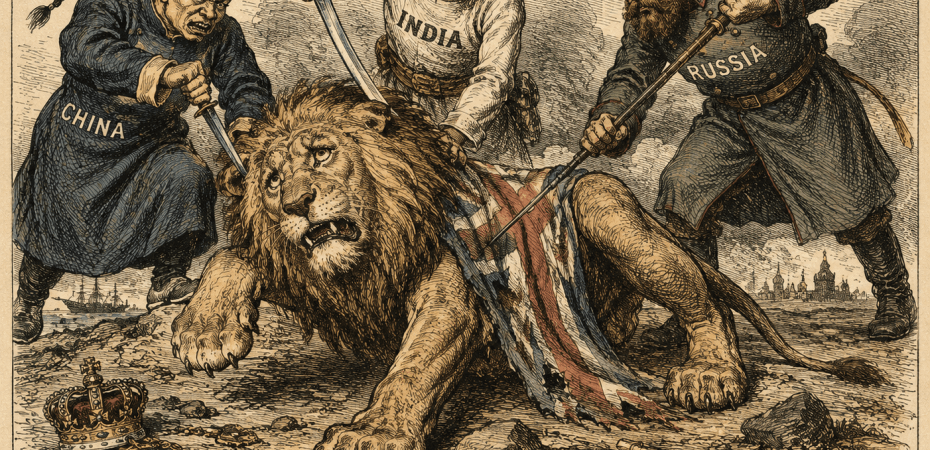
Mercadente is entirely correct that the peoples rising against the West are not motivated by abstract theories of justice. They are motivated by resentment and historical memory. The Chinese remember what Britain did to them in the nineteenth century. Indians resent British rule even while retaining parts of the British inheritance. Iranians do not distinguish neatly between Britain and America when thinking about sanctions and military pressure. The Russians possess a grievance that is not historical at all. They believe, with considerable reason, that Britain deliberately engineered the Ukraine war as a means of weakening and encircling Russia. They have watched British politicians posture as the most aggressive faction in Europe while contributing relatively little to the actual burden of conflict. These things are remembered.
Mercadente’s argument depends heavily on the assumption that England can reconstruct itself before these resentments acquire material consequences. I am less certain. Give England thirty or forty years of intelligent leadership, industrial rebuilding, demographic stabilization, and institutional reform, and it may very well re-emerge as a serious power. Mercadente may be right that the underlying civilizational capacities have been suppressed rather than destroyed. England has recovered from periods of severe weakness before. So have other nations. History contains many examples of exhausted societies rediscovering coherence under pressure.
The problem is that England may not have thirty or forty years. The transition to a genuinely multipolar world is occurring now. Energy systems are under strain now. Trade routes are becoming insecure now. Financial fragmentation is accelerating now. The Western alliance system is visibly weakening now. Rival powers are already testing boundaries that would have seemed untouchable fifteen years ago. In such an environment, a country attempting internal revolution while simultaneously rebuilding its productive base is dangerously exposed.
This is especially true because Mercadente’s own analysis implies that Britain’s weakness is not merely economic but anthropological. He repeatedly describes a population shaped by dependency, consumption, administrative supervision, and cultural exhaustion. One cannot spend half a century dissolving industrial habits and social confidence without consequences. The human material available for reconstruction has itself been damaged by the system he wants to overthrow. That does not make reconstruction impossible. It does make it slower, more fragile, and more uncertain than his more triumphant passages sometimes suggest.
There is another difficulty. Revolutions rarely proceed under controlled conditions. Mercadente writes with unusual honesty about the need for elite replacement and structural transformation. He understands that the existing ruling class will not voluntarily surrender power. But revolutionary periods often produce secondary crises beyond the intentions of revolutionaries themselves. Administrative systems cease functioning properly. Capital flees indiscriminately. Infrastructure maintenance falters. Political coalitions fracture. Productive and parasitic elites alike look for exits. Even successful revolutions usually endure prolonged dislocation before stabilization occurs. The difficulty for England is that this process may unfold while the external world becomes markedly harsher.
Mercadente correctly observes that the end of American predominance will not produce a benevolent international order. It will produce rivalry, spheres of influence, strategic bargaining, and increasingly open struggles over resources, technology, and trade routes. In such a world, weakness invites pressure. Nations that appear divided or transitional rarely receive patience from rising powers. They receive demands.
This is why I question Mercadente’s evident delight at American collapse. I understand the argument behind it. American power became, in his view, the enforcement arm of an internal order that hollowed out England from within. Its weakening therefore appears as liberation. Yet liberation from one danger may expose a nation to another before it has rebuilt the strength required to protect itself. England without American support does not immediately become sovereign and renewed. It first becomes vulnerable.
Mercadente sometimes writes as though the external challenge can be deferred until reconstruction is complete. I suspect the opposite may occur. England may face mounting external pressure precisely during the period when it is least capable of resisting it. The Global South he describes with such cold realism is unlikely to wait politely while England reorganizes itself. Rising powers do not postpone their ambitions out of respect for a rival’s internal difficulties. They exploit moments of weakness while they exist.
None of this invalidates Mercadente’s broader diagnosis. The old Anglo-American order is visibly failing. The managerial and financial system he describes has lost legitimacy across large parts of the Western world. The political center no longer inspires confidence. Institutional trust continues to erode. External shocks are accelerating internal fragmentation. In that sense, his manifesto may describe the future more accurately than the complacent managerial literature still produced by mainstream institutions. What remains uncertain is whether England or the West as a whole retains enough time.
That, finally, is where I part company with him. I share much of his diagnosis. I share much of his contempt for the managerial order governing both Britain and America. I even share his belief that the post-Cold War system is entering terminal crisis. What I do not yet share is his confidence that England can reconstruct itself quickly enough to survive the consequences of that crisis intact.
His Manifesto is therefore both exhilarating and deeply unsettling. It is exhilarating because it confronts realities most Western intellectuals still avoid discussing honestly. It is unsettling because it may underestimate how narrow the margin for recovery has already become.

Discover more from The Libertarian Alliance
Subscribe to get the latest posts sent to your email.



[…] Britain will face a reckoning more painful than Suez, more structural than Brexit. The question, as I asked the other day in response to Bryan Mercadente’s essay, is whether this can be done in time to save Britain from […]